

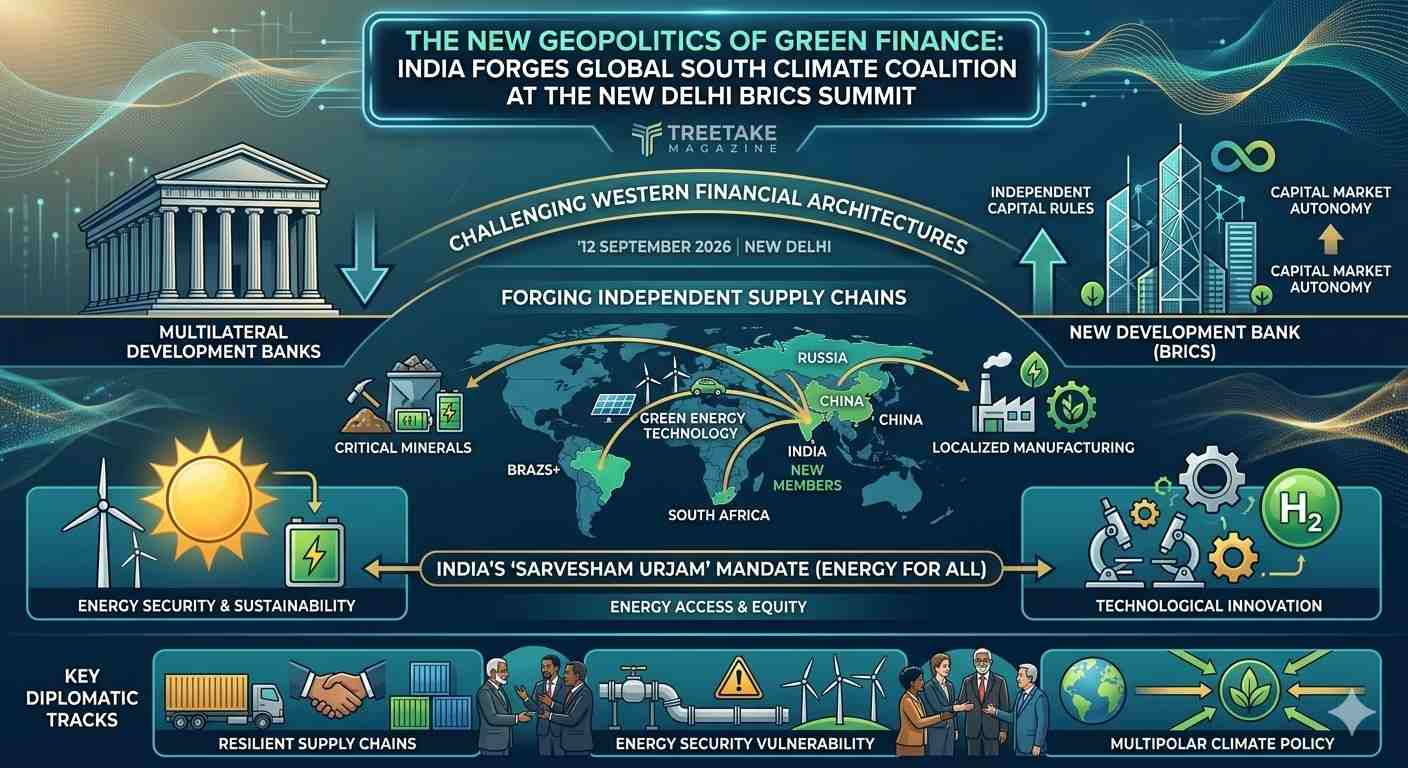
As the 18th BRICS Summit opens in New Delhi under the chairmanship of India, the conversation around the global green transition has fundamentally shifted from environmental compliance to raw economic survival. Under the expansive theme of "Building for Resilience, Innovation, Cooperation and Sustainability," India is aggressively using its platform to orchestrate a unified Global South rebellion against Western-dominated financial architectures. TreeTake presents a high-level diplomatic analysis of how New Delhi is rebuilding the case for independent climate finance, securing critical-mineral supply chains, and demanding an equitable, context-specific green transition.
A Delicate Balancing Act in New Delhi
The 18th BRICS Summit officially opened on Saturday, 12 September 2026, in New Delhi, marking India's fourth formal chairship of the influential geopolitical alliance. Hosting the expanded 11-nation bloc against a backdrop of deep international fractures, trade wars, and retaliatory tariffs, India faces an exceptionally delicate balancing act. While geopolitical conflicts threaten to fragment the alliance's political cohesion, New Delhi has strategically anchored the core operational agenda around pressing, universally shared structural issues: technology sharing, resilient supply chains, energy security, and the rising costs of climate change.
The calculus for India has grown layered and immediate due to ongoing energy shocks in West Asia. Recent disruptions to maritime choke points like the Strait of Hormuz have exposed the deep import vulnerabilities of fast-growing developing economies to fossil fuel volatility. These disruptions feed directly into domestic food and fertiliser inflation, forcing a critical realisation among Global South policymakers: transitioning to clean energy is no longer just a long-term environmental goal, but an urgent pillar of immediate national security.
Breaking the Western Grip on Climate Rules
A central, unaddressed objective of India’s leadership at the summit is to actively challenge the dominance of Western institutions in shaping global climate policy. Historically, the rules governing how climate finance flows have been written primarily within frameworks like the United Nations Climate Change Conferences (COP) or dictatorial multilateral development banks controlled by the Global North. New Delhi is leveraging the expanded scale of BRICS—which now unites the world's most significant energy producers, manufacturing hubs, and rapid-growth markets—to advocate for a fairer, multipolar climate agenda.
The Indian diplomatic track emphasises that a one-size-fits-all green transition cannot be arbitrarily imposed on developing nations if it introduces unfair economic burdens or penalises local development. "India’s BRICS chairship is guided by the vision of Prime Minister Narendra Modi in placing the concerns of the Global South at the forefront of the agenda and redefining BRICS as 'Building Resilience and Innovation for Cooperation and Sustainability,' with a people-centric approach and the spirit of 'Humanity First,'" stated Union Environment Minister Bhupender Yadav in an official address to the delegation. He further emphasised that environmental vulnerability is closely intertwined with broader development priorities, requiring context-specific transition pathways rather than Western-mandated timelines.
The 'Sarvesham Urjam' Mandate
To anchor this systemic shift, India has structured its formal energy track around the indigenous philosophical theme of 'Sarvesham Urjam', which translates directly as 'Energy for All'. This strategy centres on three unyielding priorities: energy security and sustainability, energy access and equity, and technological innovation. The agenda addresses the practical bottlenecks of the transition, focusing heavy attention on building affordable financing models, modernising national electrical grids, and scaling up massive energy storage systems.
Rather than simply acting as a passive recipient of global green rules, New Delhi is utilising the summit to showcase its own massive domestic progress in renewable infrastructure. By positioning its balanced approach—which prioritises expanding clean energy while fiercely protecting domestic energy affordability and security—as a viable blueprint, India is offering its expertise to fellow developing economies. The goal is to forge deep technological partnerships across the Global South in emerging sectors like green hydrogen, smart grids, and localised manufacturing.
Securing Critical Minerals and Independent Supply Chains
Beyond abstract policy adjustments, the closed-door negotiations in New Delhi are focused on a vital tangible asset: critical minerals. Manufacturing clean-energy technologies, from electric vehicle batteries to advanced solar arrays, relies entirely on stable access to rare earth elements and specialised minerals. To prevent the Global South from replacing its old oil addiction with a new dependency on restrictive Western or single-source supply monopolies, India is leading a push for deeper institutional cooperation among BRICS partners.
The official ministerial framework adopted by the grouping reinforces the sovereign rights of resource-rich developing countries, noting that "reliable, responsible, diversified, resilient, fair, sustainable and just critical-mineral supply chains" are the cornerstones of economic sovereignty. By formalising cross-border investments and diversifying mining, refining, and storage networks within the bloc, the alliance aims to build fully independent, resilient clean-energy supply chains. This strategy ensures that the rules for the emerging green world are heavily co-authored by the nations supplying the materials and driving the market demand, firmly positioning the Global South at the absolute centre of global climate governance.



Leave a comment