

Popular Column
TreeTake Network
Kaziranga National Park, a globally recognised wildlife sanctuary, faces an existential crisis that could wipe out eighty per cent of its unique territory. Climate-linked extreme flooding, relentless riverbank erosion, and intense linear infrastructure development are combining to subvert a century of conservation success. The core issue is that Kaziranga is rapidly transforming from a vibrant, connected sanctuary into an ecological island hemmed in by human development.
The mechanics of destruction: why and how it is happening
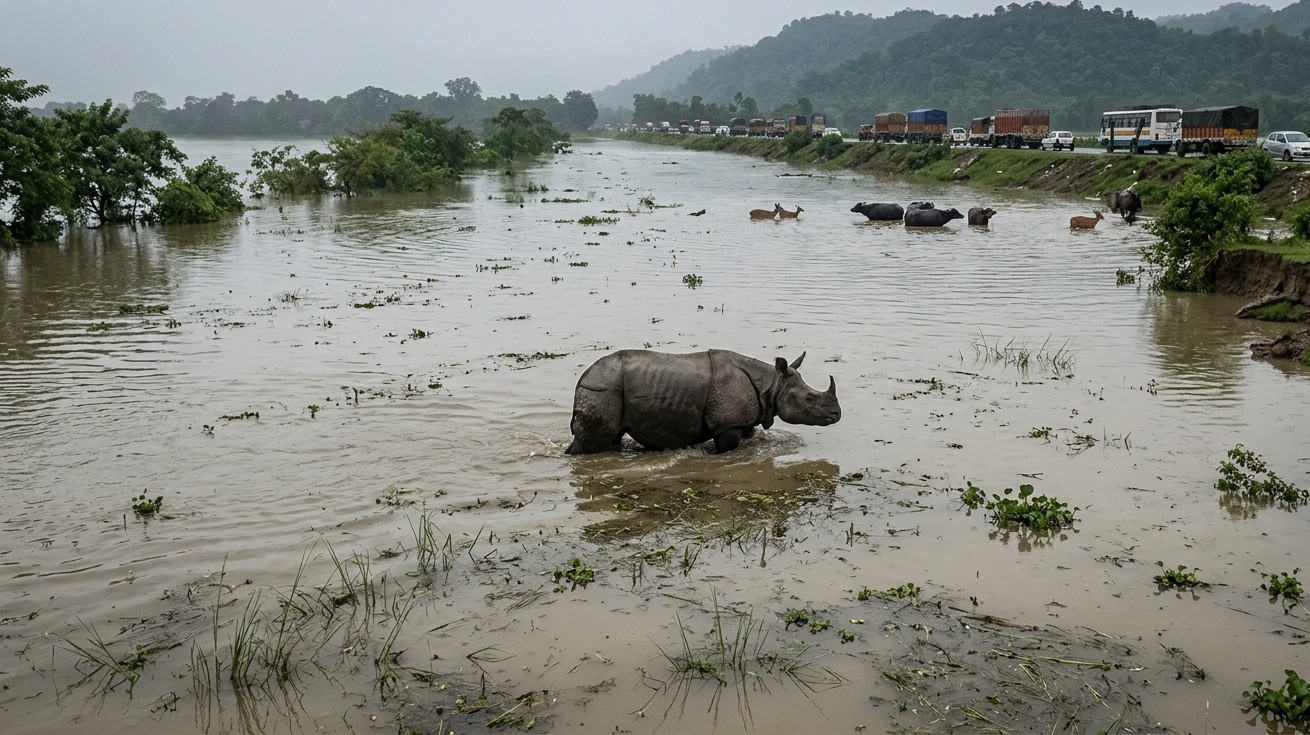
The threat to Kaziranga operates on a seasonal yet increasingly aggressive cycle driven by hydrological alterations and human encroachment. Annual flooding by the Brahmaputra River has traditionally been essential to the park’s health, cleansing grasslands and replenishing wetlands. However, climate change has severely destabilised this system. Monsoons now bring unpredictable, hyper-concentrated downpours that trigger flash floods, causing the river to rapidly submerge up to ninety per cent of the low-lying park terrain.
As these floodwaters rush through, they deposit thick layers of silt, chattering and suffocating vital grasslands while permanently altering wetland depths. Simultaneously, riverbank erosion strips away large portions of the northern boundary year after year.
The crisis peaks when animals attempt to escape the deluge. Historically, wildlife migrated south toward the safety of the Karbi Anglong hills. Today, that migration route is blocked by National Highway 715, rampant commercial construction, and new human settlements. This fragmentation traps animals in deep water or forces them onto heavily trafficked roads.
The timeline: when will the crisis peak
Rather than a singular catastrophic date, the projection that eighty per cent of Kaziranga could be lost represents a progressive, structural decline expected to reach a critical tipping point over the coming decades if current trends continue unchecked. Each heavy monsoon season acts as a step forward in this timeline, permanently reclaiming chunks of forest through erosion and converting grasslands into unusable marshes. Experts warn that the compounding pressures of an expanding human population and commercial infrastructure developments outside the boundaries will make the park ecologically non-functional within generations.
Wildlife in peril: the species affected
Kaziranga is famous for hosting two-thirds of the world's great Indian one-horned rhinoceros population, alongside significant populations of royal Bengal tigers, Asian elephants, wild water buffalo, and swamp deer. Under current conditions, these animals face unprecedented stress.
During peak floods, heavy mammals are forced to swim for survival for days at a time. Dozens of rhinos, elephants, and hundreds of deer drown annually in the fast-moving currents. Foraging animals that manage to reach the edges of the park are often hit by speeding vehicles on the southern highway or fall victim to opportunistic poaching and human-wildlife conflict as they wander into nearby agricultural villages.
Current measures: steps being taken and planned
To combat these seasonal emergencies, forest guards maintain nearly two hundred anti-poaching camps, many of which must operate via boats during the monsoons. The state government has also constructed a series of artificial highland platforms within the park to provide immediate high ground for stranded animals.
Long-term structural plans include a proposed thirty-five-kilometre elevated eco-corridor along National Highway 715. This design aims to raise the roadway, allowing wildlife to pass safely underneath to reach the Karbi Anglong hills during floods.
The conflicting perspectives: officials versus activists
The ongoing management of the park remains a subject of intense debate between conservation authorities and local environmental groups. Government administrators emphasise technical interventions and infrastructure coordination to ensure long-term resilience.
State wildlife officials defend the current strategy, noting that elevated corridors have been effectively implemented elsewhere, and experts identified this design as the most suitable option to maintain connectivity between the floodplains and the hills. Furthermore, authorities argue that balancing civic development with conservation is essential for regional growth.
Environmental activists and local community leaders express deep concern over commercial projects and the reduction of protective buffer zones. Activists argue that constructing massive commercial structures, modern stadiums, or convention centres near an eco-sensitive zone risks turning Kaziranga into an ecological island. They emphasise that prolonged construction activity, heavy machinery, and continuous human presence disrupt breeding patterns and permanently sever the vital migration paths that have sustained this landscape for centuries.
Preserving the sanctuary: what must be done next
Saving Kaziranga requires moving beyond localised engineering fixes and adopting a landscape-level approach to conservation. First, the natural wildlife corridors connecting the park to adjacent forests must receive permanent, legally enforced protection to halt commercial encroachment.
Second, catchment area management must be integrated across state borders to regulate river flow and minimise destructive siltation. Finally, any major development infrastructure around the peripheral buffer zones must undergo rigorous, scientifically independent environmental assessments that prioritise ecosystem integrity over short-term economic gains.
A final note from TreeTake magazine
The slow unravelling of Kaziranga is a stark warning that modern conservation cannot succeed inside artificial boundaries. We cannot claim to protect a species while systematically dismantling the migration paths, rivers, and hills that sustain it. Kaziranga does not belong to a single state or generation; it is a shared global heritage. If we allow short-sighted commercial expansion and inadequate environmental planning to swallow this sanctuary, we will lose far more than eighty per cent of a national park—we will lose a vital part of our planet's living soul.


.jpg?resize=120%2C90&ssl=1)



Leave a comment