

TreeTake Network
The ecologically fragile district of Wayanad was officially designated on November 17, 2026, as the permanent host centre for Processual Mountains 2026, marking the establishment of the first dedicated national congress for mountain ecology and sustainability in India. The major administrative announcement, synchronised across state and central environmental planning boards, establishes a highly specialised multi-disciplinary platform to address escalating systemic vulnerabilities across the Western Ghats. The inaugural summit, scheduled to convene a vast assembly of international geomorphologists, hydrologists, and community representatives, focuses on engineering high-altitude climate adaptation frameworks, stabilising landslide-prone topographies, and protecting regional biodiversity corridors.
Safeguarding Western Ghats Biodiversity and Topography
The selection of the district serves as an intentional geopolitical statement, coming in the wake of intensifying weather anomalies that continue to threaten the structural integrity of southwestern montane landscapes. The congress aims to completely reorganise how local administrative bodies map and counter geological risks by introducing advanced telemetry and real-time monitoring infrastructure across vulnerable mountain terrains.
Prof Madhav Gadgil, a distinguished ecologist and senior advisor to the preparatory committee, stated: "We can no longer approach mountain conservation through fragmented regional lenses. Establishing this permanent scientific centre in Wayanad allows us to finalise a cohesive, data-driven strategy that prioritises the ecological sovereignty of the Western Ghats while directly modernising our approach to habitat preservation."
A critical segment of the upcoming assembly will focus entirely on the legal and physical protection of traditional elephant and tiger corridors that intersect human settlements. Rapid infrastructure development has fragmented these historical routes, leading to an unprecedented spike in human-wildlife conflict that local forest guards struggle to manage with outdated field equipment.
Community Led Resilience and Hydro-Geological Mapping
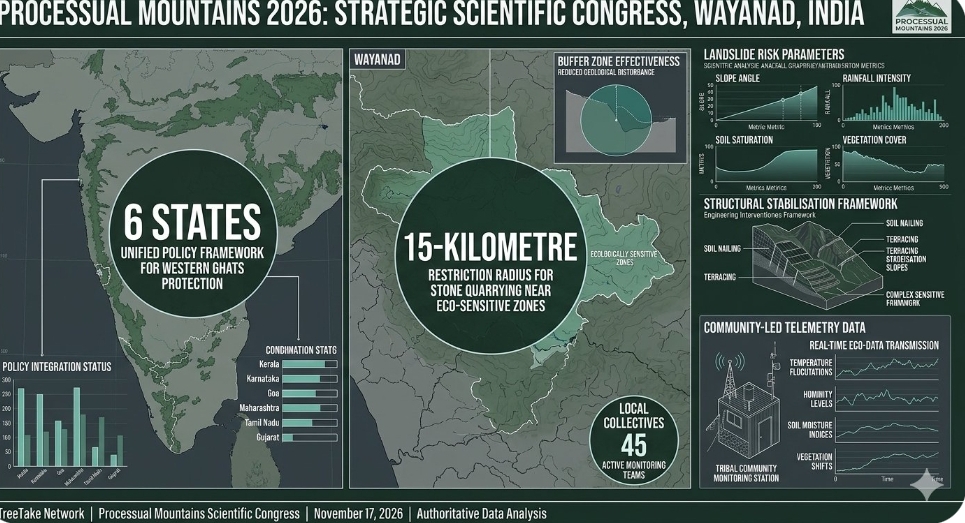
To ensure long-term climate adaptation, the congress has formalised a framework that places indigenous communities at the very heart of field operations. Local tribal collectives will be trained to utilise specialised ecological monitoring toolkits, allowing them to systematically track shifts in forest cover, soil moisture indices, and micro-climate fluctuations.
Dr Inger Andersen, offering international perspective on the initiative, observed: "The global community must look to regional models that synthesise indigenous landscape knowledge with sophisticated scientific parameters. Wayanad is pioneering a structure that can scale across other threatened tropical mountain systems, ensuring that local populations possess both the authority and resources to stabilise their natural heritage."
Simultaneously, a consortium of Indian hydro-geologists will unveil a comprehensive project during the congress to map every sub-surface water channel and aquifer across the mountain range. This massive undertaking is designed to prevent unscientific land modification and restrict commercial stone quarrying within a 15-kilometre radius of highly sensitive ecological zones.
Strategic Policy Integration and Regional Funding
The ultimate goal of the congress is to draft the Wayanad Mountain Declaration, a policy blueprint that will force a mandatory rewrite of regional master plans across six Indian states. State governments will be urged to create a unified Western Ghats Protection Fund, pooling financial resources to facilitate the immediate relocation of communities living in high-risk zones.
Emphasising the urgency of the structural policy shift during a press briefing, Prof Jennifer Morgan noted: "Climate change is accelerating the thermal degradation of tropical cloud forests at a pace that bypasses traditional bureaucratic response times. The Processual Mountains platform will serve as an aggressive policy accelerator, forcing state mechanisms to standardise and enforce strict limits on commercial tourism and unsustainable infrastructure expansions."
As field teams begin setting up the secondary monitoring stations ahead of the main event, local municipal councils are working to ensure that all upcoming tourist infrastructures within the district adhere strictly to zero-waste, carbon-neutral protocols.
Editor's Note
The establishment of Processual Mountains 2026 in Wayanad marks a monumental and long-overdue shift toward localized, high-precision climate governance. For decades, mountain ecosystems have been subjected to generalized environmental policies that fail to account for the volatile realities of tropical terrain dynamics. By uniting rigorous academic science with the lived experience of frontline communities, this congress offers a viable way forward for regional landscape preservation. To achieve genuine success, however, participating state governments must look past localized political rivalries and strictly enforce the scientific mandates generated by this historic assembly, ensuring that long-term ecological survival takes absolute precedence over short-term economic exploitation.



Leave a comment