

TreeTake Network
Delegates at the 31st Conference of the Parties to the United Nations Framework Convention on Climate Change in Antalya, Türkiye, entered their second week of intense negotiations on November 16, 2026, facing a convergence of deep systemic challenges. The summit, co-led by Turkish Environment Minister Murat Kurum as COP31 President and Australian Climate Change Minister Chris Bowen as President of Negotiations, shifted its focus toward the intersecting issues of human mobility, misinformation, and technological impacts. Global institutions delivered a series of sharp warnings and policy frameworks intended to address both the physical displacement of vulnerable populations and the rising danger of artificial intelligence tools complicating climate communication. The structural alignment of these two distinct challenges highlights a growing acknowledgement among international leaders that digital infrastructure and social resilience are inextricably linked in the modern climate era.
Human mobility and the escalating scale of climate-induced displacement
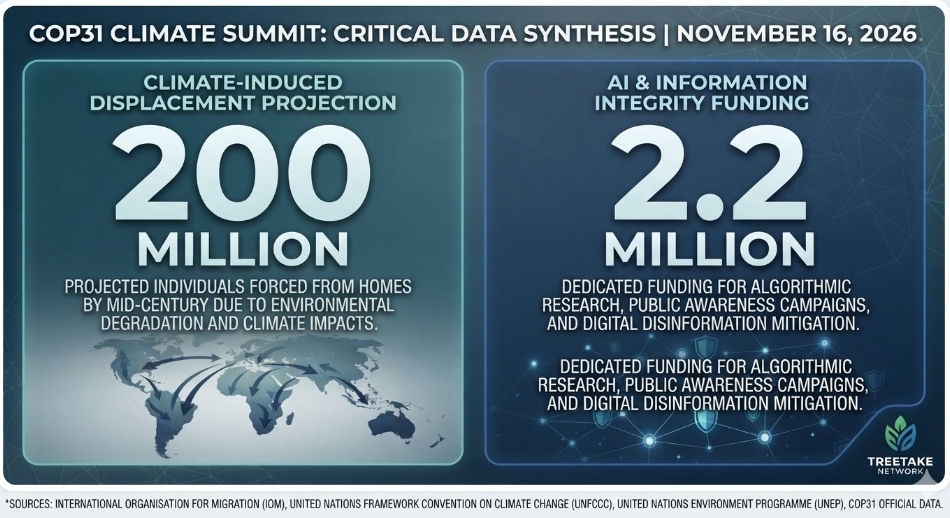
The United Nations International Organisation for Migration initiated the morning plenary sessions with a stark geopolitical warning regarding the accelerating scale of human displacement caused by rapid environmental degradation. Institutional data presented to delegates indicated that a failure to mitigate global emission trajectories will inevitably force more than 200 million individuals to flee their homes by mid-century. Amy Pope, the Director General of the International Organisation for Migration, emphasised that nations are spending billions on border security measures while neglecting the root environmental drivers that strip populations of their livelihoods. She noted that the international community can no longer separate human mobility from climate adaptation strategies.
"We are tracking an unprecedented shift in global migration patterns directly correlated with desertification, sea-level rise, and agriculture collapse," stated Director General Amy Pope during a high-level briefing inside the main assembly hall. "Spending resources on reactive border walls rather than proactive climate resilience programmes is a fundamental strategic failure. If we do not finance local adaptation immediately, the scale of forced human displacement will overwhelm existing international humanitarian frameworks."
Supporting this perspective, Dr Inger Andersen, the Executive Director of the United Nations Environment Programme, added her institutional voice to the call for immediate structural reform. She highlighted that local ecosystem collapses are driving regional instability much faster than economic models previously predicted.
"The data we are reviewing on November 16, 2026, shows that land degradation and changing rainfall patterns are no longer distant threats," stated Dr Inger Andersen during an afternoon panel on habitat loss. "When communities lose access to topsoil and predictable water cycles, migration becomes their only survival strategy. We must utilise every available mechanism to fund local resilience projects, ensuring that vulnerable populations possess the infrastructure to remain safely in their ancestral homelands."
Algorithmic threats and the new framework for climate information integrity
Simultaneously, the United Nations Framework Convention on Climate Change partnered with global communication specialists to launch the Priorities for Action on AI and Climate Information Integrity. The initiative builds directly upon the foundational principles established in the Belém Declaration during COP30 in Brazil to curb the spread of digital disinformation and algorithmic bias regarding green transition data. The new framework introduces strict guidelines for integrating information integrity directly into national artificial intelligence deployment strategies and domestic climate policies. To support the operational rollout, Germany announced a financial commitment of more than 2200000 dollars to fund dedicated algorithmic research and public awareness campaigns.
The technological framework was further expanded by the simultaneous launch of the Charter for Climate Information Integrity in Advertising. This regulatory mechanism aims to block the programmatic monetisation of climate denialism across digital advertising networks. Highlighting the dual-edged nature of advanced computing, Simon Stiell, the United Nations Climate Change Executive Secretary, noted that while artificial intelligence remains a catalytic tool for executing precision agricultural planning and climate forecasting, its unmanaged energy consumption and capacity to scale targeted disinformation pose a serious threat to public trust.
"The task ahead is to blunt their dangerous edges, sharpen their catalytic ones, and put these technologies responsibly to work," stated Executive Secretary Simon Stiell during the presentation of the AI for Climate Action Award. "We cannot allow complex algorithmic systems to mask the verifiable realities of emissions data or to provide an echo chamber for corporate obstruction. Information integrity is just as critical to the Paris Agreement architecture as finance tracking or carbon accounting."
Adding to the technical assessment, Prof Celeste Saulo, the Secretary General of the World Meteorological Organisation, expressed severe concerns regarding the systemic impacts of algorithmic manipulation on public safety. She emphasised that public confidence in meteorological science must be preserved at all costs.
"Misinformation does not merely distort political debates; it directly threatens lives during extreme weather events," stated Prof Celeste Saulo outside the Antalya Expo Centre. "When artificial intelligence systems are trained on flawed or deliberately manipulated datasets, they produce distorted models that neutralise the effectiveness of early warning mechanisms. Ensuring information integrity across all digital platforms is an absolute prerequisite for effective global disaster risk reduction."
Corporate presence and geopolitical friction in negotiation texts
As negotiation texts begin drafting for the final ministerial round, structural friction remains high between major fossil fuel producing states and highly vulnerable small island developing states. Observers noted that corporate presence is exceptionally dense, with a civil society coalition identifying more than 100 corporate polluter associations operating inside the Antalya Expo Centre. These representatives collectively outnumber the official state delegates from highly affected nations such as Nepal, Niger, and the Philippines. Negotiators from Australia indicated that a comprehensive draft text detailing global emission targets and finance mechanisms is expected to emerge early next week.
Editor's Note
The overlapping crises presented in week two of COP31 underscore that climate change is no longer just an environmental problem, but an institutional operational challenge affecting technological infrastructure and global demography. The decision to merge digital information integrity with humanitarian displacement frameworks reflects a growing understanding that data manipulation directly slows down real-world climate adaptation. Moving forward, industrial nations must bridge the finance gap by shifting resources from border militarisation toward predictable, grant-based adaptation funds. True climate stabilisation cannot be achieved if major polluters outnumber vulnerable communities in the decision-making halls.



Leave a comment