

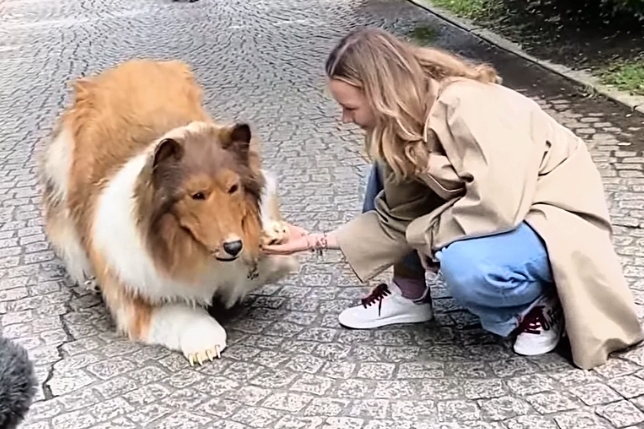
In the landscape of modern digital media, the boundary between factual reporting and pure fabrication has become increasingly thin. One of the most glaring examples of this phenomenon is the viral sensation surrounding an alleged multi-millionaire who supposedly underwent radical surgery to transform himself into a dog. Sensationalized videos across platforms like TikTok, Instagram, and YouTube Shorts boldly claim that a 26-year-old billionaire named "Jaso" or "Jason" grew tired of human life and spent $2.7 million to surgically alter his body into that of a Rough Collie. Complete with dramatic orchestrations and grave AI-generated narrations, these posts present footage of a highly realistic dog behaving like a human as definitive proof of this medical marvel. However, this entire narrative is a completely fabricated internet myth that collapses instantly under factual, logical, and biological scrutiny.
The Biological Impossibility
When evaluated through the lens of basic medical science and biological reality, the premise of the myth is entirely impossible. Modern medicine, despite its immense advancements, cannot fundamentally restructure human skeletal anatomy, joint orientation, and organ placement to mimic a quadrupedal animal. A canine's spine, pelvis, and limb proportions are anatomically incompatible with the human frame; attempting to surgically force a human into a permanent all-fours posture would result in fatal nerve damage and internal organ failure.
Furthermore, the biological barrier of tissue rejection makes grafting animal skin or fur onto a human host completely impossible without a lethal immune response. Finally, a thorough cross-reference of global financial registries reveals that the alleged billionaire "Jaso" simply does not exist, and no legitimate medical board or surgical team has ever recorded performing such an unethical and biologically impossible operation.
The True Identity: Inside the Suit
The actual reality behind the viral footage is far less grotesque and significantly more creative, centering on a private Japanese citizen known online by the pseudonym Toco. Toco is not an ultra-wealthy corporate mogul, nor has he ever stepped foot into a surgical theater for body modification. Instead, he is an ordinary individual who decided to fulfill a long-held childhood dream of experiencing what it feels like to live and perceive the world as an animal. Rather than seeking out medical procedures, Toco turned to the realm of cinematic special effects to bring his unusual imagination to life.
Reflecting on his lifelong motivation, Toco shared insight into his unique passion:
"Since childhood, I have had this unspecific fantasy of becoming an animal. I wondered whether it was a desire for transformation."
The Engineering Process
To achieve his goal, Toco commissioned a highly respected Japanese special effects and commercial prop studio named Zeppet, which routinely creates lifelike animatronics, suits, and models for major films, television productions, and theme parks. The studio's team of master designers spent roughly 40 days meticulously studying the exact anatomical proportions, fur patterns, and movement mechanics of a Rough Collie.
The task required a complete reimagining of how a human shape could be masked. A spokesperson for the agency outlined the rigorous technical challenges they faced during production:
"The point is that the skeleton of a dog can be reproduced on the skeleton of a human. Since the structure of the skeleton is very different, we spent a lot of time studying how to make it look like a dog. In addition, we collected photographs taken from various angles so that the beautiful coat of the Collie could be reproduced, and devised ways to let the coat of fur flow naturally."
They engineered a highly complex, synthetic fur costume specifically tailored to camouflage the human silhouette inside, allowing Toco to perform canine movements like rolling over, pawing at the air, and walking on all fours without revealing his human shape.
Factoring the True Economics
The viral claims regarding a multi-million-dollar price tag are also a massive distortion of reality designed exclusively to generate online engagement. The hyper-realistic suit did not cost millions of dollars; Toco paid the special effects studio approximately 2 million Japanese Yen, which translates to a much more modest range of 14,000 to 20,000 American dollars.
Toco does not live his life as a dog; he maintains a standard everyday human job, protects his true identity to keep his professional life separate, and wears the custom suit strictly as a weekend hobby. He documents these lighthearted interactions—such as playing fetch in a backyard or going for a brief walk on a leash—for his personal YouTube channel titled "I want to be an animal."
Addressing the public intrigue and the misconceptions surrounding his lifestyle, Toco clarified:
"I don't want my hobbies to be known, especially by the people I work with. They think it's weird that I want to be a dog. For the same reason, I can't show my real face. I rarely tell my friends because I am afraid they will think I am weird."
Conclusion: A Lesson in Media Literacy
Ultimately, the transformation of Toco's creative costume hobby into a global billionaire myth highlights how easily online misinformation spreads when driven by algorithmic incentives. Content creators frequently pirate authentic videos, overlay them with entirely fictional scripts using automated AI voices, and invent outrageous figures like "$2.7 million" to maximize shock value and user retention.
This case serves as a powerful reminder of the necessity of media literacy in the digital age. Confronting sensationalized online claims with logic, scientific truth, and investigative research remains the only definitive way to separate authentic human creativity from fabricated digital hoaxes.
Editor’s Note: At TreeTake, we track digital ecosystems, media trends, and the intersection of human subcultures with technology. Recently, global social platforms have been flooded with highly sensationalized videos alleging that an anonymous tech billionaire underwent multi-million dollar surgeries to live permanently as a canine. This report breaks down the viral footage to separate algorithmic fiction from creative physical reality, investigating how a simple movie-prop fabrication became a worldwide misinformation case study.



Leave a comment