

TreeTake Network
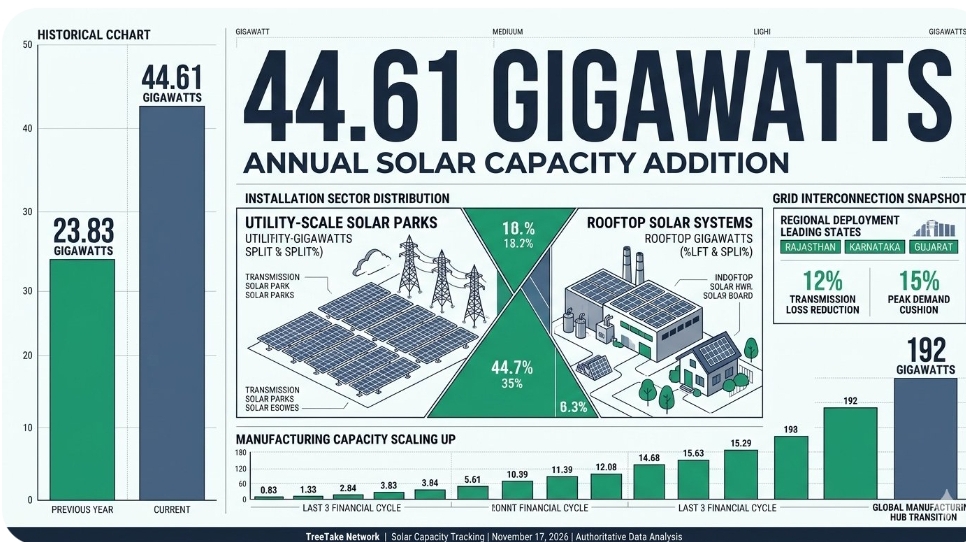
Official metrics released by the Union Ministry on November 17, 2026, reveal that India has achieved a historic milestone by integrating an unprecedented 44.61 gigawatts of solar power capacity into its national grid within a single financial tracking cycle. This massive surge in clean energy generation represents a near doubling of the 23.83 gigawatts added during the previous fiscal year, far exceeding the administrative target of 34 gigawatts originally prioritised by central planning committees. This geometric expansion permanently secures India's position as the world's third-largest cumulative solar producer, altering the nation's energy infrastructure profile and rapidly accelerating its carbon mitigation targets.
Breaking Large Scale Infrastructure Records
The monumental volume of additions has been predominantly driven by giant utility-scale projects and specialised solar parks decentralised across the western arid zones. Large-scale ground-mounted projects contributed 133 gigawatts to the cumulative framework, supported by extensive installations across critical national energy hubs.
Dr Ajay Mathur, speaking during a high-level review segment at the Bharat Renewable Energy Summit, noted: "Achieving 44.61 gigawatts in annual additions is a phenomenal testament to India's manufacturing and deployment capability. This scale of deployment acts as a massive cushion against grid disruptions, allowing the central infrastructure to weather extreme seasonal demands without relying entirely on traditional thermal reserves."
The rapid commissioning of infrastructure within major regional centres, including Rajasthan's Bhadla Solar Park and Karnataka's Pavagada Solar Park, has transformed regional economies. These massive installations have generated significant local employment while providing cheap, zero-emission electricity to adjacent industrial complexes.
Decentralised Adoptions and Grid Modernisation
A highly significant component of this tracking cycle's success is the exponential growth of distributed and rooftop solar configurations across rural and suburban households. Driven by central financial assistance frameworks, grid-connected rooftop systems surged to contribute 34.97 gigawatts of the collective total.
Reflecting on the domestic deployment metrics, Dr Mrutyunjay Mohapatra stated: "The transition toward distributed solar power is vital for democratising the national grid. By solarising over 65 lakh households, regional energy systems are experiencing diminished transmission losses, allowing local distribution companies to stabilising electricity supply lines during periods of peak thermal stress."
Government records confirm that over 21 lakh households have now registered zero electricity bills, demonstrating the immediate socio-economic benefits of the expansion. This widespread adoption has forced local municipal corporations to completely reorganise their urban planning codes to favor mandatory renewable integrations on all new commercial and residential high-rises.
Strategic Policy Impact and Future Projections
The unprecedented escalation in solar infrastructure has placed India well ahead of its international climate pledges. Central authorities confirmed that the country has surpassed its initial commitments five years ahead of the scheduled 2030 deadline, prompting planners to look toward even more aggressive expansion strategies.
Prof Jennifer Morgan, a senior renewable energy policy analyst, observed: "India's recent solar trajectory serves as a blueprint for the global energy transition. By lowering equipment costs and scaling module manufacturing to 192 gigawatts, the domestic market has neutralised international supply vulnerabilities, demonstrating that aggressive climate action can co-exist with robust macroeconomic expansion."
As the ministry transitions its focus toward the newly approved Pradhan Mantri Surya Sarovar Yojana—which targets the deployment of 5000 megawatts of floating solar infrastructure paired with 10000 megawatt-hours of advanced battery storage—engineers are endeavouring to standardise multi-layered storage solutions to prevent power curtailment during periods of intense solar peak production.
Editor's Note
The addition of 44.61 gigawatts of solar power in a single cycle is a magnificent engineering triumph that fundamentally validates India's green energy ambition. However, this historic milestone must not foster administrative complacency. The sheer volume of intermittent renewable energy flowing into the national grid will inevitably test the structural limitations of existing transmission infrastructure. To sustain this momentum and prevent large-scale power curtailment, the next phase of national energy strategy must focus heavily on the localisation of advanced energy storage systems and smart grid technology. Only by modernising transmission networks can the country fully utilise its massive generation capabilities and ensure a resilient, carbon-free future.



Leave a comment