

TreeTake Network
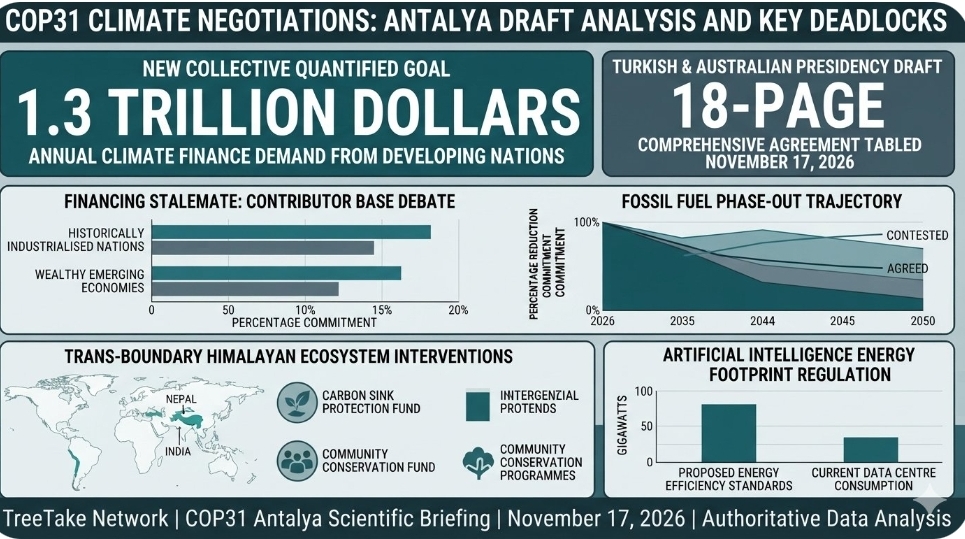
Negotiations at the COP31 climate summit descended into a critical impasse on November 17, 2026, as co-hosts Australia and Türkiye introduced a highly contentious 18-page draft text aimed at establishing global frameworks for the next decade. The text, presented to delegates during a tense plenary session in Antalya, attempts to bridge the deep financial chasm between industrialised nations and developing economies, while introducing pioneering regulatory sections for technology-driven resource management. Tensions erupted almost immediately over the language surrounding the phase-out of fossil fuels, the energy consumption of data infrastructure, and specialised accounting mechanisms for trans-boundary mountain ecosystems.
Financing Gridlocks and Fossil Fuel Rhetoric
The primary point of friction revolves around the New Collective Quantified Goal on climate finance, with developing nations demanding a commitment of at least 1.3 trillion dollars annually from historic emitters. The tabled text attempts to compromise by introducing a multi-tiered contributor base that includes wealthy emerging economies, a move that drew swift condemnation from major negotiating blocs.
Dr Inger Andersen, speaking on the sidelines of the high-level segment, stated: "We are witnessing a structural standoff that risks stalling genuine planetary stabilisation. The draft agreement attempts to decentralise financial accountability, but without absolute, legally binding commitments from historic polluters, local adaptation strategies across the Global South will collapse entirely."
Further complications arose as several oil-producing countries fiercely resisted a clause aimed at transitioning away from fossil fuels in a just, orderly, and equitable manner. Representatives from these nations argued that the text unfairly penalises hydrocarbon-dependent developing states without providing the necessary technology transfer to modernise alternative grid infrastructures.
Regulating Artificial Intelligence Energy Metrics
In a historic first for a United Nations climate text, a dedicated sub-section has been introduced to target the exponential carbon footprint of technology infrastructure. The draft proposes rigorous international standards to organise and monitor the energy efficiency of massive data centres, explicitly targeting hyper-scale artificial intelligence installations.
Prof Jennifer Morgan, a senior climate policy specialist tracking the negotiations, observed: "The inclusion of digital infrastructure metrics is a necessary evolution, yet the current text lacks enforcement teeth. We cannot separate the expansion of artificial intelligence from global energy grid pressures, and the summit must enforce a framework that forces technology conglomerates to utilise 100 per cent verifiable renewable power."
The draft mandates that any future national decarbonisation plans must explicitly account for the computational load of regional software operations, an inclusion that has triggered heavy lobbying from international technology coalitions seeking to decentralise these compliance benchmarks.
Himalayan Carbon Sink Initiatives
A major diplomatic victory was achieved by a coalition of South Asian nations, led by India, Nepal, and Bhutan, who successfully inserted dedicated text protecting mountain ecosystems. The draft formally recognises the critical role of Himalayan forests and high-altitude wetlands as vital trans-boundary carbon sinks, proposing a specialised fund to incentivise local community-led conservation programmes.
Reflecting on this development during an official briefing, Dr Mrutyunjay Mohapatra noted: "The inclusion of specific mountain environment frameworks is an essential advancement for regional climate security. High-altitude ecosystems are experiencing thermal acceleration at twice the global average rate, and stabilising these zones is non-negotiable for the water security of over 1000 million people downstream."
Despite the inclusion of the mountain ecosystem framework, the draft remains heavily contested, with negotiators preparing for round-the-clock sessions as the presidency endeavours to secure a consensus text before the scheduled closure of the summit.
Editor's Note
The Antalya draft text exposes the profound systemic friction defining modern climate diplomacy. By attempting to expand the contributor base for climate finance while simultaneously introducing complex regulations for emerging technology footprints, the COP31 presidency has set an incredibly ambitious but fragile agenda. For these negotiations to deliver a meaningful way forward, industrialised nations must look past temporary economic self-interest and formalise transparent, unconditional financial pipelines. Failing to do so will reduce this historic text to a mere administrative exercise, leaving vulnerable global ecosystems to bear the catastrophic brunt of unchecked climatic disruptions.



Leave a comment