

Tree Take Network
A sequence of official briefings and comprehensive data packets tabled before Parliament on August 5 and August 6, 2026, has provided a critical status update on the nation's environmental health, conservation achievements, and long-term climate vulnerability. The latest legislative disclosures highlight an extraordinary wildlife recovery in western India, balanced against stark artificial intelligence projections regarding prolonged global weather anomalies and intensive regional greening mandates.
The Wildlife Victory: Asiatic Lions Launch a 32% Comeback
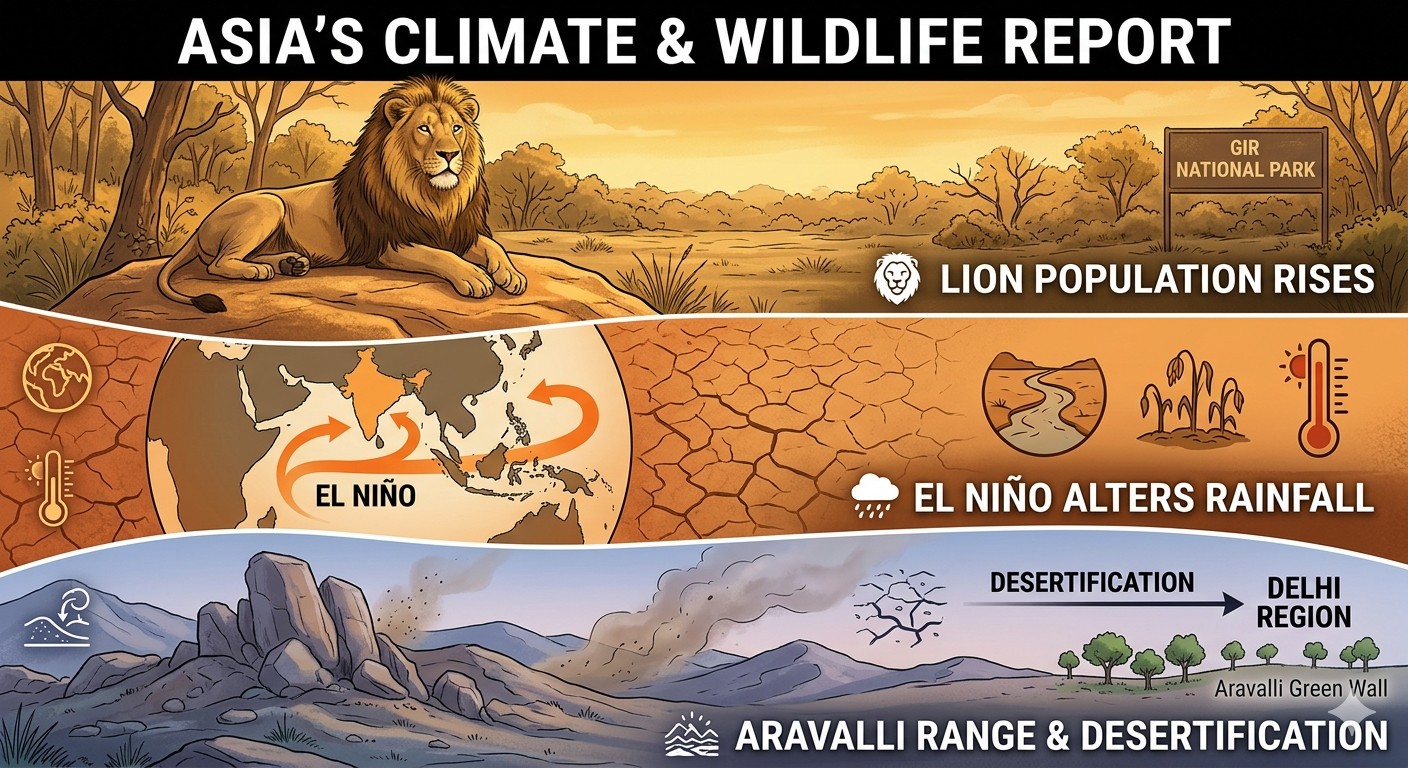
In an official brief presented to the Rajya Sabha on August 6, 2026, the Union Environment Ministry showcased an extraordinary conservation milestone, confirming that the endemic Asiatic lion population across the sprawling Gir landscape has grown by 32% compared to the 2020 baseline census data. Once cornered on the brink of localized extinction due to genetic bottlenecks and territorial shrinkage, the apex predators have achieved a stabilized population resurgence.
Ministry officials credited three highly structured pillars for the success: intensive community-led policing that mitigates human-wildlife friction, the establishment of dedicated habitat extension corridors outside traditional sanctuary boundaries, and the integration of tech-driven veterinary surveillance networks to preemptively halt disease outbreaks.
"This 32% surge proves that wildlife conservation cannot succeed in isolation," a senior ecology official stated in a parliamentary brief. "By fusing localized tribal guardianship with real-time veterinary tracking, we have transformed the Gir landscape into a globally recognized model for carnivore preservation."
The Climate Warning: Predictive AI Tracks El Niño Extension Into 2027
While conservation efforts yielded positive results, the atmospheric forecasts presented to lawmakers painted a far more volatile picture. On August 5, 2026, the Indian National Centre for Ocean Information Services (INCOIS) presented updated predictive artificial intelligence modules to the Lok Sabha, mapping out long-range global oceanic anomalies.
The advanced AI projections indicate that moderate El Niño conditions are highly likely to persist until February 2027. This prolonged presence introduces a severe structural risk to the Indian subcontinent's weather stability. The extended horizon is projected to distort the traditional winter cooling cycle and inject severe volatility into the upcoming agricultural sowing seasons, complicating food security planning.
"Our updated machine-learning models confirm that the equatorial Pacific warming is proving structurally stubborn," noted an INCOIS climate modeller. "An El Niño stretching into early 2027 means our winter monsoon and early spring patterns will likely be highly erratic, requiring states to build immediate agricultural contingencies."
The Ecological Shield: Structural Greening to Revive the Aravallis
Addressing the dual pressures of land degradation and collapsing hydrological baselines during the same session, Union Environment Minister Bhupender Yadav championed aggressive localized restoration frameworks. The Ministry is pushing for massive, data-tracked planting targets under the national 'Ek Ped Maa Ke Naam' initiative.
The primary ecological target remains the highly degraded Aravalli mountain ranges. Special multi-district eco-restoration drives are actively underway to counter decades of illegal mining and soil erosion. Rather than relying solely on arbitrary tree planting, the current framework prioritizes structural grasslands development to naturally trap seasonal runoff, reduce topsoil loss, and systematically recharge the region's rapidly dipping water tables.



Leave a comment