

Talking Point
TreeTake Network
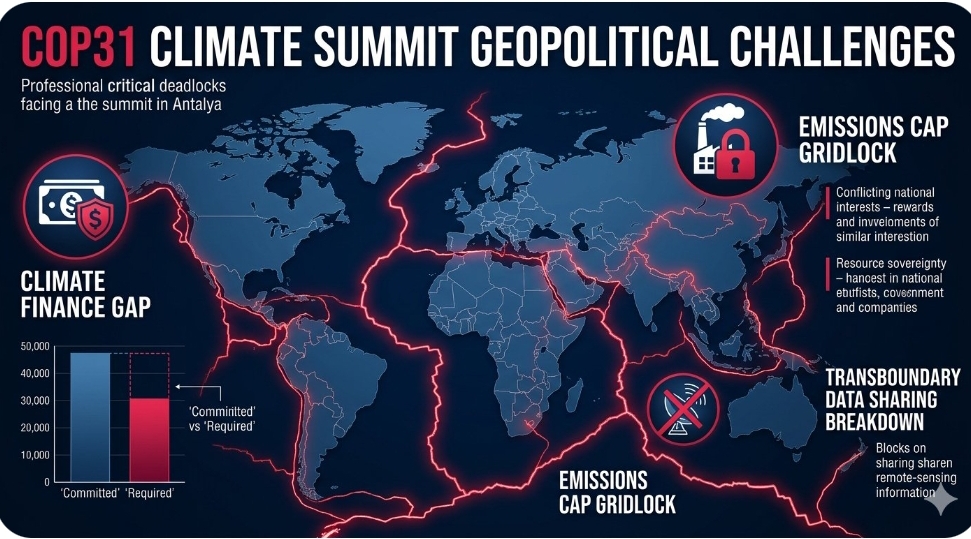
Ongoing regional conflicts and shifting political alliances are severely testing the structural integrity of international climate diplomacy just days before the United Nations COP31 Climate Summit, scheduled to commence on November 9, 2026, in Antalya. Senior diplomatic delegations arriving in Turkey report that deep economic divisions and historical energy security disagreements have created substantial friction during initial closed-door working sessions. The primary framework for global carbon reductions faces unprecedented gridlock, as key industrialised nations deprioritise international carbon targets to shore up internal resource sovereignty. Emerging economies have explicitly warned that without binding capital guarantees from developed states, the broader structural components of the Paris Agreement risk complete operational stagnation.
The international climate finance negotiations scheduled for the upcoming week face immediate distress as sovereign contributors adjust domestic budgets toward national defence expenditures rather than global ecological programmes. Professor Fatma Karaca, Lead Climate Architect at the Antalya Environmental Institute, stated: "The collective willingness to commit to long-term climate financing mechanisms has visibly deteriorated, leaving vulnerable developing nations entirely exposed to systemic ecological risks without necessary mitigation infrastructure." Adding to these concerns, Professor Jean-Pascal van Ypersele, former Vice-Chair of the Intergovernmental Panel on Climate Change, observed: "We are witnessing a dangerous trend where immediate geopolitical tensions completely overshadow the catastrophic, long-term trajectory of global ecological shifts, effectively stalling critical updates to Nationally Determined Contributions."
Multilateral environmental protection strategies targeting shared river basins and transboundary ecosystems are suffering from a distinct lack of state-level cooperation. Dr Selin Demir, Director of the Mediterranean Ecological Alliance, cautioned: "Geopolitical blockades are preventing the shared deployment of remote-sensing equipment required to track rapid biodiversity losses and illegal logging activities along industrial borders." Furthermore, Professor Michael Mann, Director of the Penn Centre for Science, Sustainability, and the Media, emphasised: "International climate summits cannot function effectively in an environment of deep diplomatic isolation, as the atmospheric reality of rising emissions ignores political boundaries and requires absolute transparency between competitive superpowers."
Editor's Note
The escalating diplomatic friction observed ahead of COP31 underscores the danger of tying survival-critical climate policy to volatile geopolitical cycles. Moving forward, global environmental governance must build resilient, legally independent frameworks that enforce domestic decarbonisation independent of international state relationships.



Leave a comment