

Talking Point
TreeTake Network
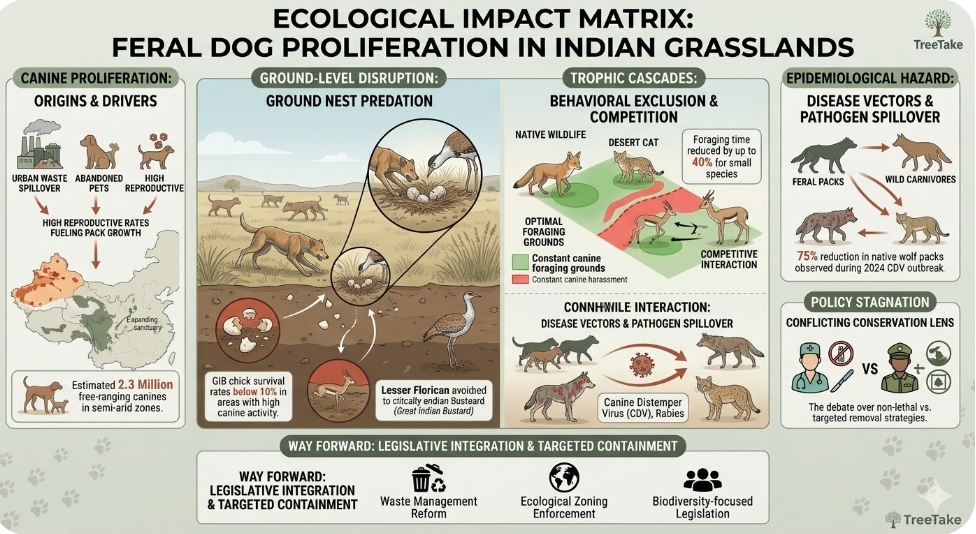
In an unprecedented ecological shift across India's arid and semi-arid landscapes, the unchecked expansion of free-ranging feral canine populations has emerged as a primary driver of native wildlife displacement and habitat degradation. The crisis, expanding deeply into fragile rural grassland frontiers, represents a severe conservation challenge where domestic species transitions have breached wilderness boundaries. Environmental authorities and field biologists are warning that the lack of structured ecological containment is actively accelerating the decline of highly specialised, ground-dwelling grassland fauna.
Predatory pressures and ground nest devastation in sanctuaries
The immediate impact of feral dog packs is most acute within protected conservation zones where ground-nesting avian species face direct survival challenges. Wildlife conservationist and senior researcher Abi Tamim Vanak observed, "Our multi-year field telemetry data demonstrate that free-ranging domestic canines function as highly efficient, invasive apex predators in these flat open terrains. They are not merely occasional nuisances; their pack-hunting dynamics are responsible for extensive ground-nest predation, which systematically prevents the reproductive success of highly vulnerable avian species." The seasonal migration of unmanaged packs into sanctuary cores introduces an artificial predatory pressure that native ecosystems are structurally unequipped to absorb.
Endangered species displacement and trophic cascade acceleration
Beyond direct predation, the presence of feral packs induces severe behavioural modifications and resource competition among native carnivores and herbivores. Dr Arjun Gopalaswamy, a prominent wildlife biologist specialising in carnivore ecology, stated, "The presence of feral dogs alters the entire spatial occupancy of the grassland ecosystem. Native species like the Chinkara and the Indian Fox are actively avoiding optimal foraging grounds due to the constant threat of pack harassment." This spatial exclusion creates a negative trophic cascade, forcing native wildlife into fragmented, suboptimal habitats where their long-term survival metrics decline precipitously.
Disease transmission vectors and cross-species contamination risks
The physiological threat of feral proliferation extends beyond physical predation to systemic epidemiological hazards. Highlighting the veterinary and conservation interface, field epidemiologist Dr Naveen Kumar noted, "Feral canine packs act as highly mobile reservoirs for lethal pathogens such as Canine Distemper Virus and Rabies. In crowded grassland frontiers, these domestic vectors frequently spill over into wild carnivore populations, including the Indian Wolf and the Desert Cat, threatening localised population collapses through unpredictable disease outbreaks." The proximity of poorly managed rural waste sites ensures a continuous replenishment of the dog population, compounding the viral load carried into pristine wildlife habitats.
Policy stagnation and targeted extraction debates
Conservation bodies argue that standard urban population stabilisation methods are completely ineffective in vast open wilderness areas. Addressing the regulatory bottlenecks, veteran wildlife policy analyst Dr Asad Rahmani stated, "Applying standard urban animal birth control protocols to vast, rural wildlife sanctuaries is logistically impossible and biologically irrelevant for conservation purposes. Protecting our final grassland biomes requires the immediate legislative validation of targeted feral dog removal from declared ecologically sensitive zones." While animal welfare platforms advocate for non-lethal containment, the accelerating pace of biodiversity loss has forced a polarising debate over the legal definition of invasive domestic species within protected forests.
Editor's Note
The crisis unfolding across India's grassland frontiers highlights a critical flaw in current conservation frameworks, which fail to legally treat free-ranging domestic animals as invasive predators. While structural fencing and garbage containment are vital long-term priorities for peri-urban areas, protecting the remaining remnants of grassland biodiversity requires immediate, localised extraction protocols within sanctuary boundaries. The sustainable way forward demands a clear separation of urban street dog management policies from wilderness conservation laws, ensuring that the protection of critically endangered native species takes absolute legal precedence over domestic animal preservation.



Leave a comment