

TreeTake Network
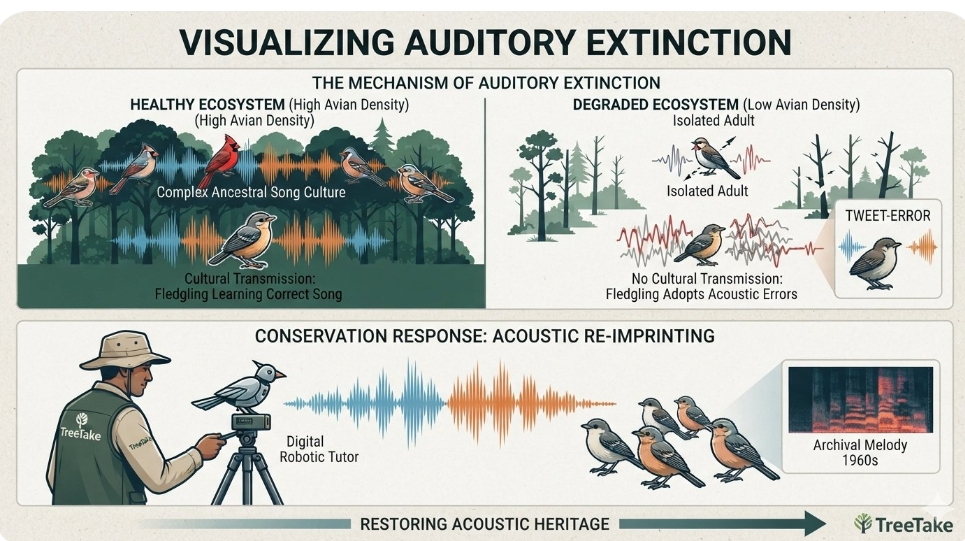
Deep within fragmenting forest ecosystems, an invisible crisis is unfolding that threatens the very core of avian survival. While global attention remains firmly fixed on the physical decline of animal populations, international field research has exposed a parallel, hidden emergency termed "auditory extinction". The study reveals that as avian numbers plummet due to human encroachment and habitat loss, the complex ancestral acoustic libraries of surviving species are rapidly disintegrating because juvenile birds no longer have healthy adult populations to learn their songs from.
The groundbreaking field investigation, led by Professor Gabriel Mindlin, a prominent professor of physics at the University of Buenos Aires, demonstrates that birdsong is not merely an innate reflex but a learned culture transmitted across generations. When human activities cause severe population crashes, the cultural chain breaks down entirely. Fledglings and young juvenile birds, isolated from a robust network of singing adults, grow up making significant structural errors, tweeting abnormally or mistakenly adopting elements from entirely different species.
Professor Gabriel Mindlin highlighted that learned animal culture like birdsong is an essential part of population metrics alongside genetics, noting that systematic registration of dialects is urgently needed. The loss of local dialects impedes reproductive success, as females select mates based on complex, energetic songs. Conservation scientist Rebecca Lewis from Chester Zoo explained that birds with mismatched songs struggle to pair successfully or perform as well after pairing. Translocation tracking further confirms that relocated birds facing foreign dialects experience severe integration and reproductive hurdles.
To counter this, researchers have deployed electronic robot tutors playing historical melodies from archives dating to the 1960s to re-imprint juvenile birds with correct ancestral dialects.
Editor's Note
Auditory extinction redefines biodiversity conservation by proving that protecting physical populations must be matched by preserving their behavioural and cultural infrastructure. The way forward demands systematised international efforts to record and archive wildlife dialects, integrating acoustic integrity into broader habitat management frameworks.


.jpg?resize=120%2C90&ssl=1)



Leave a comment