

TreeTake Network
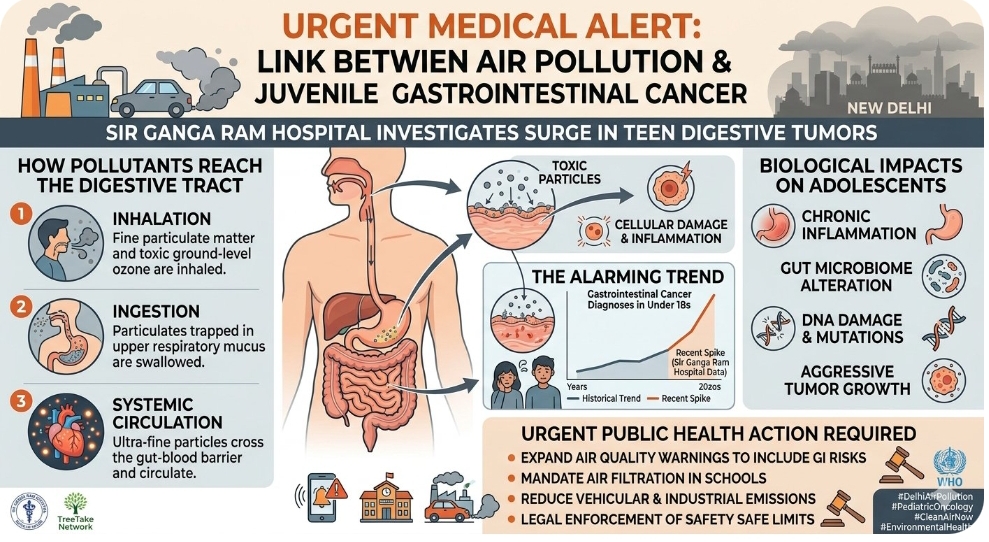
Oncologists and gastrointestinal specialists at New Delhi’s prestigious Sir Ganga Ram Hospital have initiated an urgent medical investigation following an unprecedented, highly alarming spike in aggressive gastrointestinal cancers among adolescents as young as fifteen years of age. While the catastrophic respiratory impacts of northern India’s toxic winter smog are extensively documented, this new clinical inquiry marks a critical paradigm shift in environmental medicine. Researchers are actively tracing how long-term systemic exposure to high concentrations of fine particulate matter and toxic ground-level ozone can cross the gut-blood barrier, acting as a direct carcinogenic catalyst within the human digestive tract.
The clinical files under review reveal a devastating inversion of traditional oncological trends across the National Capital Region. Historically, malignancies of the colon, stomach, and oesophagus were diagnosed almost exclusively in older demographics with long-term lifestyle risk factors. However, over the past twenty-four months, diagnostic labs have recorded a sharp escalation in advanced-stage digestive tumours among school-aged children who possess no hereditary genetic markers or pre-existing dietary predispositions. Medical teams state that the sheer velocity of tumour growth in these young patients points directly to an aggressive, environmentally driven trigger.
Extrapulmonary pathways and toxic ingestion
The working medical thesis focuses on the direct ingestion of airborne pollutants. While larger dust particles are filtered by the nasal passages, fine particulate matter is frequently trapped in the upper respiratory tract, cleared into the pharynx via mucus, and subsequently swallowed into the stomach. Once inside the digestive system, these toxic particles induce severe, chronic cellular inflammation, alter the delicate gut microbiome, and trigger localised oxidative stress that can permanently damage cellular DNA, leading to malignant mutations.
Dr. S.P. Byotra, Chairman of the Department of Medicine at Sir Ganga Ram Hospital, observed during a clinical briefing: "We are observing an undeniable and deeply terrifying trend where children with absolutely no family history of malignancy are presenting with advanced gastrointestinal tumors. The medical community must accept that air pollution is no longer just a respiratory crisis; these toxic particulates are being swallowed, causing widespread inflammation and cellular damage throughout the digestive tract of our youth."
Overlooked environmental factors and systemic failure
Public health researchers argue that current municipal defence frameworks are dangerously flawed because they focus almost entirely on lung health, leaving the broader systemic effects of toxic air unmonitored. Independent air quality data logs confirm that throughout the autumn and winter months, regional particulate levels routinely exceed the safe limits established by the World Health Organisation by more than thirty times. Medical advocates warn that without immediate intervention, the compounding biological toll on the younger generation will trigger a severe, long-term public health catastrophe.
Dr Arvind Kumar, a leading robotic chest surgeon and founder of the Lung Care Foundation, noted during an environmental health forum: "For decades, we have warned that breathing the air in New Delhi is equivalent to smoking multiple cigarettes a day. This new data confirms our worst fears: the damage is not contained within the lungs. These ultra-fine particles circulate through the bloodstream and settle in the digestive system, turning a seasonal air pollution crisis into a permanent, multi-organ oncological emergency for our children."
Editor's Note
The emergency inquiry at Sir Ganga Ram Hospital exposes a terrifying expansion of the health hazards linked to urban air pollution, proving that toxic smog degrades the human body far beyond the respiratory system. The way forward requires public health policies to immediately expand air quality warnings to include gastrointestinal risks, whilst mandating strict air filtration infrastructure inside all schools and pediatric care facilities across the region. True preventative medicine is impossible without an aggressive, legally binding reduction in vehicular and industrial emissions, as the state cannot continue to trade the long-term biological survival of its youth for short-term economic convenience.



Leave a comment