

TreeTake Network
A major multi-state wildlife translocation initiative has successfully transferred a healthy adult tigress from the plains of Bihar to the Buxa Tiger Reserve in West Bengal. The inter-state operation marks a critical step forward in national apex predator conservation, aiming to genetically reinforce an isolated tiger population that has long suffered from habitat fragmentation and a lack of natural breeding corridors.
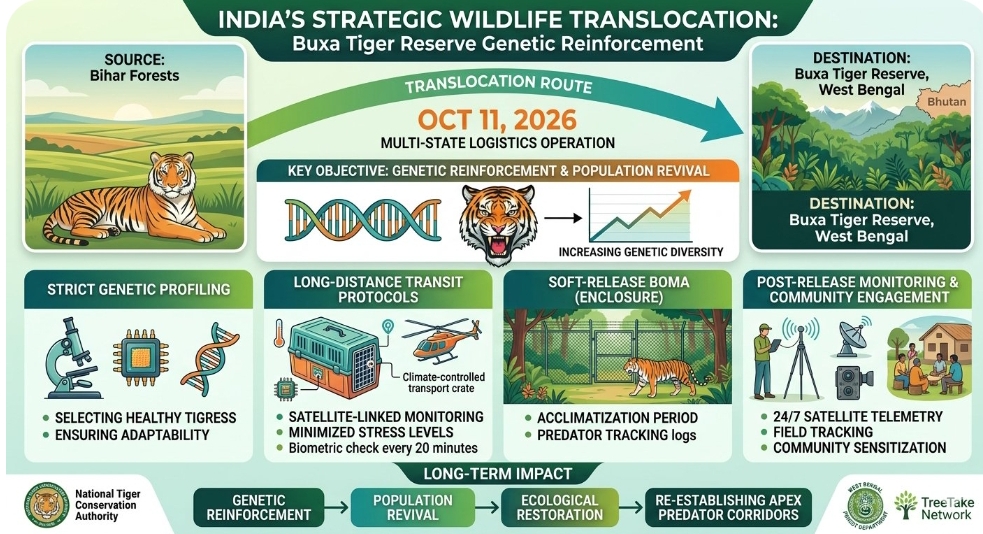
The high-stakes transit operation, concluded on Oct 11, 2026, involved an intricate collaborative logistics network between forest departments, wildlife veterinarians, and security teams across state lines. The tigress was selected based on strict genetic profiling and physical health metrics to ensure maximum adaptability to the unique forest ecosystem of northern West Bengal.
Reversing the Isolation of Apex Predator Pools
The Buxa Tiger Reserve, located along the international border with Bhutan, has historically faced severe challenges in maintaining a sustainable tiger density due to historical commercial logging, railway lines, and human encroachment. By introducing fresh genetic material from the robust breeding pools of Bihar, conservation biologists hope to trigger a natural population revival and prevent the long-term genetic decay associated with isolated populations.
Dr K Ramesh, a senior wildlife biologist who oversaw the habitat readiness assessment, highlighted the strategic importance of the move, stating that this translocation is not just about increasing raw numbers, but about restoring evolutionary functionality to an apex predator corridor that had been functionally cut off for decades. He added that the success of this operation proves that inter-state administrative barriers can be overcome when scientific data mandates immediate conservation intervention.
Field veterinarian Dr Shailesh Kumar detailed the strict medical protocols implemented during the long-distance transit, explaining that the tigress was monitored every 20 minutes via satellite-linked biometric sensors embedded in the specialised transport crate to track respiration and core stress levels. He emphasised that the smooth release into the soft-release boma at Buxa at 06:45 AM confirms that our sedation and climate-controlled transport protocols performed flawlessly under demanding field conditions.
West Bengal's Chief Wildlife Warden Subrat Pal Choudhury welcomed the development, noting that field tracking teams will maintain round-the-clock monitoring of the tigress using automated camera traps and radio telemetry. He stated that the local community has been actively sensitised to ensure zero conflict, and this translocation marks the beginning of a comprehensive decade-long ecological restoration strategy for the entire Buxa-Jaldapara conservation landscape.
Editor's Note
The successful translocation to Buxa Tiger Reserve demonstrates that active genetic management is now mandatory to save fragmented wilderness zones from ecological collapse. The way forward requires the National Tiger Conservation Authority to formalise a permanent inter-state genetic rescue pipeline, ensuring that isolated sanctuaries are regularly reinforced before local inbreeding depression becomes irreversible.


.jpg?resize=780%2C450&ssl=1)


.jpg?resize=120%2C90&ssl=1)



Leave a comment