

TreeTake Network
India's wildlife conservation frameworks are facing a profound double crisis that exposes the deep vulnerability of both translocated apex predators and undocumented endemic species to environmental stressors. Within the same week, the heat-stroke death of an African cheetah in Madhya Pradesh and the discovery of a new legless amphibian in an active construction zone in the Western Ghats have forced an urgent re-examination of how the country balances habitat management against climate volatility and rapid infrastructure growth.
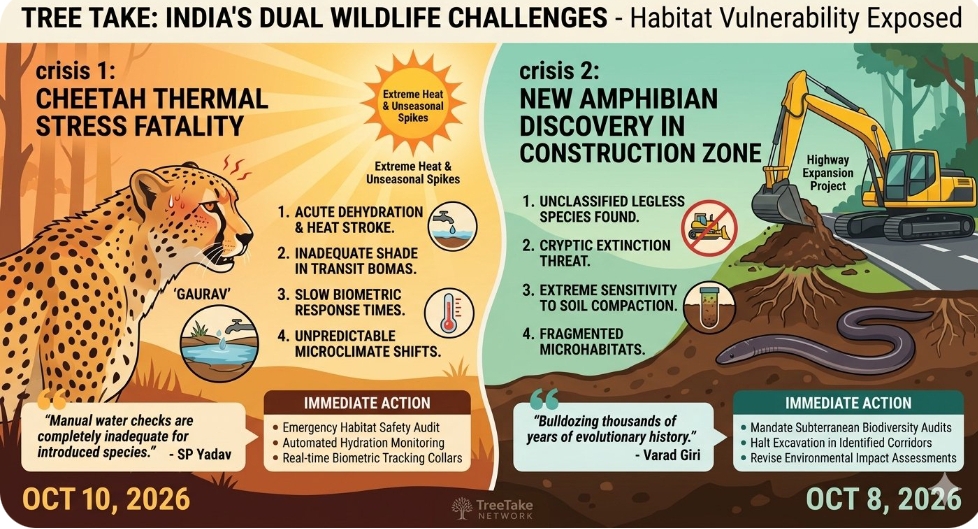
The dual developments have triggered immediate administrative interventions from the Union Environment Ministry. On Oct 10, 2026, wildlife authorities ordered an emergency habitat safety audit across national carnivore reserves following the death of the adult male cheetah, Gaurav, who succumbed to acute dehydration and thermal shock during an unseasonal temperature spike. Simultaneously, a formal taxonomic paper published on Oct 8, 2026 confirmed the discovery of a previously unclassified burrowing caecilian species, found clinging to a narrow forest patch directly adjacent to a major commercial highway expansion project.
Thermal Shock and Infrastructure Pressure Threaten Ecosystem Baselines
The loss of the cheetah has renewed intense scrutiny over the microclimatic suitability of transit enclosures, while the amphibian discovery highlights the silent threat of "cryptic extinction" occurring beneath the soil surface due to heavy engineering machinery. Caecilians are subterranean amphibians exceptionally sensitive to soil compaction and moisture loss, meaning the very earthmovers clearing corridors for transport networks are destroying entire undocumented populations before they can be recorded.
An official tracking log from the sanctuary veterinary team detailed the immediate medical timeline, noting that the animal showed acute symptoms of hyperthermia at 11:30 AM, followed by rapid neurological decline, and despite the immediate administration of intravenous fluids and cooling packs, internal organ failure occurred by 02:15 PM due to unprecedented metabolic stress.
A senior wildlife management scientist attached to the translocation project stated that the death of Gaurav due to acute thermal stress is a severe warning that our habitat infrastructure must adapt to rapid weather shifts, requiring an immediate transition to automated telemetry tracking that alerts field vets to biometric spikes. He added that we did not anticipate a temperature spike of this magnitude so late in the year, and it is now clear that manually filling watering holes is completely inadequate for an introduced species accustomed to different seasonal patterns.
Dr SP Yadav, a prominent conservation official involved in large carnivore management, commented on the infrastructure challenges, stating that the project requires us to constantly refine our field tactics based on real-time setbacks, and this safety review will critically evaluate if the current design of our transit bomas provides enough natural thermal insulation during extreme weather anomalies. He emphasised that we are moving into a phase where automated microclimate control within core enclosures is no longer optional but a baseline necessity for survival.
Commenting on the subterranean crisis, Dr Karthik Vasudevan, a leading herpetologist, emphasised that discovering a new species in an active road-widening zone proves how little we understand the underground networks of the Western Ghats, warning that altering soil moisture and compaction permanently seals the fate of specialized burrowing fauna that cannot physically flee from construction zones. He noted that our current ecological surveys completely skip the topsoil layers, meaning we are effectively bulldozing thousands of years of evolutionary history without even knowing it is there.
Adding to the concern, environmental field researcher Dr Varad Giri stated that caecilians are the forgotten organisms of our tropical forests, and because they lack the public appeal of large mammals, their habitats are sliced apart by highway projects without a second thought. He added that the discovery of this unclassified species just meters away from an active excavator must serve as a legal wake-up call to alter how environmental clearances are granted in the Ghats.
Editor's Note
Together, the loss of cheetah Gaurav and the accidental discovery of a new caecilian reveal a systemic flaw in conservation governance: management protocols remain structurally blind to hyper-local climate spikes and subterranean biodiversity. The way forward requires the Ministry of Environment to mandate real-time automated biometric tracking for translocated macrofauna while simultaneously implementing compulsory topsoil and leaf-litter ecological audits before granting any infrastructure clearances in eco-sensitive zones.


.jpg?resize=780%2C450&ssl=1)


.jpg?resize=120%2C90&ssl=1)



Leave a comment