

H.N.SINGH
Lions International Faculty, Member SPHEEHA, Naturalist, HAM Radio Licensee, Trekker & Mountaineer
Nestled in Agra, the land of the Taj Mahal, Dayalbagh—literally “Garden of the Merciful” , is a unique social, spiritual, and ecological experiment founded in 1917. Conceived as a self-reliant and value-based community, Dayalbagh has since blossomed into a model of sustainable living, Agro-Ecological farming, renewable energy, inclusive education, holistic healthcare, and women’s empowerment.
Unlike modern urban colonies that often embody consumerism and environmental stress, Dayalbagh embodies simplicity, service, and sustainability. Its residents view work not as mere employment but as Seva, selfless service dedicated to society and the Divine. This vision has made Dayalbagh a living embodiment of the United Nations Sustainable Development Goals (SDGs), long before the goals were formally articulated.
Foundational Principles – Better Worldliness
Dayalbagh’s lifestyle is rooted in the philosophy of “Better Worldliness”—living in the material world while aspiring for spiritual upliftment. Its foundation rests on the Fatherhood of God and Brotherhood of Man, fostering harmony across communities.
The model integrates the Sigma Six Q-IVA framework:
Innovation, Water quality, Air quality Education & healthcare, Agriculture & dairy, Human values
Together, these make Dayalbagh a self-contained community, providing everything “from maternity to eternity” from pre-nursery education to old-age care.
Agroecology & Precision Farming – Core of Dayalbagh’s Sustainability
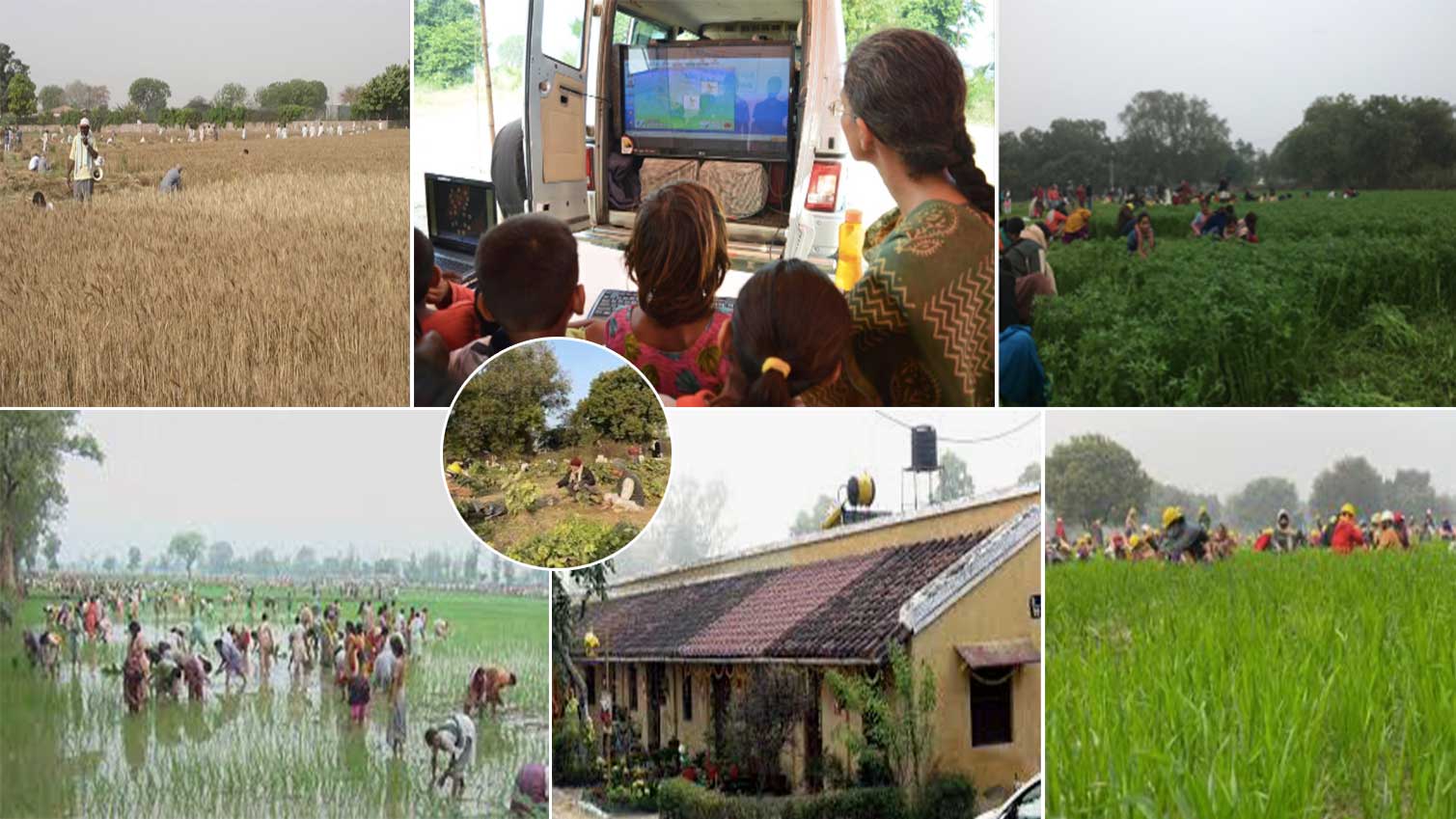
Agriculture in Dayalbagh is not just economic ,it is cultural, spiritual, and ecological. On what was once barren land, Dayalbagh now sustains multi-layered, diverse Agro-ecosystems that meet food needs, conserve biodiversity, and maintain soil health.
Agroecological practices include:
Vertical diversity: 9000+ fruit trees layered with bougainvillaea, shrubs, and tall trees, creating microclimates for delicate crops.
Spatial diversity: Intercropping (e.g., sugarcane with gur), allowing natural weeds like bathua to thrive for fodder and food.
Temporal diversity: Crop rotation with legumes (arhar, groundnut) for nitrogen fixation.
Livestock integration: Cattle graze on crop residues; weeds are used as fodder.
Organic farming: Zero chemical fertilisers; reliance on bio-manure, neem-based pesticides, and vermicompost.
Water conservation: Rainwater harvesting ponds, drip irrigation, and use of recycled wastewater reduce water use by 40%.
Protected cultivation: Hi-tech greenhouses and poly-houses grow strawberries, tomatoes, peppers, and cucumbers off-season.
Solar agriculture farms: Combining solar panels with crop cultivation increases land productivity.
Dayalbagh has also created 25 biodiversity parks and an 84-acre Anupam Upvan Agroforestry project, enhancing climate resilience, biodiversity, and carbon sequestration.
This agroecology system advances multiple SDGs: Zero Hunger (SDG 2), Clean Water (SDG 6), Responsible Consumption and Production (SDG 12), Climate Action (SDG 13), Life on Land (SDG 15).
Gaushala and Smart Dairy Farming
The Dayalbagh Gaushala, founded in 1926, remains central to the community’s agroecological cycle. With 1100 indigenous cattle, it produces over 1500 litres of milk daily, forming a key part of the residents’ lacto-vegetarian diet.
The Gaushala is a model of zero waste and zero pollution:
Cow dung and urine are used to make biofertilizers (Beejamrit, Jeevamrit), biogas, and Dasparni (for reducing air pollution). Biogas fuels cooking and electricity, cutting methane emissions. Residues enrich soil fertility for farming. With DEI’s research support, the Gaushala has adopted Smart Dairy Farming: RFID tagging for cattle identification and health monitoring. Smart cooling systems reduce heat stress, improving milk yield.
A dairy technology plant where students produce cheese, shrikhand, and flavoured milk, exported internationally under certification.
This synergy of ancient tradition + modern science ensures nutritional security, entrepreneurship training, and sustainable livestock management, aligning with SDG 3, SDG 8, and SDG 12.
Cleaning of the Yamuna River near Dayalbagh: A Step Towards Sustainability
The Yamuna River, flowing adjacent to Dayalbagh, is both a lifeline and a spiritual symbol for the community. However, like many rivers in India, it faces severe challenges from pollution, untreated sewage, industrial effluents, and solid waste dumping. Recognising the importance of the Yamuna for ecological balance and community well-being, Dayalbagh has actively engaged in initiatives aimed at its cleaning, restoration, and long-term conservation.
Dayalbagh’s approach to the Yamuna cleaning project is rooted in community participation, ecological responsibility, and sustainable practices. Residents, students of the Dayalbagh Educational Institute, and affiliated organisations regularly organise:
Cleanliness drives along the riverbanks, removing plastic, solid waste, and debris.
Awareness campaigns for nearby communities, emphasising the importance of keeping the river pollution-free.
Tree plantation and afforestation along the riverbanks to prevent soil erosion and improve water retention.
Promotion of eco-friendly lifestyle practices—such as banning plastics, using green gas, recycling wastewater, and preventing untreated sewage discharge—that directly reduce pollutants entering the Yamuna.
These actions directly contribute to the achievement of multiple United Nations Sustainable Development Goals (SDGs):
SDG 6 (Clean Water and Sanitation): Protecting freshwater sources, promoting clean water for communities.
SDG 11 (Sustainable Cities and Communities): Ensuring eco-friendly urban living near the river.
SDG 12 (Responsible Consumption and Production): Reducing waste and preventing pollution at the source.
SDG 13 (Climate Action): Riverbank afforestation enhances carbon sequestration and resilience.
SDG 14 & 15 (Life Below Water and Life on Land): Conserving aquatic biodiversity and protecting riparian ecosystems.
By integrating spirituality with sustainability, Dayalbagh shows that river cleaning is not only an environmental duty but also a moral and social responsibility. The ongoing efforts to rejuvenate the Yamuna near Dayalbagh stand as a model of how community-driven initiatives can restore natural ecosystems, support human well-being, and fulfil global sustainability goals.
Healthcare Habitat and Eco-Village
Dayalbagh is often described as the “Green Lungs of Agra.” Its tree-lined avenues, parks, and orchards maintain lower pollution levels compared to the city.
Key eco-village practices include: Walking, cycling, and solar/electric rickshaws; fossil-fuel vehicles are restricted. Ban on plastic, crackers, and biomass burning. Green gas pipelines in every household & in the community kitchen, which is also powered by solar cooking and induction. Waste segregation and composting at source.
Air quality monitoring stations for PM10/PM2.5, NOx, and Ozone.Water quality checks of wells; potassium permanganate treatment ensures potable water without RO. Dayalbagh thus becomes an eco-village where daily life minimises ecological footprints, advancing SDG 11 and SDG 13.
Education – From Nursery to University
Dayalbagh is unique in offering complete education, from nursery to doctoral level, within one colony.
Primary School: Provides foundational education with emphasis on values, discipline, and holistic growth.
The Sant Su(perhuman) Evolutionary Scheme: The Sant Su(perhuman) Evolutionary Scheme, launched in 2017 at Dayalbagh, is a holistic educational program for infants and children aged 3 weeks to 12 years. Participants are integrated into the Dayalbagh community's daily routine, engaging in spiritual activities like Satsang, participating in selfless service in agricultural fields, and performing daily health exercises to develop spiritual values, strong character, and a desire to serve humanity. The goal is to nurture a generation of "Superhumans" characterised by their quality and ideals, contributing to a better world by embodying principles of humility, peace, love, and selfless service.
Prem Vidyalaya Girls’ Intermediate College – a pioneering centre for girls’ education. This college is devoted to girls’ education, ensuring equal opportunities for young women to pursue academics and leadership roles.
Women’s Polytechnic – training women in technical and vocational skills, offering technical and vocational training specifically for women, enabling them to become self-reliant and skilled professionals in diverse fields
R.E.I. Inter College – strong foundations for boys established to provide quality secondary and higher secondary education.
Dayalbagh Educational Institute (DEI, Deemed University) : known worldwide for its work-integrated education model, blending academics with vocational training, agroecology, industry, and social service.
DEI leads in skill-based courses (B.Voc in Dairy Technology, Food Processing, Renewable Energy, Apparel, Automobile Engineering, etc.) with NSQF alignment. Student-run enterprises produce dairy, textile, and food products, some even exported.
Through Rajaborari in Madhya Pradesh tribal outreach, Dayalbagh extends education to 1200+ tribal children using ICT and distance learning. Women Self-Help Groups there run enterprises (ATMA for apparel, ADyNAM for dairy products, AAM for automobile repair), creating sustainable livelihoods.
This ecosystem exemplifies SDG 4 (Quality Education), SDG 5 (Gender Equality), SDG 8 (Decent Work), and SDG 10 (Reduced Inequalities).
Healthcare – Saran Ashram Hospital and Medical Camps
Saran Ashram Hospital provides modern, Ayurvedic, Unani, and homoeopathic care to residents and nearby populations. Affordable and charitable, it caters to thousands annually.
Dayalbagh also organises regular medical camps in nearby villages, combining treatment with health awareness and computer literacy games for children. This holistic approach ensures healthcare access for underserved communities, advancing SDG 3 and SDG 10.
Community Kitchen: Bhandar Ghar
The Bhandar Ghar serves nutritious meals daily at subsidised rates to residents and visitors. Most of the ingredients, grains, vegetables, and milk come from Dayalbagh’s own farms.
Cooking is powered by solar and green gas, and most work is done by volunteers aged 18 to 90, embodying seva. Food waste is minimal, with peels fed to livestock, completing the cycle.
This unique model of self-reliant food systems contributes to SDG 2, SDG 12, and SDG 11.
Waste Management and Recycling
Dayalbagh follows zero waste principles. Segregation of biodegradable/non-biodegradable waste. Composting, vermicomposting, and use of biogas plants.
Paper recycling unit producing notepads, envelopes, and exam papers.
Bio-toilets with DRDO technology. E-waste garden repurposing electronics into art.
These practices reinforce SDG 6, SDG 12, and SDG 13.
Culture, Values, and Social Impact :
Life in Dayalbagh is built on cooperation, humility, and dignity of labour. Residents, from children to elders, work in fields, industries, and service activities. Children learn early to value food, avoid waste, and coexist with nature.
Festivals and national days are celebrated with eco-friendly practices, reinforcing cultural continuity with sustainability. The emphasis on traditional, seasonal diets (sprouts, sugarcane juice, groundnuts) ensures both health and cultural integrity.
Impact on society includes:
Nutritional security for all. Green fields as carbon sinks and city lungs .
Eco-conscious youth and women leaders. A model for self-reliant, inclusive, sustainable communities worldwide.
Dayalbagh and the SDGs – A Perfect Match
Dayalbagh fulfils all 17 UN SDGs through integrated agroecology, renewable energy, healthcare, education, and social responsibility.
SDG 1 (No Poverty): Rural entrepreneurship, SHGs at Rajaborari.
SDG 2 (Zero Hunger): Organic farming, dairy, community kitchen.
SDG 3 (Good Health): Hospital, nutritious food, active lifestyles.
SDG 4 (Quality Education): DEI, Women’s Polytechnic, Prem Vidyalaya.
SDG 5 (Gender Equality): Women-led institutions, equal opportunities.
SDG 6 (Clean Water): Rainwater harvesting, water recycling.
SDG 7 (Clean Energy): Solar farms, biogas.
SDG 8 (Decent Work): Skill-based courses, rural entrepreneurship.
SDG 9 (Innovation): Smart dairy, precision agriculture.
SDG 10 (Reduced Inequalities): Tribal outreach, free medical camps.
SDG 11 (Sustainable Cities): Eco-village planning, green transport.
SDG 12 (Responsible Consumption): Circular economy, waste recycling.
SDG 13 (Climate Action): Afforestation, carbon-neutral energy.
SDG 14 (Life Below Water): Water recycling, pollution reduction.
SDG 15 (Life on Land): Agroforestry, biodiversity parks.
SDG 16 (Peace, Justice): Spiritual governance, community harmony.
SDG 17 (Partnerships): MoUs with universities worldwide for agroecology research.
Dayalbagh is not just a colony but a visionary experiment in sustainable civilisation. For over a century, it has shown that spirituality, science, service, and sustainability can coexist
With its agroecological farms, smart dairy, renewable energy systems, eco-village practices, inclusive education, healthcare, women empowerment, and rural outreach, Dayalbagh is a living laboratory of the SDGs. As cities worldwide struggle with pollution, inequality, and climate change, Dayalbagh offers a replicable model: a society that is self-reliant, eco-conscious, equitable, and spiritually fulfilling. Truly, Dayalbagh is a beacon of sustainable human settlement, guiding humanity towards a greener, fairer, and more compassionate future.



Leave a comment