

TreeTake Network
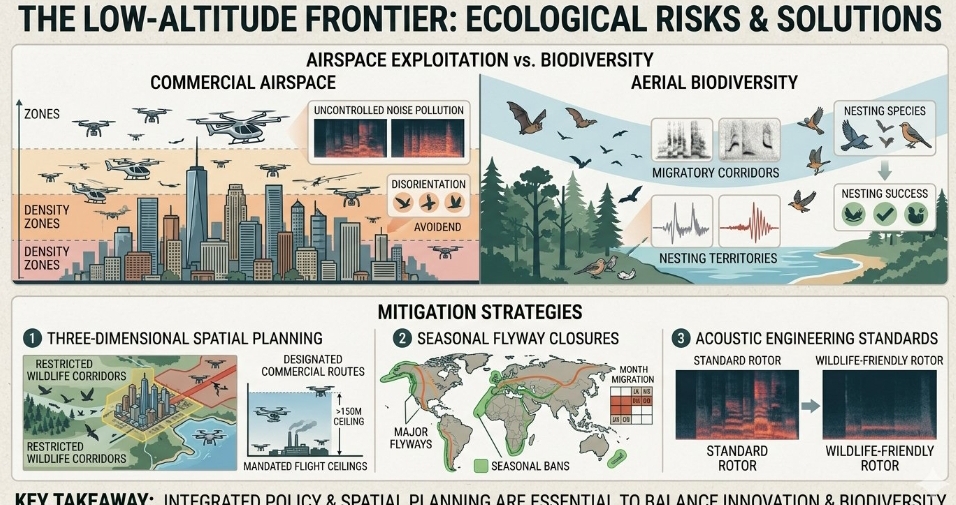
The uncontrolled commercial expansion of drone delivery networks and low-altitude transport across urban and wilderness airspaces has created a critical policy gap, directly threatening aerial biodiversity. A global macro-ecological assessment warns that as commercial investments flood the "low-altitude economy," standard conservation regulations fail to protect essential migratory routes and avian corridors from unprecedented levels of artificial airspace disturbance.
The comprehensive assessment, published in Nature Reviews Biodiversity on 22 September 2026, reveals that infrastructural developments for unmanned aerial vehicles (UAVs) and electric vertical take-off and landing (eVTOL) aircraft are advancing entirely independent of wildlife protection measures. Lead author Dr Zhen Xu pointed out that drone delivery and air taxi use are expanding rapidly without sufficient data on how continuous machinery noise, high-frequency rotor vibrations, and physical collisions affect flying organisms. The problem remains especially acute in major manufacturing and usage hubs like China, which serves as the anchor point for the global commercial civilian drone manufacturing sector.
Invisible Barriers to Aerial Connectivity
The rapid development of transport infrastructure, such as city-scale drone takeaway hubs and automated vertiports, creates widespread ecological burdens alongside its green emissions-slashing enabling effects. Wildlife ecologist Dr Sergio Lambertucci, a co-author of the study, emphasised that ecological safeguards for the shared airspace between automated drones and flying wildlife remain scarce. This lack of zoning forces birds and bats to alter critical flight trajectories, expend vital energy reserves avoiding collisions, or abandon long-established nesting areas altogether.
Furthermore, lifecycle environmental analyses show that short-range drone deliveries often require substantial energy inputs during the infrastructure and warehousing phases, leading to an overlooked ecological footprint. Conservation policy analyst Dr Xiangyi Li noted that while these autonomous networks have the potential to lower last-mile vehicle emissions, their operational reality introduces severe acoustic masking, disorienting nocturnal migratory waterbirds and breaking up delicate aerial wildlife corridors.
Editor's Note
The expansion of the low-altitude economy exposes a dangerous flaw in current environmental policy, which strictly regulates ground-level ecosystems but treats the lower airspace as an empty commercial highway. The way forward requires environmental ministries to implement immediate three-dimensional spatial planning, mandating strict low-altitude flight ceilings, seasonal drone bans along major migratory flyways, and standardised wildlife-friendly rotor acoustic engineering.


.jpg?resize=120%2C90&ssl=1)



Leave a comment