

TreeTake Network
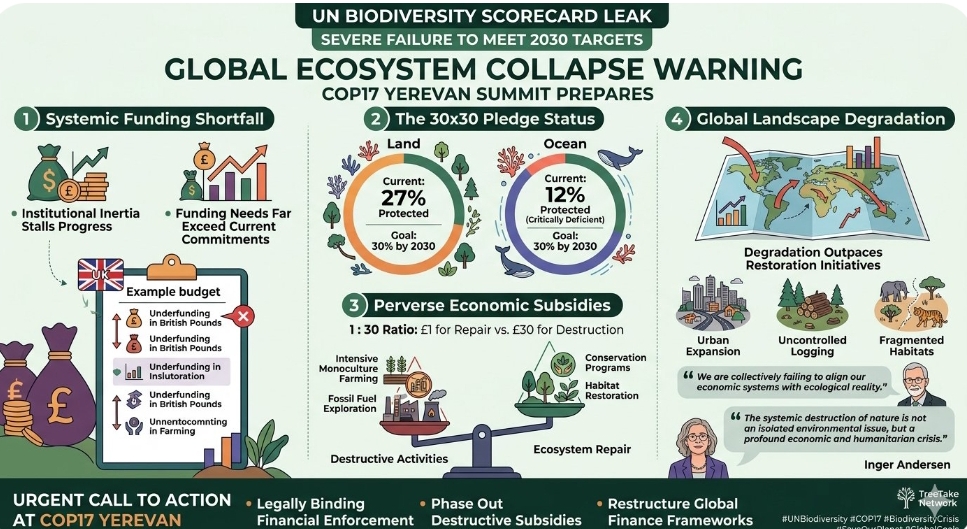
A highly confidential draft scorecard compiled by the United Nations Framework Convention on Biological Diversity has leaked ahead of the critical COP17 United Nations Biodiversity Summit in Yerevan, Armenia, revealing that nearly two hundred signatory nations are catastrophically off-track to achieve the landmark targets established to reverse global ecosystem collapse by the end of the decade. The internal review provides a damning progress assessment on the twenty-three concrete conservation goals brokered during the 2022 Montreal pact. The evaluation warns that institutional inertia, combined with a severe systemic funding shortfall, has effectively stalled global efforts to repair severely degraded land and marine environments.
The most alarming structural failure highlighted within the UN ledger focuses on the celebrated "30x30" pledge, which legally binds international governments to formalise strict protections over thirty per cent of the planet’s terrestrial and marine areas by 2030. According to the compiled state metrics, current national policies and designated sanctuaries will encompass merely twenty-seven per cent of landmasses and a critically deficient twelve per cent of global oceans by the close of the decade. This profound conservation deficit leaves immense stretches of ecologically vital marine corridors completely exposed to aggressive commercial overfishing, deep-sea resource extraction, and industrial waste dumping.
Perverse economic subsidies outstripping conservation capital
The internal documentation identifies a stark, systemic contradiction in how global public finance is allocated. Financial audits embedded within the draft scorecard show that for every single pound sterling directed toward active habitat preservation and species reintroduction programmes, approximately thirty pounds continue to flow directly into industrial activities that systematically dismantle fragile ecosystems. These immense, state-sanctioned outlays primarily manifest as massive agricultural handouts for intensive monoculture farming and deep financial relief packages for fossil-fuel exploration, which actively incentivise large-scale wilderness clearcutting and accelerate global carbon loading.
Addressing the structural gridlock, Dr David Cooper, the former Acting Executive Secretary of the United Nations Convention on Biological Diversity, observed during preparatory briefings: "The data shows we are collectively failing to align our economic systems with ecological reality. If governments do not urgently repurpose the hundreds of billions of dollars currently propping up destructive environmental practices, the targets set to preserve the very life-support systems of our planet will remain entirely out of reach."
Global landscape degradation outpaces local restoration initiatives
The report notes that whilst localised community-led preservation initiatives have achieved minor regional successes in reforesting critical catchment areas, the raw velocity of global landscape degradation continues to vastly outpace active ecosystem restoration. The rapid expansion of urban corridors, combined with uncontrolled logging across tropical and temperate zones, has left remaining wildlife populations increasingly isolated in highly fragmented, vulnerable pockets of habitat. UN analysts warn that without a dramatic, mandatory structural shift at the upcoming Yerevan summit, multiple critical ecosystems face irreversible baseline collapse.
Underscoring the critical nature of the impending diplomatic talks, Inger Andersen, the Executive Director of the United Nations Environment Programme, stated during a high-level briefing: "We cannot afford another decade of empty rhetorical promises and unfulfilled financing pledges. The leaked scorecard must serve as a severe wake-up call for every head of state; the systemic destruction of nature is not an isolated environmental issue, but a profound economic and humanitarian crisis that requires an immediate, total realignment of global finance."
Editor's Note
The leaked United Nations evaluation exposes a profound systemic failure in current global environmental governance, highlighting that international treaties are completely toothless without mandatory financial enforcement. The way forward requires delegates at the COP17 Yerevan summit to immediately establish legally binding mechanisms that penalise non-compliance and aggressively phase out destructive agricultural and industrial subsidies. True ecological stability can only be restored when international finance frameworks are heavily restructured to treat intact natural ecosystems as invaluable global infrastructure rather than free resources for exploitation.



Leave a comment