

TreeTake Network
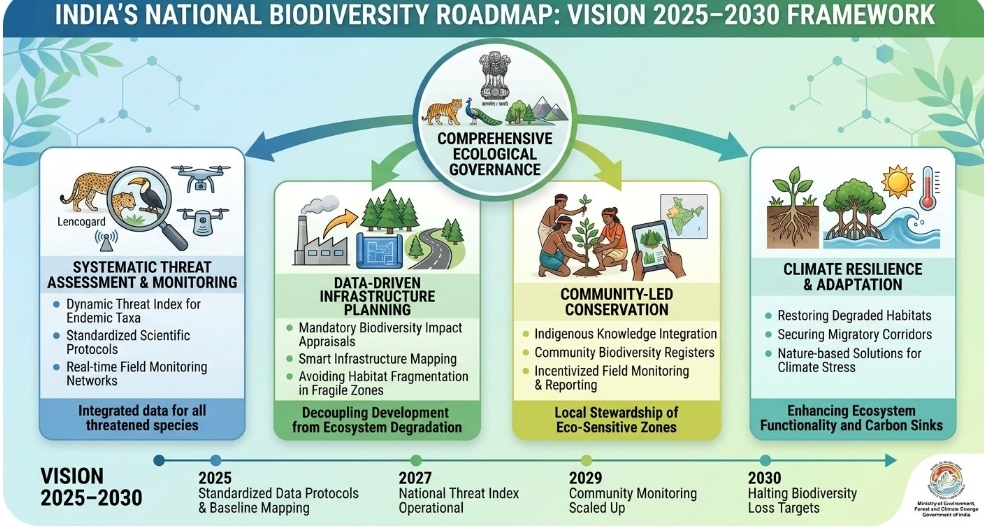
India's Ministry of Environment, Forest and Climate Change has formally finalised a comprehensive national biodiversity roadmap and Vision 2025-2030 framework. The policy document establishes systematic threat assessments and evidence-based tracking pipelines for all domestic endangered taxa. This landmark initiative aims to dramatically modernise how the country monitors its vulnerable ecosystems, ensuring that local infrastructure expansion is directly balanced against rigid environmental baselines.
The multi-year strategic framework introduces standardised scientific protocols to replace fragmented state-level tracking data. Under this roadmap, the central government will deploy an integrated network of field monitoring systems, remote sensing tools, and genetic data repositories to establish continuous tracking of threatened species across all key biogeographic zones.
Systematic Threat Tracking Across Ecologically Fragile Zones
The core objective of the Vision 2025-2030 framework is the elimination of administrative blind spots in regions facing heavy development pressure. Environmental registries will systematically catalogue species populations, habitat ranges, and specific localised stressors to create a dynamic, legally binding threat index. This digital ledger will serve as a mandatory reference point for all future infrastructure project clearances, ensuring that industrial development does not silently decimate isolated predator or floral pools.
Union Environment Ministry officials noted that the framework ensures India directly fulfils its international targets under the Kunming-Montreal Global Biodiversity Framework. A senior scientist attached to the Wildlife Institute of India explained that we can no longer rely on ad hoc surveys conducted every few years when land-use patterns are changing weekly, and this systematic roadmap ensures that every endangered taxon, from large apex predators to localised soil macrofauna, has a data-driven survival tracking matrix.
The framework also prioritises the active involvement of indigenous communities living within eco-sensitive buffer zones. Forest conservation experts emphasised that community-led monitoring networks will receive direct financial and technological support from the state, turning local traditional knowledge into structured field data to prevent illegal hunting, habitat conversion, and forest fragmentation.
Editor's Note
The finalisation of the Vision 2025-2030 roadmap marks a fundamental shift from reactive wildlife management to predictive ecological governance. The way forward requires the Ministry to maintain absolute legislative transparency, ensuring that this new digital threat index cannot be bypassed or diluted by regional political interests seeking to fast-track destructive infrastructure through protected sanctuaries.

.jpg?resize=780%2C450&ssl=1)


.jpg?resize=120%2C90&ssl=1)



Leave a comment