

TreeTake Network
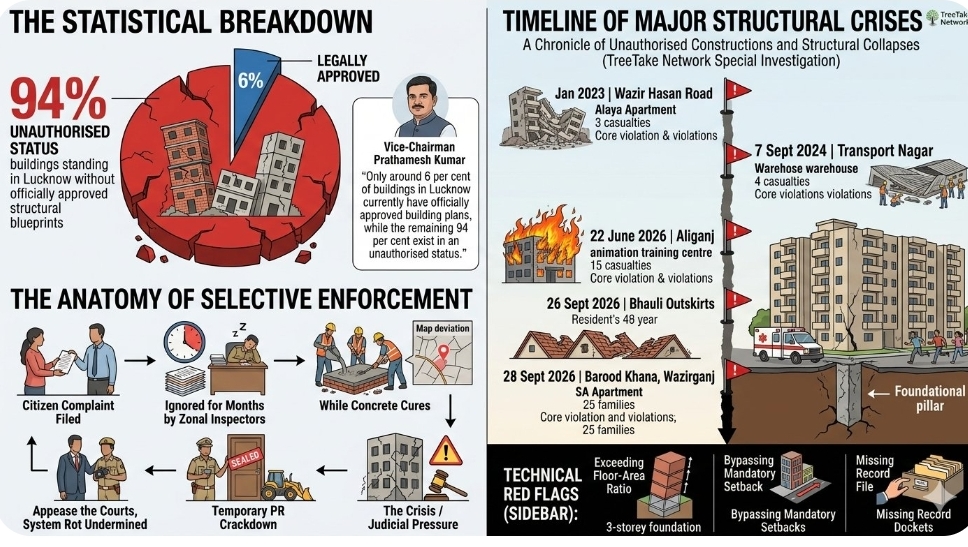
The memory of the catastrophic Aliganj inferno on 22 June 2026—where a commercial complex illegally retrofitted on a residential plot claimed 15 young lives—is not even a distant past, yet the capital of Uttar Pradesh continues to stand on a structural powder keg. A series of deeply irresponsible urban development lapses have rapidly come to the fore across Lucknow, revealing a systemic culture of administrative lawlessness. The recent dramatic structural failure of the SA Apartment building in Barood Khana, Wazirganj on 28 September 2026, where a vital load-bearing pillar abruptly sank and cracked, triggered the emergency evacuation of 25 families who were left suddenly homeless.
This near-tragedy follows the horrific Transport Nagar warehouse collapse on 7 September 2024, which killed eight people and injured 24, as well as the fatal Alaya Apartment disaster on Wazir Hasan Road in January 2023 that claimed three lives. Furthermore, relentless heavy downpours on 26 September 2026 triggered multiple roof collapses across Bhauli and surrounding outskirts, claiming the life of a 65-year-old man. Concurrently, unchecked multi-storey illegal constructions in Rajendra Nagar have further intensified public fury. Despite routine disasters, the Lucknow Development Authority (LDA) stands accused of executing highly selective enforcement measures simply to appease judicial scrutiny, while top leadership remains insulated from genuine public grievances.
Structural Pandemonium in Wazirganj
The sheer fragility of Lucknow’s rapidly expanding concrete jungle manifested in absolute panic within the densely populated Wazirganj locality between 10:30 am and 11:00 am on 28 September. The six-storey SA Apartment complex shook violently before tilting precariously, as its foundational pillar suffered a catastrophic failure. Investigations quickly revealed that the LDA had originally sanctioned a blueprint restricting the property to merely a basement and three residential floors in 2009 under the name of the owner, Shahabuddin. Instead, the builders brazenly stacked three additional floors without any structural safety assessments.
"We felt a massive tremor and heard a loud cracking sound, like a bomb going off underground," recalled Mohammad Shariq, an eyewitness and neighbouring resident. "Families ran out into the streets screaming with whatever they could carry. The structure is leaning, and if it collapses, it will take down three other adjacent houses and the main electrical line with it. The authorities only turned up with temporary hydraulic jacks after the damage was done."
Urban engineering experts argue that the incident exposes terminal flaws in regular civic oversight. "The concrete quality utilised in these unauthorised extensions lacks any load-bearing viability," noted structural engineer Dr Amitabha Mitra. "When you double the permissible floor-area ratio on a foundation built for three storeys, structural failure is not an accident; it is a mathematical certainty. The entire system relies on luck rather than enforcement."
Even local political representatives have expressed outrage at the persistent oversight gaps. Mayor Sushma Kharkwal, who arrived at the Wazirganj site to assess the emergency deployment of hydraulic jacks by the SDRF and NDRF, stated flatly, "This incident raises serious questions about construction quality and blatant violations that have been allowed to fester for years."
The Rajendra Nagar Menace and Selective Enforcement
While Wazirganj faces immediate disaster, the upscale residential enclave of Rajendra Nagar has transformed into a hotbed for illegal commercial constructions. Massive multi-storey complexes are routinely erected without approved site layouts, bypassing mandatory setbacks, fire escape corridors, and parking allocations. Residents have frequently raised alarms regarding structural encroachments that choke emergency vehicle access routes, yet construction activities continue unimpeded under the very noses of zonal inspectors.
The civic response to this crisis has exposed deep institutional bias. The LDA's recent flurry of bulldozer actions and sealing drives is widely criticised as a calculated public relations exercise designed exclusively to placate the Supreme Court and High Court benches during ongoing public interest litigations. The regulatory body’s sudden vigilance follows intense scrutiny from the apex court. During the landmark hearing of Loknathan vs State Government of Tamil Nadu, the Supreme Court demanded immediate, granular details of illegal urban projects, explicitly lambasting municipal bodies by noting, "The rampant conversion of residential zones into unchecked commercial spaces without regulatory hindrance shows a complete collapse of municipal oversight, leaving citizen safety entirely at risk."
"The authority acts only when a building is on the verge of collapsing or when the judiciary threatens contempt proceedings," stated civic activist Rakesh Dixit. "In Rajendra Nagar, formal complaints detailing blatant map deviations are deliberately ignored for months to allow builders to complete their illegal structures. Once the concrete cures, the LDA claims its hands are tied by legal technicalities. It is an entirely selective mechanism meant to create an illusion of compliance for the courts."
A Leadership Insulated from the Public
At the absolute centre of this governance deficit is the complete unresponsiveness of the top administration. Ground reports indicate that the LDA Vice-Chairman, Prathamesh Kumar, has consistently refused to grant audiences to resident welfare associations or listen to genuine, documented complaints regarding ongoing illegal constructions. When confronted with the sheer scale of urban lawlessness during a recent state administrative review, LDA Vice-Chairman Prathamesh Kumar himself offered a shocking statistical admission that left residents reeling: "Only around 6 per cent of buildings in Lucknow currently have officially approved building plans, while the remaining 94 per cent exist in an unauthorised status."
While the Vice-Chairman publicly admits to this nearly universal lawlessness, critics point out that his administration has failed to provide a proactive solution, choosing instead to issue retrospective notices after lives are lost. Following the Aliganj disaster, Kumar stated to the press, "The authority has initiated immediate demolition proceedings after finding blatant violations of construction norms, and we have ordered a strict inquiry into the role of officials responsible for monitoring the building." However, residents argue that these punitive inquiries are an afterthought.
The zonal officer, who was on the scene supervising emergency structural stabilisation works at Wazirganj, initially confirmed the steep gaps in documentation: "The map was initially sanctioned for a three-storey building. We are now being told by the owner that two additional floors were constructed after compounding, but no supporting records have been produced so far." The zonal officer further noted at the site that enforcement teams would move to structurally seal the entire multi-storey premises the moment evacuation procedures were finalised.
The institutional decay has been further laid bare by the LDA's chaotic administrative handling of the ongoing tracking records. While the authority has technically issued a fresh regulatory notice to the property owner demanding immediate explanations for the illegal extensions, officials internally concede that the agency has completely lost its own tracking mechanism. The authority has officially admitted that it is entirely unable to trace the original physical files and historic documentation pertaining to the building's compliance notices and prior engineering alerts.
Another senior administrative official, speaking on absolute anonymity, added: "The missing files relating to the Wazirganj building notices are symptomatic of a deeper rot. Dockets are routinely misplaced within the authority to shield corrupt builders. Genuine whistleblowers are stonewalled at the headquarters, while unauthorised complexes are granted implicit protection until a public catastrophe forces the executive's hand."
With structural audits now declaring the Wazirganj complex entirely unviable for human habitation, District Magistrate Vishak G confirmed that all 25 families have been permanently evacuated, with emergency accommodation arranged at night shelters for those with nowhere else to go. The LDA has now announced plans to entirely demolish the SA Apartment building, admitting that the construction quality is so poor that the option of compounding no longer exists. However, the state government faces a critical choice: completely overhaul a compromised municipal planning apparatus or wait for the next, inevitable urban tragedy to unfold.
Editor’s Note: The state of urban planning in Lucknow has crossed the boundary of mere administrative negligence and entered the realm of criminal endangerment. The transition from the Aliganj fire tragedy in June to the Wazirganj pillar collapse in September demonstrates that the lessons of blood are easily forgotten when civic bodies function as protective shields for rogue developers. The shocking admission by the LDA leadership that 94 per cent of the city's structures are unauthorised, compounded by the convenient disappearance of critical tracking files, proves that enforcement has broken down entirely. Patchwork enforcement, designed solely to satisfy Supreme Court timelines, will no longer suffice. If the leadership of the Lucknow Development Authority remains deliberately deaf to the preemptive warnings of its citizens, it must be held directly accountable for the debris that follows.
.jpg?resize=780%2C450&ssl=1)


.jpg?resize=120%2C90&ssl=1)



Leave a comment