

TreeTake Network
While the world focuses on atmospheric shifts and surface weather extremes, an invisible, multi-decadal tug-of-war raging thousands of kilometres beneath our feet is physically altering the rotation of the Earth and rewriting the exact duration of a human day.
A groundbreaking study published in the journal Nature has finally cracked the enigmatic physical mechanism behind why Earth's 24-hour day fluctuates by several milliseconds over decadal cycles. Moving past standard surface-level observations, geophysicists have successfully demonstrated that the solid, Mars-sized inner core is not only spinning independently but is actively deforming in shape, pulling the planet's rocky outer mantle along with it.
The Gravitational Torque Mechanism
For roughly thirty years, planetary scientists have tracked a mysterious phenomenon: the liquid iron outer core speeds up its rotation over a period of decades, subsequently slowing down to compensate and preserve the planet's overall angular momentum. Yet, how this massive momentum was transferred to the 3,000-kilometre-thick rocky shell of the mantle remained entirely unproven.
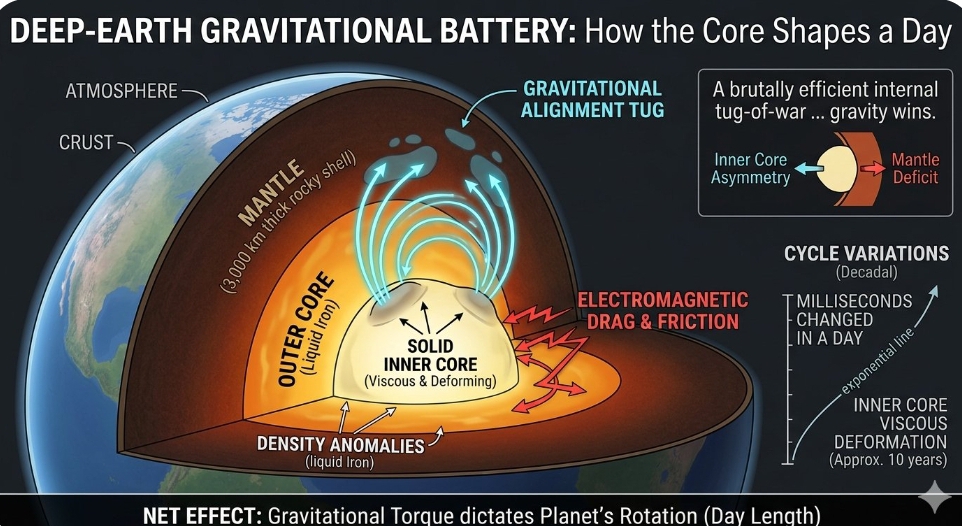
The breakthrough model reveals that the solid inner core is not a perfect sphere. As it rotates at a variable speed, it becomes misaligned with large-scale mass irregularities embedded within the surrounding mantle.
"The core fundamentally wants to be aligned," explained Dr Mathieu Dumberry, a prominent geophysicist at the University of Alberta who co-authored the investigation. "Because gravity tries to pull these massive internal layers back into a harmonic position, it exerts an immense gravitational torque that directly influences the rotation speed of the surface we live on. It is a brutal internal tug-of-war, but ultimately, gravity wins."
A Viscous, Changing Interior
The most surprising revelation of the research bypasses long-held assumptions regarding the absolute rigidity of the deep Earth. To accurately match the historical records of the planet's rotation between 1964 and 2019, the researchers discovered that the solid inner core cannot be perfectly rigid. Instead, it must be changing its physical form.
"Our data demonstrates that the inner core deforms viscously on a remarkably short timescale of about 10 years," revealed Huifeng Zhang, a geophysics doctoral researcher who spearheaded the analytical modelling. "This means the absolute centre of our planet is far more dynamic, malleable, and responsive to competing physical forces than its solid metal composition originally suggested."
This internal deformation acts as a structural buffer. While the core-mantle boundary experiences immense electromagnetic drag and friction that try to keep the layers moving in unison, the gravitational pull between the core's asymmetry and the mantle's density anomalies acts as the dominant accelerator or brake.
Deep Planetary Implications
By reconstructing decades of seismic velocity measurements and shifts in the global magnetic field, the research team proved that small variations in day length are not random anomalies. They are the direct consequence of this profound sub-surface friction. While a shift of a few milliseconds is completely imperceptible to human daily routines, it is a critical variable for high-precision satellite navigation, deep-space communication tracking, and understanding the thermal evolution of our planet.
Editors Note
TreeTake Network highlights this research as a paradigm shift in deep-earth geodynamics. By providing concrete mathematical proof of gravitational coupling between the core and the mantle, these findings ground our understanding of the planet's internal magnetic engine and provide structural engineers and global timekeepers with highly precise metrics to calibrate spatial navigation networks.



Leave a comment