

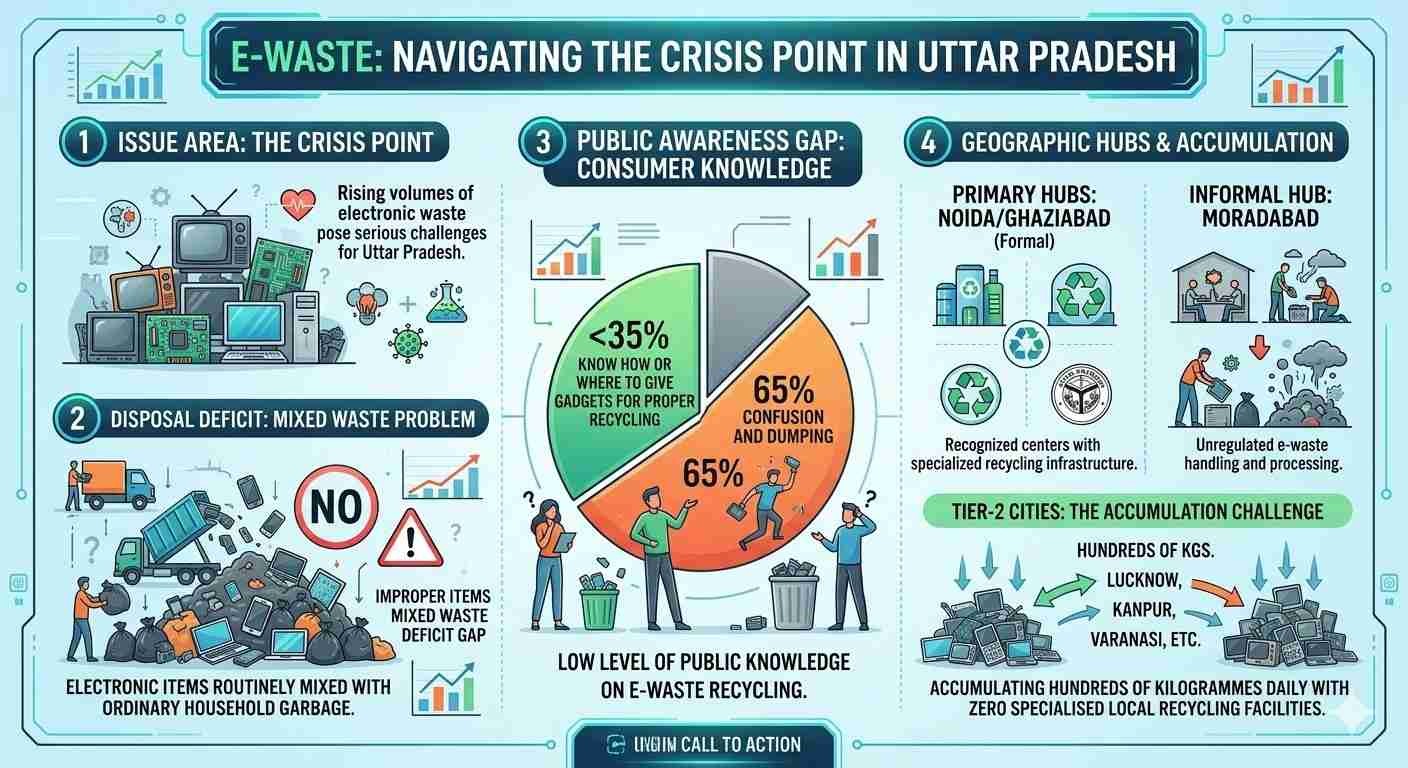
The rapid surge in upgrading our gadgets has turned tech trash (e-waste) into the world’s fastest-growing municipal waste stream, creating a massive disposal crisis. Because formal recycling systems cannot keep pace, millions of tonnes of obsolete electronics are improperly discarded annually, creating severe ecological and human health hazards. TreeTake looks at how the afterlife of tech trash affects people and the environment, and explores how to meet the challenge…
Walk through the bustling tech markets of Delhi, Bengaluru, Mumbai or even Lucknow, and you will see the vibrant pulse of a hyper-connected India. But follow that trail of discarded circuit boards, cracked screens and dead batteries and you arrive at the quiet, toxic underbelly of our digital revolution. India’s relentless appetite for tech has triggered an unprecedented e-waste crisis, outstripping the nation's formal recycling infrastructure. Far from high-tech, zero-emission processing facilities, this modern waste stream is largely managed by an unorganised army of waste pickers working without protective gear. As toxic elements like lead, mercury and cadmium leak into the soil and water tables, a profound question emerges: Can a nation truly claim to be technologically advanced if it cannot cleanly sweep up after its own progress? India ranks as the world's third-largest generator of electronic waste, producing millions of tonnes annually while formally recycling only a small fraction of it. Indian experts highlight that India is the third-largest e-waste generator globally. They point out that while Extended Producer Responsibility (EPR) laws are getting stricter, a massive portion of the crisis stems from the struggle between primitive informal dismantling and formal circular economies.
The electronic waste (e-waste) problem in Uttar Pradesh (UP), particularly the state capital, Lucknow, is also acute. Here experts observe a striking paradox: the state has officially emerged as India’s top state in formal e-waste recycling capacity, yet it simultaneously battles deep-rooted public health and environmental damage stemming from localised informal dismantling centres. The state has a total of 82 government-approved recycling units. Data released by the Ministry of Environment, Forest and Climate Change (MoEFCC) shows that UP led the nation by recycling 3,76,896 metric tonnes of digital waste.
What exactly is e-waste?
Electronic waste, or e-waste, refers to any discarded electrical or electronic device, as well as its components or spare parts. Essentially, if a product plugs into a wall, runs on batteries, or has a circuit board, it becomes e-waste once it is broken, obsolete, or no longer wanted. As modern gadgets are a complex mix of valuable materials and highly toxic chemicals, they cannot be disposed of like ordinary trash.
E-waste is generally grouped into a few major categories:
Personal & office electronics: Smartphones, laptops, desktop computers, tablets, routers, monitors and keyboards.
Large household appliances: Refrigerators, washing machines, air conditioners, microwaves and television sets.
Small consumer gadgets: Digital cameras, smartwatches, electronic toys, power banks and headphones.
Cables & components: Power cords, chargers, printed circuit boards (PCBs), lithium-ion batteries, and LED bulbs.
Why e-waste is a serious problem
Unlike organic waste or basic plastics, e-waste presents a dual challenge of extreme toxicity and lost resource value:
The toxic threat: Electronics contain hazardous heavy metals and chemicals like lead, mercury, cadmium and brominated flame retardants. If dumped in ordinary landfills or burned improperly, these toxins leach into the soil and groundwater or escape into the air, causing severe neurological, respiratory and reproductive damage to humans and animals.
The ‘urban mine’ (lost value): Electronics are rich in precious metals like gold, silver, copper and platinum. When e-waste is thrown into standard trash bins, these valuable, finite resources are permanently lost to landfills instead of being recovered and reused.
Key aspects of the crisis
Massive volume: India generates millions of tonnes of e-waste each year, driven by rapid digital consumption and a severe capacity gap where generation far outpaces formal processing infrastructure.
Dominance of the informal sector: Over 90% of e-waste is handled by the informal sector (such as local scrap dealers or kabadiwalas), using crude methods like open burning and acid baths.
Environmental damage: Improper dismantling and burning release toxic pollutants like lead, mercury, arsenic and dioxins, severely contaminating local air, soil, and groundwater systems.
Health hazards: Workers—including women and children in informal hubs—face extreme risks of respiratory illness, neurological damage and organ failure due to unprotected exposure to toxic heavy metals. • Regulatory challenges: While frameworks like Extended Producer Responsibility (EPR) exist to hold manufacturers accountable, poor enforcement, low consumer awareness and traceability gaps hinder effective management.
The primary factors driving this acute crisis span environmental, health, and structural dimensions:
1. The paradox of big capacity vs. informal reality. The leading recycler: According to the Ministry of Environment data, UP officially led India by recycling 376,896 metric tonnes of e-waste. Most of this formal activity is clustered in the industrialised Noida and Ghaziabad corridors.
The shadow economy: Despite this huge formal footprint, the vast majority of consumer e-waste across the state still flows into the unorganised sector. Moradabad has infamously evolved into one of India's largest informal e-waste hubs. Local workers—often families working out of basements or rooftops—manually dismantle gadgets to recover precious metals like gold, copper and silver.
2. Severe health and environmental hazards
In the informal hubs, e-waste processing is done using primitive, dangerous methods:
Toxic fumes: Workers melt circuit boards over open flames or use crude acid baths to extract gold, releasing lethal lead, mercury, and cadmium vapours.
Groundwater contamination: Acidic waste and hazardous chemical residues are often dumped straight into local soil or rivers (like the Ramganga in Moradabad). This has forced intervention from the National Green Tribunal (NGT) due to severe groundwater contamination.
The Energy and Resources Institute (TERI) outlines the immediate public health crisis of urban, unorganised processing: “If e-waste is dismantled and processed crudely, its toxic constituents can wreak havoc on the human body... manual extraction of toxic metals leads to the entry of dangerous material in the bloodstream”.
Lopsided infra in UP
The regional divide (The Noida-Ghaziabad Corridor vs. the rest of UP): Industrial and logistical experts point out that UP’s infrastructure is heavily lopsided.
The structured west: The Noida and Ghaziabad corridor has become the industrial focal point for formal waste management. Under the Central Pollution Control Board (CPCB) guidelines, this region is driving a massive transition toward certified recycling centres.
The central and eastern treatment deficit: Experts warn that key urban hubs like Lucknow, Varanasi and Gorakhpur remain critically short of operational treatment plants. Local UP Pollution Control Board (UPPCB) officials admit that while tech is collected and dismantled locally, actual processing is forced back toward the west, causing local e-waste to slip routinely into standard household landfills.
The Moradabad crisis (The backyard recycling hub): Environmental safety analysts look at Moradabad as a primary cautionary tale of informal hazards. After the decline of its famous brass industry, the city’s unorganised sector pivoted heavily into informal e-waste processing. Labourers here handle circuit extraction via manual hammering, acid-washing components to draw out gold or silver, and open-air burning of motherboards. This takes a heavy ecological toll. Experts warn this releases a severe volume of toxic lead, mercury and acid fumes, deeply poisoning local soil, air, and the Ramganga River ecosystem.
3. The localised urban crisis (e.g., Lucknow): While the Noida region handles industrial e-waste, tier-2 cities face an absolute infrastructural vacuum.
No local processing: Major municipal hubs like Lucknow generate roughly 200 kg of e-waste daily from bustling commercial markets. However, the city lacks local authorised facilities to process it scientifically.
Mixed garbage streams: As municipal bodies do not segregate electronic items at the source, discarded phones, chargers and batteries are thrown straight into domestic trash bins, ending up in regular landfills.
4. Gaps in consumer awareness: Public behaviour remains a massive hurdle to formalising e-waste management. Studies show that only 37% of electronics users in cities like Lucknow are aware that e-waste causes severe health risks.
Around 87% of citizens are completely unaware of government e-waste guidelines. Most prefer to stockpile old tech in their homes, sell it to local scrap dealers (kabadiwalas), or throw it out with everyday trash.
State capital scene
Lucknow produces nearly 200 kg of electronic waste every day, yet the city's e-waste hazard is amplified by unique structural gaps and local consumer patterns. A recent study by King George’s Medical University (KGMU) highlighted severe public health and environmental threats stemming from specific local causes:
1. Zero local processing infrastructure: Despite a high volume of gadget accumulation from heavy commercial electronics hubs like Naza Market, Naka Market, Amber Market and Hazratganj, Lucknow does not have an active, authorised scientific recycling plant. A treatment facility previously established near Mohanlalganj has shut down. As a result, any formally collected e-waste must be transported out of the city to western Uttar Pradesh (such as Ghaziabad or Meerut) for safe processing.
2. High concentration of informal backyard workshops: As formal pathways require cross-state or cross-district transit, local scrap dealers, ragpickers and informal handlers dominate disposal. They pull apart computers, phones and batteries in residential areas without safety gear. To extract valuable metals like copper and gold, informal workers utilise dangerous, crude methods. Open-air burning of PVC cables and plastic casings releases highly toxic dioxins and fine particulate matter, causing severe respiratory conditions. Splashing strong acids over circuit boards releases heavy chemical residues directly into local sewers.
3. Mixing with ordinary household garbage: As municipal segregation is poorly enforced, everyday consumers regularly throw small electronics, dead batteries and chargers into standard domestic bins. This mixed municipal solid waste ends up in city landfills, where toxic heavy metals—such as lead, mercury, cadmium and arsenic—leach directly into Lucknow's soil and groundwater systems.
4. Low consumer awareness and behavioural habits: Local community studies reveal a significant lack of awareness regarding e-waste hazards. Roughly 63% of consumers in Lucknow are unaware that improper e-waste handling severely impacts health. More than 87% are entirely unfamiliar with official e-waste management guidelines. Instead of handing products back to manufacturers or verified drop-offs, residents historically stockpile unused gadgets at home indefinitely or sell them directly to unauthorised kabadiwalas. Several verification programmes and e-waste collection channels operate in Lucknow, offering sustainable drop-off or doorstep pickup solutions. Yet they are rarely used.
When electronic waste is improperly handled, burned, or dumped in municipal garbage bins, it transforms from a pile of dead gadgets into an active public health and environmental crisis. A July 2026 landmark study by researchers at King George’s Medical University (KGMU) investigated local electronic waste handling and public health risks in Lucknow. According to the local KGMU study and global health data, the physical dangers are divided into direct human health impacts and severe environmental damage.
Direct human health dangers
Electronics contain a cocktail of toxic heavy metals and chemicals. When informal workers smash or burn them without protective gear, these toxins enter the body:
Lead (from circuit boards & CRT monitors): Causes irreversible brain and central nervous system damage, particularly in children. It leads to blood disorders, severe kidney damage and developmental delays.
Mercury (from switches & flat screens): Chronic exposure targets the brain, destroying fine motor skills and memory. It can also harm the immune system and cause foetal development issues in pregnant women.
Cadmium (from laptop batteries & resistors): An extremely potent carcinogen linked directly to lung cancer, chronic kidney failure and the weakening of bone density.
Dioxins and furans (from burning plastic cables): Inhaling the thick black smoke produced by burning PVC wires triggers immediate respiratory illness, severely damages immunity and increases long-term cancer risks.
Local environmental hazards
As Lucknow mixes its daily e-waste directly with household trash, the toxic aftermath spreads into the broader community:
Groundwater poisoning (leaching): As heavy rain falls on open dumping grounds, heavy metals leach and sink deep into the earth. This permanently contaminates the local water table, allowing toxins to seep into residential tube wells and bore wells.
Food chain contamination: Toxins accumulating in the soil are absorbed by local crops and vegetation. Animals grazing near waste sites ingest these chemicals, eventually passing high concentrations back to humans through meat and milk.
Dr Mangal Deep Gupta, Assistant Professor, Department of Electronics and Communication Engineering, Babasaheb Bhimrao Ambedkar Central University, Lucknow, said: “Rapid urbanisation, increasing use of electronic products, short product life cycles and frequent replacement of gadgets have made e-waste, including mobile phones, computers, televisions, refrigerators, air conditioners, printers, batteries, chargers and other electronic devices an important environmental problem in cities such as Lucknow, not to speak of Uttar Pradesh or India. Rapid technological development and replacement of old devices continuously increase the amount of electronic waste generated. Major problems are that the burning of wires and circuit boards and unsafe recovery of metals can expose workers and nearby communities to toxic substances and lead to the loss of valuable resources like copper, aluminium, iron, gold and other valuable components. E-waste should be managed by promoting the repair and reuse of electronic products that can be repaired, refurbished and reused instead of immediately being discarded. This reduces both e-waste generation and demand for new raw materials. Collected e-waste should be transported to authorised recyclers for dismantling and recovery of valuable materials. Households, offices, schools, colleges and businesses should keep e-waste separate from wet and dry municipal waste. Old computers, mobile phones, printers, televisions and other electronic equipment should be handed over to authorised collection agencies. Electronic waste should be managed by the establishment of an integrated system based on Reduce, Repair, Reuse, Recover and Recycle.”
Researcher Ritu Rajput (KGMU study co-author) formally raised the alarm on infrastructure gaps, stating: “Scientific e-waste processing units must be set up, as e-waste is often mixed with household garbage and ends up in landfills or informal workshops.”
Anil Singh Chauhan (authorised E-Waste Centre operator, Lucknow) verified the transit issues forcing trash out of the city, noting that because Lucknow completely lacked a local functional recycling facility, all collected e-waste had to be packaged and transported outside the city boundaries to formal plants.
An environmentalist, requesting anonymity, issued a stern warning to civic planners, urging the immediate establishment of neighbourhood collection centres and a localised plant, warning that the city’s growing electronic footprint threatened public health.
Course of action
To solve Lucknow’s e-waste crisis, action is required at three levels: local government infrastructure, strict corporate enforcement and a major shift in public behaviour.
The primary solutions required to fix the systemic problem include:
1. Building local processing facilities
Lucknow must establish at least one authorised, scientific recycling plant within district lines. Processing e-waste locally eliminates the costly logistics of shipping waste to western Uttar Pradesh, making formal recycling financially viable for local scrap collectors.
2. Formalising the informal sector
Instead of banning local kabadiwalas, the municipal corporation should integrate them into the safe supply chain. Training programmes: Provide informal workers with basic safety gear and tools to dismantle electronics safely without using fire or acid. Collection incentives: Pay informal collectors a fair market rate to bring raw e-waste to authorised municipal collection hubs instead of processing it in backyard workshops.
3. Implementing strict municipal segregation
The Lucknow Municipal Corporation (LMC) needs to enforce mandatory three-way waste segregation at the household level: wet waste, dry waste and domestic hazardous waste (electronics and batteries). Dropping electronic waste into standard green or blue bins must be penalised.
4. Enforcing corporate accountability (EPR)
Electronics brands selling products in major local markets like Naza Market and Hazratganj must be held strictly accountable to India’s Extended Producer Responsibility (EPR) mandates.
Take-back schemes: Brands must set up highly visible physical drop-off kiosks in electronic markets.
Financial incentives: Companies should offer clear buy-back discounts or cash incentives to consumers returning old laptops, chargers or phones.
Policy groups note that the UP government is rolling out targeted, modern countermeasures to bridge systemic vulnerabilities. There is the Paryavaran Mitra Scheme, an active transition programme aimed at formalising thousands of backyard informal scrap workers into organised, safe recycling roles. Steps are underway for industrial shared infrastructure, like building new e-waste and battery recycling clusters near Kanpur and Agra equipped with Shared Effluent Treatment Plants (CETPs) to lower the steep operational compliance costs for smaller green entrepreneurs.
Immediate individual steps
Never throw electronics in the trash: Securely store old devices until you can dispose of them safely.
Use digital pick-up services: Utilise local doorstep scrap pick-up applications that guarantee safe delivery to authorised dismantlers.
Wipe personal data first: Always perform a factory reset on your phones and laptops before handing them over to secure your privacy.
Extend device lifespans: Clean dust from your gadgets, update software regularly and protect devices with cases to prevent early upgrades or replacements.
Choose repairability: Support modular product designs and buy from brands that offer official repair paths and take-back schemes.
So, to put it in a nutshell: rapid escalation of electronic waste represents a critical turning point for urban environmental policy, highlighting the profound dangers of unchecked technology consumption outstripping municipal regulatory frameworks. Addressing this compounding hazard requires moving far beyond superficial clean-up drives; it demands a fundamental restructuring of urban waste management systems. State and local administrations must bridge the massive infrastructure gap between formal recycling zones like Noida and underserved Tier-2 hubs by establishing specialised, accessible electronic buy-back centres. Concurrently, rigorous consumer education initiatives are urgently needed to elevate public recycling awareness from its dismal sub-35 per cent baseline. As eminent geoscientist Dr C.P. Rajendran notes: "The toxic footprint of our digital dependence is quietly seeping into the hydrological and terrestrial matrices of our cities. When heavy metals from unscientific electronic disposal breach urban water tables, we are no longer just dealing with a waste crisis—we are looking at an irreversible ecological and public health emergency that bureaucratic delays will only worsen."
Ultimately, managing e-waste is not merely a technical challenge, but a vital public health imperative. It is a test of sustainability and consumer responsibility. As electronic devices continue to drive human progress, society can no longer afford the "take-make-waste" model that treats precious, toxic materials as disposable junk. Failure to enforce structural separation at the source and eliminate toxic, informal processing loops will inevitably ensure that the very gadgets designed to connect society will permanently contaminate the soil and water systems that sustain it. The choice is clear: either we revolutionise how we manage our digital debris today, or we allow tomorrow’s innovation to bury the planet in toxic waste.



Leave a comment