

TreeTake Network
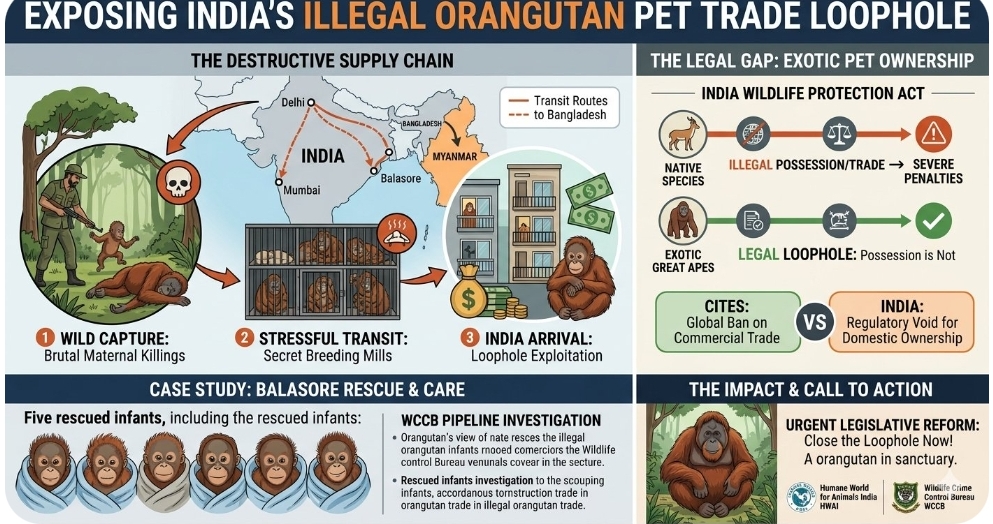
The recent interception of five infant orangutans in the Balasore district of Odisha has exposed a deeply unsettling vulnerability in India’s environmental governance: the country's lack of strict laws on the private ownership of great apes is actively fuelling the illegal international wildlife trade. This alarming pattern, formally flagged by the organisation Humane World for Animals India (HWAI), exposes a thriving black market driven by wealthy private collectors. Wildlife experts and conservationists warn that behind the appeal of these exotic animals lies an incredibly brutal supply chain characterised by maternal killings in the wild and inhumane captive breeding practices.
The Domestic Legal Grey Area
At the heart of the crisis is a significant regulatory loophole regarding exotic wildlife inside India. While India is a signatory to the Convention on International Trade in Endangered Species of Wild Fauna and Flora (CITES)—which strictly prohibits the commercial international trade of critically endangered species like orangutans—and possesses a rigorous domestic framework for native species under the Wildlife Protection Act, the domestic possession of non-native great apes remains a legal grey area. Commenting on this vulnerability, Sumanth Bindumadhav, the Director of Wildlife Protection at HWAI, noted that "India lacks a comprehensive legislative mandate declaring great apes entirely unsuitable for private captivity." He further emphasised that "because the mere possession of these exotic animals inside a private home is not thoroughly criminalised or regulated, affluent buyers face few legal repercussions once the animals clear the borders, transforming India into a lucrative destination for international smugglers." This regulatory failure creates a continuous pull factor for the black market, as evidenced not only by the recent crisis in Odisha but also by previous high-profile seizures, such as a juvenile orangutan discovered during a law enforcement raid on a private apartment in Mumbai.
The Tragedy of Maternal Killings
The supply chain required to meet this private demand is devastatingly destructive, directly linking the acquisition of exotic pets to what conservationists call maternal killings. In their natural habitats across Southeast Asia, baby orangutans share an incredibly intense bond with their mothers, remaining entirely dependent on them for up to seven years and clinging tightly to them high in the rainforest canopy. Wildlife experts point out that "it is biologically and physically impossible for poachers to separate an infant orangutan from its mother without using lethal force against the adult female." Consequently, to capture five healthy, uninjured infants for the illegal market, multiple wild mother orangutans were almost certainly slaughtered by poachers. For the infants that do not originate from the wild, the reality is equally grim, as they are often born into highly stressful, unlicensed commercial wildlife mills or secretive breeding facilities in transit countries, where "adult apes are subjected to brutal captive breeding conditions solely to supply profitable offspring to trafficking networks."
The Odisha Rescue Operations
The operational response to the smuggling pipeline came to a head when authorities successfully intercepted the traffickers. Providing details on the dynamic field operation, Balasore Divisional Forest Officer Prateek Indalkar confirmed that teams managed to successfully "secured all five animals without using tranquillisers." Highlighting the immediate results of the raid, Prakash Chand Gogineni, the Regional Chief Conservator of Forests (RCCF), formally announced, “We have rescued all of them. Of the five, three are male, and two are female.” The five rescued orangutans, estimated to be a mere six to eight months old, were found abandoned in a casuarina plantation in Odisha, likely dumped by an international smuggling syndicate attempting to evade intensifying law enforcement checkpoints. Following their rescue, the traumatised infants were transported to the Nandankanan Zoological Park, where they have been placed under strict medical quarantine and round-the-clock monitoring by veterinary specialists.
Investigation Status & Pipeline Analysis
Following the immediate rescue operations, a deeper investigation was jointly launched by the Odisha Police Special Task Force (STF), the state Forest Department, and the federal Wildlife Crime Control Bureau (WCCB). Acknowledging the scale of the ongoing probe, Ganesh Ram Singhkhuntia, the Odisha Forest and Environment Minister, briefly stated that "the matter is under active investigation." Highlighting the obvious cross-border nature of the crime, wildlife researcher and conservationist Uttara Mendiratta remarked that “Orangutans can't just land up in Odisha. This incident is obviously linked to wildlife trafficking." Intelligence teams discovered that the five infants were abandoned in a casuarina plantation within the Udaipur-Talsari forest area of the Jaleswar Range in Balasore, approximately 40 kilometres from National Highway 16. Because this remote drop-off point closely borders West Bengal, investigators suspect the animals were transported across state borders via land routes after entering India through porous international entry points, such as the Indo-Bangladesh or Indo-Myanmar border. Financial data gathered by the WCCB reveals the high-stakes nature of this trade, noting that a single juvenile orangutan can command anywhere between ₹20 lakh and ₹25 Lakh on the Indian domestic black market, bringing the total estimated street value of this single intercepted shipment to over ₹1 Crore.
Legal Protections vs. Enforcement Constraints
While India prides itself on stringent wildlife preservation laws, the "exotic" loophole presents unique obstacles that frustrate field officers. Currently, once an exotic animal successfully bypasses the border undetected by customs officials, domestic prosecution becomes incredibly difficult because under Section 11A of India's Wildlife (Protection) Act, absolute domestic penal power is largely reserved for native Indian species. For non-native species, enforcement agencies like the WCCB have to heavily rely on the Customs Act, 1962, which primarily penalises the act of illegal importation rather than domestic possession. This shifts a massive burden of proof onto the state; if an affluent individual is caught housing an exotic ape in a private estate, officers must prove the animal was smuggled into the country illegally. Without a clear paper trail, collectors exploit this gap, claiming the animal was bred locally in captivity, rendering law enforcement virtually powerless to seize the animal or prosecute the keeper.
Medical Status and Rehabilitation Hurdles
The five rescued primates are currently housed under strict isolation at the Nandankanan Zoological Park in Bhubaneswar to address immediate medical and long-term survival concerns. Upon arrival, veterinary specialists noted high levels of psychological trauma and mild dehydration, though four out of five were stable enough to accept food normally. Beyond immediate medical stability, their long-term legal custody remains undecided. An anonymous senior Forest Department spokesperson stated that “the decision on whether the orangutans will be kept in captivity for public viewing will be taken by the authorities at the Centre and in the State.” Meanwhile, repatriation remains a highly complex hurdle. While geneticists are actively conducting DNA sequencing to pinpoint whether the infants belong to the Bornean (Pongo pygmaeus), Sumatran (Pongo abelii), or Tapanuli (Pongo tapanuliensis) lineages, returning them to Southeast Asia requires complex cross-border treaties and an absolute confirmation of their wild origins. Consequently, conservationists acknowledge these infants will likely remain in long-term sanctuary care inside India, serving as living reminders of a broken legal framework.



Leave a comment