

TreeTake Network
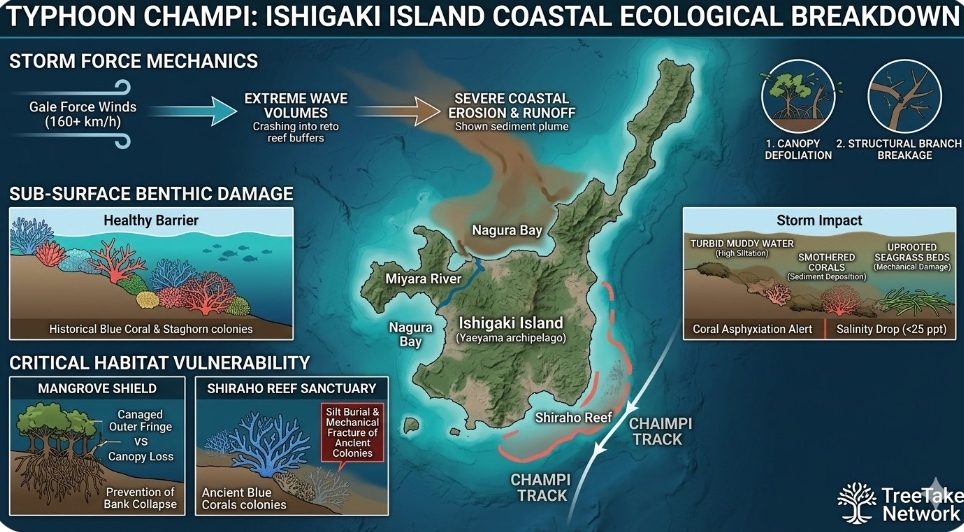
Technical monitoring teams and marine ecologists have deployed field tracking assets along the fragile coastlines of Ishigaki Island to evaluate sudden environmental terrain damage as Typhoon Champi sweeps across Japan’s southwestern Okinawa Prefecture. The severe tropical system, packing sustained gale-force winds and massive wave volumes, has made direct contact with the ecologically sensitive Yaeyama archipelago. Field monitoring networks indicate that the storm's intense coastal surge is subjecting the island's unique coral reef buffers and vulnerable mangrove estuaries to extreme physical stress, raising immediate conservation alerts over localized habitat destruction.
The geographical position of Ishigaki Island makes its fringing coral systems particularly vulnerable to severe meteorological disruptions. The island is home to the Shiraho reef, a globally significant marine sanctuary containing massive, centuries-old blue coral (Heliopora caerulea) colonies that are highly sensitive to sudden mechanical damage and terrestrial sediment runoff. Preliminary satellite data and shoreline observation posts show that the heavy storm surge is causing severe coastal erosion, pulling thousands of tonnes of upland clay and topsoil directly into the shallow lagoon waters, which threatens to smother these delicate marine organisms under thick layers of silt.
Dr. Kenji Takahashi, Principal Ecologist at the Ryukyu Marine Research Laboratory, expressed serious concerns regarding the long-term biological recovery of the island's marine zones. According to Dr. Takahashi, while healthy coral ecosystems possess a natural historical resilience to seasonal storms, the current baseline conditions are highly compromised due to rising sea temperatures and historical coral bleaching events. The massive wave action generated by Typhoon Champi is physically snapping delicate staghorn corals and uprooting extensive patches of intertidal seagrass beds. Takahashi warned that the high volume of muddy freshwater pouring from swollen inland streams will drastically lower local salinity levels in the bays, threatening to trigger a secondary, catastrophic die-off of reef-associated organisms over the coming days.
The environmental stress extends heavily onto the island's terrestrial-marine interface, specifically targeting the vital mangrove forests lining the mouth of the Miyara River. These dense mangrove networks serve as a critical defensive shield against coastal erosion and function as a primary nursery habitat for rare estuarine fish and crustacean species. High-velocity wind gusts have caused extensive canopy defoliation and structural branch breakage across the outermost forest fringes, though the deep root networks appear to have successfully prevented catastrophic bank collapses so far.
As the core of Typhoon Champi moves northwestward into the East China Sea, the Japanese Ministry of the Environment is preparing to deploy autonomous underwater vehicles and specialized dive teams to conduct comprehensive sub-surface biodiversity mapping. The data gathered from these real-time storm assessments will be critical in designing future ecological restoration frameworks, helping regional authorities reinforce natural coastal barriers against increasingly severe weather patterns across the Pacific frontier.
Editor's Note
The environmental impact of Typhoon Champi on Ishigaki Island highlights the urgent need to integrate natural ecosystem health directly into national coastal defense strategies. Mechanical storm damage and sudden terrestrial siltation are no longer isolated natural events; they act as severe accelerators of decline on marine habitats already weakened by global climate shifts. Moving forward, disaster risk management agencies must treat fringing coral reefs and mangrove estuaries as critical living infrastructure, implementing strict upland soil-retention zones and comprehensive marine buffer protections to ensure these vital natural shields can survive the intensifying storm patterns of the future.



Leave a comment