

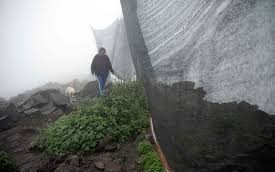
Fog harvesting, a relatively new concept, is essential to mitigate acute water scarcity, support agriculture in arid regions, reduce drought impacts, and provide fresh drinking water to remote or arid, high-altitude communities, according to experts. It helps replenish reservoirs, increases snowpack for future meltwater and aids in wildfire suppression. TreeTake takes a look …
For natives of Cape Verde, an archipelago off the west African coast, water scarcity was a pressing challenge till they resorted to a centuries-old, but overlooked hydroclimatic technique—fog harvesting. The harvested water supports agroecological restoration by irrigating endemic trees, fruit crops, forest species, and fodder plants. It promotes soil recovery, enhances biodiversity conservation, and provides nutritional security for local people and livestock.
Fog harvesting, an innovative "green technology," offers a lifeline to arid regions where traditional water sources like rain and groundwater are nonexistent. By mimicking natural processes—such as how the Namibian desert beetle or redwood trees capture moisture from the air—this technology extracts potable water from wind-driven fog using simple mesh structures. Fog harvesting utilises biomimetic, 3D-printed, or mesh materials to extract potable water from atmospheric moisture. Experts note the technology is highly viable in arid and mountainous areas, including parts of India, by creating water for consumption and agriculture without requiring energy-intensive infrastructure.
Several experts in India and abroad are in favour of the concept. "There are several plants in arid and semi-arid regions of the world leaves of which can harvest water from dew and fog. If they can do it, so can we," Dr Venkata Krishnan, Associate Professor at IIT Mandi, was quoted as saying. To note, IIT Mandi researchers have developed a biomimetic material inspired by the Dragon’s lily (Gladiolus dalenii) and Bermuda grass, capable of harvesting potable water from fog, capturing 230% more water than unpatterned surfaces. This sustainable technology utilises 3D-printed, conical, and grooved structures to condense and collect atmospheric moisture in water-stressed, mountainous regions. The material mimics the surface properties of plants that excel at capturing water from the air. The team used 3D printing to create special surfaces with well-arranged conical spines and gradient grooves to enhance water collection efficiency. The study was published in the journal ACS Sustainable Chemistry and Engineering, focusing on collecting water from fog and mist in water-stressed environments. The designed structures trap water droplets from the air, which then condense and are collected, similar to how natural surfaces or mesh nets function. The technology aims to provide a sustainable source of drinking water for areas with low rainfall, utilising natural atmospheric moisture. A fog-harvesting pioneer and Chilean expert said: "I think we are beginning a new stage of collecting fog. We are moving on from an artisanal phase to an industrial one." "Where there's fog, we can harness it for the community... instead of looking for very expensive and fossil-based solutions like desalinating water," Moroccan expert Dr Jamila Bargach was quoted as saying by a news network.
According to Dr Vibhuti Rai of Lucknow University, “In many parts of the world, water scarcity can be eliminated by collecting atmospheric water through methods such as fog collection. Fog harvesting uses specialised mesh nets to capture small water droplets from fog. In this method of drinking water, air moisture is condensed into liquid form, and it is most viable in dry and semi-dry or arid zones, as there are few traditional sources of water. It is passive, needing no electricity and making it an eco-friendly solution for communities that may be facing water shortage. The nets are usually made of fine mesh held between two poles. They are set up in fog-prone regions, such as coastal or mountain areas. As fog flows through the mesh, water droplets accumulate and coalesce onto its surface. The droplets drip into a container below and are funnelled into storage tanks. Studies show that one square metre of mesh can collect 2.5 to 10 litres of water per day, depending on the environmental conditions and fog density. This technology is cost-effective and requires low maintenance, so it can be implemented for communities that do not have the proper infrastructure in place for water supply systems. As large fog collectors can produce significant amounts of water without energy-intensive pumping systems, this technology may be a more sustainable option for providing fresh drinking water to regions struggling with scarcity. Although fog harvesting is a new concept in India, a few viable places where freshwater is scarce and this technology can be effective are Ladakh, the northeastern states, the mountainous regions of Uttarakhand, Himachal Pradesh and the Thar desert. In our view, local modification of the system using local natural material can add value for its implementation in specific Indian conditions.”
How fog harvesting works
The process of fog harvesting is a passive one, requiring no external energy. It relies on the physical interception of microscopic water droplets (1–40 µm in diameter) suspended in the air. Interception: Wind pushes fog through a vertical mesh, typically made of UV-stabilised polypropylene or polyethene. Coalescence: As droplets hit the mesh filaments, they stick and merge. High-tech "harps" (vertical-only wires) or double-layered Raschel mesh are often used to prevent clogging and speed up this process. Collection: Once the droplets grow large enough, gravity pulls them down into a trough or gutter. Storage: The water is channelled through pipes into storage tanks or cisterns. In many systems, the storage is situated at a lower elevation so that the final delivery to homes happens via gravity flow.
Ideal conditions
Fog harvesting is not universal; it requires a specific "meteorological recipe" to be effective. Altitude and relief: The best sites are typically on coastal mountains or high ridgelines (400m to 1,200m above sea level) where moisture-laden air is forced upward and cools, forming dense fog. Wind patterns: Persistent, moderate onshore winds (2–12 m/s) are essential to drive the fog through the mesh.
Key global projects:
Chile: The birthplace of modern fog harvesting, specifically in the Atacama Desert (e.g., Chungungo and Alto Hospicio).
Morocco: Home to the world's largest system on Mount Boutmezguida, yielding up to 6,300 litres per day for 15 villages.
Others: Successful implementations exist in Peru, Ecuador, South Africa, Oman, Yemen, and Nepal.
History and implementation: While the Incas reportedly placed buckets under trees to collect condensation, modern scientific interest began in the early 1900s with studies by Dr Marloth in South Africa.
Implementation timeline: A project usually starts with an assessment phase using a Standard Fog Collector (SFC)—a 1 m² panel used to measure potential yield over one year. If successful, Large Fog Collectors (LFC) of 40–50 m² are installed.
Economics: It is highly cost-effective compared to desalination.
Former director, Directorate of Environment, OP Varma said: “Fog harvesting systems are simple, low-cost and need minimal energy, suitable for remote and water-scarce areas, especially in hills and coastal areas. The harvested water can be used for drinking, farming and afforestation purposes. It supports sustainable development as it reduces dependence on groundwater and large infrastructure projects. It can provide an assured supplementary water source for remote and rural communities. A small fog harvesting system, yielding about 1-10 litres per square metre per day, is likely to cost from Rs 6000-16000 per unit. A standard large fog harvesting system, yielding about 200-1000 litres per day, is likely to cost from Rs 80000-120000 per unit. A village-level fog harvesting community system, yielding about 2000 litres per day, is likely to cost from Rs12 to Rs13 lakh. Fog harvesting works best in regions with frequent fog, strong, moist winds and elevated terrain. However, Uttar Pradesh has very limited potential except in the Terai districts and eastern Gangetic plains due to seasonal winter fog.”
Impact and challenges
Fog harvesting provides clean water that often meets the WHO drinking standards immediately. It has a profound social impact, particularly for women and girls who no longer need to spend hours fetching water from distant valleys. However, challenges remain. The source is seasonal, meaning large storage tanks are required to bridge dry periods. Maintenance is also critical; nets can be damaged by extreme winds or clogged by dust if not regularly cleaned and tensioned.
What would a blueprint be like:
Building a Standard Fog Collector (SFC) involves constructing a rigid 1m x 1m frame, typically made of galvanised steel or UV-resistant PVC, and mounting it between two vertical poles at a height of approximately two metres to catch unobstructed airflow. The core of the system is a double layer of Raschel mesh, which should be tensioned across the frame to maximise surface area contact for the fog. Below the mesh, a plastic gutter or trough is installed at a slight incline to capture the coalesced droplets as they drip down, channelling the water through a flexible hose into a clean storage container. For optimal performance, the collector must be positioned on a ridgeline perpendicular to the prevailing moisture-laden winds, as "advection fog" driven by wind is far more productive than stationary ground fog. While the water is naturally distilled and often meets WHO drinking standards, a basic sand filter or UV treatment is recommended to remove any environmental dust or debris collected by the netting.
Cloud to cup: Low-cost atmospheric water harvesting in the Indian context
In India, building a Standard Fog Collector (SFC) is a highly cost-effective "green" solution for water-stressed regions, as most components are readily available through local hardware stores or industrial suppliers. The primary material, Raschel Mesh, is commonly sold as "Agro Shade Net" in agricultural markets; for fog harvesting, a high-density (75–90% shade) black or green UV-stabilised HDPE mesh is required, typically costing around Rs 50– Rs 150 per square metre. Structural frames and support poles are best constructed from galvanised iron (GI) pipes to prevent rust in humid conditions, with 1-inch to 2-inch diameter pipes costing approximately Rs 60 – Rs 85 per kg. The collection system can be assembled using UPVC roof gutters, widely available for Rs 85 – Rs 250 per metre, along with end-caps and elbow drops. For storage, a standard 500-litre triple-layer water tank from Indian brands offers a durable, UV-protected solution, ranging from Rs 2,500 to Rs 6,500. While a basic system can be installed for Rs 5,000 to Rs 12,000, large-scale village projects (40 \(m^{2}\) size) may cost nearly Rs 1,00,000 and last for up to a decade.
Potential high-yield locations in India
The Himalayas: northern regions like Shimla (Himachal Pradesh), Nainital and Pithoragarh (Uttarakhand) experience dense winter fog ideal for collection. In northeast India, states like Sikkim, Meghalaya, Manipur, and Arunachal Pradesh are high-potential areas due to frequent fog during dry seasons.
Along the Western Ghats, coastal hill stations such as Munnar (Kerala), Coorg (Karnataka) and Lonavala (Maharashtra) are considered prime locations for water augmentation.
Other regions: Coastal Tamil Nadu (Kanyakumari) and the Aravalli Hills in Rajasthan (Mount Abu) also show significant feasibility based on recent climate data.
Sustaining the flow: Maintenance and water quality protocols
To ensure a fog harvesting system remains a reliable source of potable water under India's diverse climatic conditions, a rigorous maintenance routine is essential. The primary focus is the Raschel mesh, which must be inspected weekly for physical damage from high winds or local wildlife and cleaned monthly with fresh water to remove accumulated dust, salt, or organic debris. In high-altitude regions like Shimla or the Western Ghats, the UPVC collection gutters and delivery pipes should be flushed bi-monthly to clear out dry leaves and sediment that could lead to bacterial growth. Furthermore, the GI pipe structural supports require a pre-monsoon check for rust and joint stability to ensure the unit survives the intense wind loads of the Indian monsoon season. Water quality management is equally critical, as the mesh acts as a giant air filter. Implementing a first-flush diverter—a simple valve system using standard Indian PVC fittings—is highly recommended to discard the initial runoff that washes away environmental contaminants. For long-term storage, the tanks must be sanitised quarterly with a mild chlorine solution to inhibit algae. While the harvested water is naturally pure, passing it through a slow sand filter or a basic UV purifier ensures it meets WHO drinking water standards. Given the intense UV exposure in the Indian subcontinent, the HDPE mesh should be completely replaced every 3 to 5 years to prevent microplastic shedding and maintain optimal collection efficiency.
Protecting purity
In the Indian context, constructing a "first-flush" diverter is a simple plumbing task using standard 1-inch (25mm) or 1.5-inch (40mm) PVC pipes and fittings available at any local hardware store. The purpose of this device is to automatically divert the initial "dirty" water—which carries dust, bird droppings and insects from the mesh—into a separate vertical pipe before allowing clean water to flow into the main storage tank. To build one, a PVC T-junction can be installed on the main delivery pipe coming from the collector; one outlet of the 'T' should point straight down into a vertical "standpipe" (the diverter chamber), while the other outlet leads horizontally to the storage tank. Inside the vertical standpipe, a small plastic float ball (or a simple hollow rubber ball) that is slightly smaller than the pipe's diameter can be placed. As the initial dirty water fills this vertical chamber, the ball rises until it reaches the top of the 'T', effectively sealing the vertical pipe and forcing the subsequent clean water to flow horizontally into the main tank. At the very bottom of this vertical standpipe, a PVC ball valve or a threaded "end-cap" may be installed with a tiny hole drilled into it. This allows the trapped dirty water to slowly drain out over several hours, automatically resetting the system for the next fog event. This inexpensive addition, costing roughly Rs400–Rs700, ensures that only the purest atmospheric water enters the primary reservoir, significantly reducing the frequency of tank cleaning and manual filtration.
Institutional support and financial framework
Accessing funding for fog harvesting in India is primarily channelled through the Jal Jeevan Mission (JJM), a central government initiative that empowers Village Water and Sanitation Committees to implement localised, sustainable water solutions. In regions like Uttarakhand, Himachal Pradesh, and the North-East, these projects are often integrated into Village Action Plans, making them eligible for decentralised water supply grants. Complementing government efforts, prominent NGOs such as Seva Mandir and various IIT-led rural technology cells frequently partner with organisations like FogQuest to deploy pilot projects. On a commercial level, companies often fund these installations through Corporate Social Responsibility (CSR) mandates, as fog harvesting provides a measurable social impact for remote communities. The pricing for these institutional projects is significantly higher than DIY units due to industrial-grade durability requirements and large-scale storage needs. A community-scale project featuring a 40 \(m^{2}\) collector array (like the CloudFisher) typically costs between Rs 1,00,000 and Rs 1,50,000 per unit for materials and professional installation. For a full village network that includes ten large collectors, high-capacity 5,000-litre storage reservoirs, and distribution pipelines to individual homes, the total budget generally ranges from Rs 12,00,000 to Rs20,00,000. Despite the upfront cost, these systems are economically viable as they require zero electricity and minimal operational expenses over their 10-to-15-year lifespan, costing significantly less than transporting water tankers to high-altitude areas.
The path forward
Fog harvesting is a testament to the power of low-tech, biomimetic engineering. It is a nature-based fix for not only India but the world’s water stress. While it cannot replace regional water grids, it is a vital unconventional source that empowers remote communities to pull life-sustaining water directly from the atmosphere.



Leave a comment