

Travelogue
H.N.SINGH
Lions International faculty, SPHEEHA member, naturalist, HAM radio licensee, trekker & mountaineer
Travel is often described as movement across geography, but the journeys that remain etched in the mind are those that traverse time itself. My relationship with Sanchi is defined by such temporal crossings, two visits, separated by 26 years, beginning in Bhopal and unfolding along the same road, yet experienced through entirely different lenses of life. The first visit was in 1990. I was younger, curious and driven by an almost instinctive urge to see what lay beyond textbooks and postcards. The second was in 2016, undertaken with my friend Shubhankar Goswami, when experience had tempered curiosity with reflection. Between these two journeys lay decades of personal change, national transformation and evolving awareness of heritage and environment. Sanchi, however, remained quietly constant, timeless, composed and contemplative.
The Road from Bhopal: Geography as Prelude
The journey from Bhopal to Sanchi is not long, roughly 50 kilometres, but it is rich in symbolism. Leaving behind the lake-studded capital, the road slips gently into the undulating countryside of central India. Fields stretch out in patchwork hues of green and ochre, punctuated by villages where time appears to pause under banyan trees and tea stalls. One moment on this road has always felt special: crossing the Tropic of Cancer, known locally as the Kark Rekha. In 1990, there was little more than a modest marker, easily missed if one wasn’t paying attention. Yet the idea was powerful, that an invisible line circling the Earth passed quietly beneath our wheels, dividing the tropical from the subtropical world. In 2016, the crossing felt more ceremonial. Clear signage announced the latitude, inviting travellers to pause, photograph and reflect. For me, it became a metaphor: just as the Tropic of Cancer marks a climactic threshold, my two journeys to Sanchi marked different phases of life, youth and maturity, each illuminating the landscape in its own way.
Sanchi in 1990: Discovery and awe
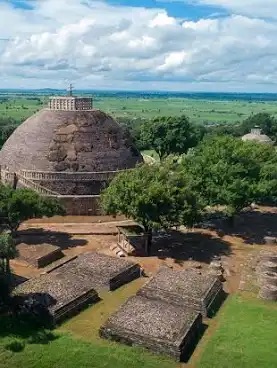
Arriving in Sanchi for the first time in 1990 was like stepping into a page of ancient history. The hill rose gently from the plains, crowned by monuments that seemed less constructed than grown, as if stone, earth and sky had conspired to create something enduring. The Sanchi Stupa dominated the scene. Its hemispherical dome, serene and grounded, contrasted sharply with the ornate temple architecture I was more familiar with. There was a quiet power in its simplicity. No idols beckoned worshippers, no rituals clamoured for attention. Instead, the stupa invited circumambulation, silence and inward travel. In those days, tourism was sparse. The air carried birdsong more often than conversation. I remember walking slowly around the stupa, tracing the carved narratives on the toranas, the birth of the Buddha, the Jataka tales, scenes of devotion rendered without depicting the Buddha in human form. It was my first encounter with aniconic art, and it left a lasting impression. Environmental awareness, at least in the way we articulate it today, was not at the forefront of my mind then. Yet I sensed that Sanchi’s tranquillity owed much to its natural setting. The surrounding trees, the open sky and the absence of urban noise were not incidental; they were integral to the experience.
Time’s passage and a changed world
Between 1990 and 2016, India transformed dramatically. Roads improved, cities expanded, tourism flourished, and heritage sites gained global visibility. My own life, too, is filled with responsibilities, experiences and a deeper appreciation for places that endure beyond individual lifespans. When the opportunity arose to revisit Sanchi in 2016 with Shubhankar Goswami, I was curious to see how the site had weathered these changes. Would modernity intrude upon its calm? Would the silence I remembered survive the age of selfies and tour buses?
Sanchi in 2016: Reflection and rediscovery
The approach to Sanchi in 2016 was smoother, better signposted, and unmistakably more organised. Facilities had improved, pathways were clearly defined and interpretative boards offered context in multiple languages. Yet remarkably, the essence of Sanchi remained intact. Walking alongside Shubhankar, conversations flowed easily about history, philosophy, photography and the curious way certain places invite introspection. The stupa appeared once again at the hilltop, unchanged in form yet newly meaningful to me. What I had once seen with wonder, I now regarded with reverence. I noticed details I had overlooked in my youth: the careful alignment of structures, the way light shifted across stone surfaces through the day and the deliberate preservation of open spaces around the monuments. These were not aesthetic choices alone; they were environmental decisions.
Sanchi and environmental harmony
Sanchi’s importance is not limited to its Buddhist heritage; it stands as a quiet lesson in environmental balance. The monuments are set within a protected landscape where construction is regulated, vegetation is preserved and visual pollution is kept at bay. This restraint is rare and precious. The hill itself supports a mosaic of local flora. Trees provide shade and habitat for birds, while grasses stabilise the soil, preventing erosion around ancient foundations. Unlike many heritage sites overwhelmed by unchecked development, Sanchi benefits from a buffer zone that respects both archaeology and ecology. What struck me most in 2016 was how seamlessly history and nature coexist here. The stone structures do not dominate the landscape; they converse with it. The stupas rise gently, never challenging the horizon, embodying a philosophy of humility before nature, a principle deeply aligned with Buddhist thought. In an era of climate anxiety, Sanchi offers a subtle reminder: sustainability is not a modern invention. Ancient builders understood the value of working with the land rather than against it. Their choices have allowed these monuments to survive not just centuries of weather, but waves of human change.
Memory, friendship, and the meaning of return
Travelling with a friend adds another dimension to revisiting a place. With Shubhankar, Sanchi became not just a site to observe but a space to discuss how silence affects the mind, how history shapes identity and how landscapes influence belief systems. We lingered longer than most visitors, sitting quietly, watching the play of light, listening to the wind move through trees planted long after the Mauryan period, yet now inseparable from the scene. In those moments, I felt the two journeys of 1990 and 2016 merge into one continuum. Crossing back over the Kark Rekha on our return to Bhopal, I was struck again by that invisible line. Geography had not changed, but I had. Sanchi had served as a mirror, reflecting not just India’s past, but my own passage through time.
Why Sanchi matters today
Sanchi matters because it teaches without preaching. It demonstrates that spiritual depth does not require grandeur, that preservation is an act of respect and that human creativity flourishes best when grounded in environmental sensitivity. For travellers, it offers more than photographs. It offers perspective. For policymakers, it stands as proof that heritage conservation and environmental stewardship can coexist. And for those fortunate enough to return, as I did, it offers the rare gift of continuity in a rapidly changing world.
Epilogue: The road continues
Some journeys end when you return home; others continue quietly within you. My two visits to Sanchi, separated by decades but united by memory, belong firmly to the latter category. Each time I think of that road from Bhopal, the crossing of the Kark Rekha, and the calm presence of the stupa on its hill, I am reminded that the most meaningful travel is not about distance covered, but about awareness gained. Sanchi remains there, patient and poised, waiting for future travellers to discover not just its history, but themselves.



Leave a comment