

ROOT TO RUNWAY
In a magnificent fusion of heritage and hope, TreeTake Magazine and the Lucknow Farmers Market came together in a brilliant collaboration to celebrate the magazine’s 11th anniversary. This landmark event, held during the vibrant Spring Carnival at the historic Habibullah Estate, served as a powerful manifesto for circular fashion, proving that the future of style lies in the ‘4Rs’: reuse, recycle, repurpose and refashion.
A symphony of collaboration
The success of the ‘Root to Runway’ show was woven together by a powerhouse collective of partners, each contributing a vital thread to the tapestry: TreeTake magazine and Lucknow Farmers Market jointly hosted the celebration, uniting the voice of Lucknow’s green movement with a community that lives the values of mindful living. JD Institute of Fashion Technology: Infused the runway with academic excellence and cutting-edge sustainable design perspectives. Katwalk Academy: Orchestrated the high-energy choreography and professional grace of the runway displays. Gitanjali Salon: Expertly sculpted the aesthetic looks and grooming that complemented the eco-friendly couture. The competition: Honour, innovation, and earth. The runway featured 16 innovative garments from six designers across three soul-stirring categories: Dharohar: Honouring the past through handed-down garments and precious heirlooms. Punarsrijan: The art of refashioning existing garments into fresh, modern silhouettes. Back to the Soil: Highlighting organic, eco-friendly materials like jute.
An elite jury of visionaries
The difficult task of crowning the winners fell to a prestigious judging panel whose collective expertise provided an unparalleled standard of excellence. We extend our deepest praise to Anju Narain (prominent designer), Shipra Anand (director, JD Institute), Saumya Misra (Editor, TreeTake), Jyotsna Kaur Habibullah (CEO, LFM) and Dr Amita Kanaujia, deptt of Zoology, University of Lucknow. Their discerning eyes, professional rigour and unwavering commitment to sustainable ethics ensured that the champions selected were true pioneers redefining the industry’s future.
11 years of synergy
Jyotsna Kaur Habibullah, CEO of Lucknow Farmers Market, said: “The collaboration between the Lucknow Farmers Market and TreeTake magazine represents a powerful alliance between action and advocacy. For 11 years, TreeTake has served as the intellectual heartbeat of the city’s green movement, providing the stories and science that inspire change, while LFM has provided the ground-level platform for that change to take place. The success of our partnership was evident at the ‘Root to Runway’ show, where the magazine’s editorial mission came to life as nine designers showcased visionary sustainable garments. By celebrating their milestones together, LFM and TreeTake demonstrate that a sustainable ecosystem requires both a marketplace for conscious commerce and a persistent voice for environmental education. Together, we have fostered a community where being an ‘environmental superhero’ is no longer an outlier—we showcased this in action.
Combined influence of reading & visual
Saumya Misra, Editor of TreeTake magazine, said: “To celebrate 11 years of TreeTake at the Lucknow Farmers Market is to celebrate the persistence of hope and the power of community. For over a decade, this magazine has been the ‘environmental superhero’ that gave a narrative to our mission. Seeing the ‘Root to Runway’ designers transform forgotten garments into high-fashion art is the perfect tribute to that legacy. They didn’t design just clothes; they imbibe our values and designed a future where nothing is ever wasted—only reimagined. At TreeTake, our mission has always been deeply rooted in serving Mother Nature. As a monthly bilingual magazine, we are fully committed to protecting our biosphere and the incredible biodiversity it holds. We believe that our commitment to sustainability and social responsibility measures true progress. This shared vision is exactly why we have united with the Lucknow Farmers Market. We share the same core values: a dedication to a cruelty-free lifestyle, the promotion of local, ethical farming and the drive to reduce our collective carbon footprint. February 8 ‘Root to Runway’ fashion show is a deliberate choice. While our magazine provides the depth of research and reading, this fashion show serves as a powerful visual medium. It is designed to show—not just tell—how a sustainable lifestyle can be adopted in our day-to-day lives through ‘waste-to-wear’ artistry and upcycled fashion. By combining the lasting impact of both reading and visual experience, we hope to inspire you to ‘Rethink, Reduce and Reuse’. Together, we can take those small, united steps toward a greener world.”
Sustainable fashion is the need of the hour
Sandeep Gola, Centre director of JD Institute of Fashion Technology, said: “With awareness about the environment increasing in all walks of life, it has become the need of the hour that we include sustainable fashion in our lifestyle so that we learn and teach to live sustainably. ‘Root to Runway’ is a brilliant approach to spread this awareness in all strata of society, and the beautiful creations and display of sustainable garments were a huge success in meeting the purpose to communicate the same most noticeably.
Sustainable fashion is a necessary shift
Amit Samson Nanoo, KatWalk Academy founder, said: “Making our models walk the ramp for a cause like sustainable and cruelty-free fashion is deeply fulfilling. Fashion today is not just about glamour — it is about responsibility. When our models represent a cause, they are not just showcasing garments; they are promoting awareness, ethics and conscious living. At KatWalk Academy, we believe that true beauty lies in compassion and responsibility. Sustainable fashion is not merely a concept for us; it is a necessary shift in the industry. Encouraging cruelty-free fabrics, promoting ethical designers, supporting local craftsmanship and reducing waste are values we strongly align with. As mentors, it is our duty to groom models who are not only confident and graceful but also socially aware. When fashion supports sustainability, it sends a powerful message that style and responsibility can go hand in hand. I feel proud that our platform contributes to shaping a more conscious and progressive fashion ecosystem.” On associating with Femina Miss India: Conducting the Femina Miss India Uttar Pradesh selections is an immense honour and an even bigger responsibility. Femina Miss India is not just a pageant — it is a legacy platform that has shaped some of the most powerful and inspiring women of our country. Being entrusted with this responsibility reflects the credibility and dedication of KatWalk Academy over the years. We understand that we are not just selecting contestants; we are shaping ambassadors of Uttar Pradesh who will represent the strength, grace and cultural richness of our state on a national platform. Bagging this contract for Uttar Pradesh, especially hosting it in Lucknow, is a proud moment for us. Lucknow is a city of heritage, elegance and evolving aspirations. Our vision is to ensure that the winner from Uttar Pradesh is not only beautiful but confident, socially aware, and globally competitive. We are committed to making Uttar Pradesh shine brighter than ever on the Femina Miss India stage.
Celebrating the champions
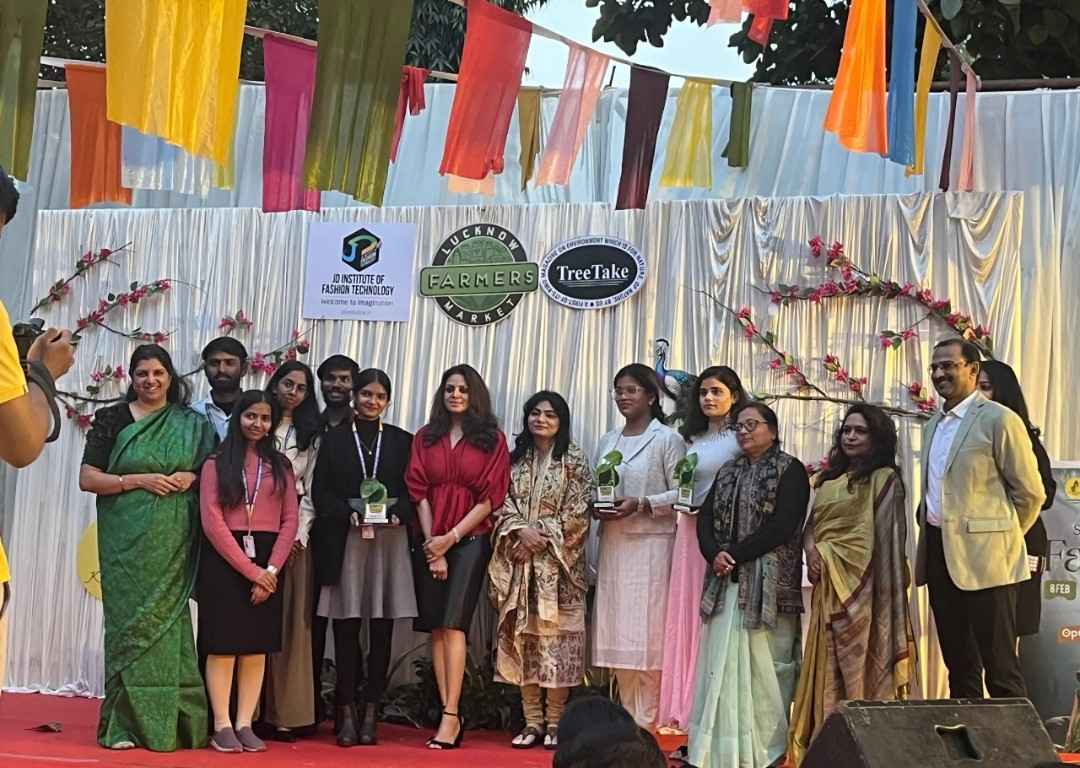
The winners were awarded trophies that were masterpieces of upcycling. The winners were Shweta Awasthi, NIFT Raebareli team (Shraddha Rai, Raghunath Verma, Vaibhav Rathore, Mashi Jaiswal and Menika Keevari) and Nida Khan.
A golden standard for green achievement
The winners of ‘Root to Runway’ did not just receive an award; they carried home a tangible piece of the environmental solution. The upcycled trophies- crafted with love by Radhika Mishra of SparkLiv- serve as a shimmering testament to the beauty of circularity, proving that even ‘waste’ can be reimagined as a prestigious symbol of progress. The environmental footprint of a single trophy is a master class in sustainability: 350 grams of plastic upcycled, transforming a significant volume of waste into a sophisticated work of art. Eighteen plastic bottles repurposed: Breathing new life into everyday pollution, turning it into a lasting, meaningful memento. 100% Landfill diversion: A pure circular success story, ensuring that no part of the award contributed to the planet’s burden. Handcrafted in India: Celebrating and supporting local artisanal skill while championing global ecological goals.
A meaningful platform, say participants
My experience of the show was very good, full of learning and pure magic. The thousands of harmful chemicals used in the textile mills around the world are dangerous to both the environment and the people working with them, and the time has come for a global change in the industry. That change must come in the form of sustainable fashion. Hence, my focus on the design was to upcycle the fabric and create something new. The award fuelled my commitment to pushing creative boundaries in designing. - Shweta Awasthi, JD Institute of fashion and technology, Lucknow
My experience of the show was very good and full of learning. The notion behind my design was to focus on sustainable fashion by reusing and upcycling fabrics and creating something new and meaningful. Sustainable fashion is very important as it helps reduce waste and supports eco-friendly practices. This show helped me gain confidence, improve my creativity and understand the importance of sustainability in fashion design. - Vandana Gupta, JD Institute of Fashion Technology, Lucknow
My experience was very good, and the sustainable fashion show made me realise that fashion can be creative, meaningful and responsible at the same time. Using old fabrics and recycled materials helped reduce waste and promote eco-friendly design. Sustainability is important today because the fashion industry causes pollution and resource depletion. Sustainable fashion supports environmental protection, ethical practices, and preservation of traditional crafts, making it essential for a better future.- Aashi Deol, JD institute of fashion Technology, Lucknow
The sustainable fashion show was a meaningful platform to showcase creativity with responsibility. Our garment was designed using upcycled fabric scraps and patchwork techniques, focusing on waste reduction and conscious design. Every element of the outfit reflected the idea that fashion can be innovative, expressive and sustainable at the same time.
Shraddha Rai, NIFT Raebareli team
I chose the category Dharohar, which presented the modern silhouettes rooted in heritage craftsmanship, thoughtfully designed to suit all age groups. Each piece blended timeless tradition with contemporary elegance, celebrating handwork while supporting skilled artisans. Created with purpose, our designs went beyond fashion to preserve craft and conscious luxury. My experience has been incredibly rewarding, as it gave me the space to explore craftsmanship with intention. The notion behind my designs was to honour traditional techniques while presenting them in a modern, refined form. I strongly believe sustainable fashion is the future—it supports artisans, reduces waste and creates pieces that hold value beyond trends. - Nida Khan, JD Institute of Fashion Technology, Lucknow
As per our theme, we designed and created an outfit using fabric scraps and leftover cloth pieces (katrans). Instead of throwing away these small pieces of fabric, we reused them creatively to give them a new life through fashion. The main purpose was to spread awareness that fashion can be beautiful, innovative and eco-friendly at the same time. This event taught us that even waste material can be transformed into something meaningful and stylish with the right creativity and effort. Working on this outfit was a unique learning experience for me. It helped me understand the importance of sustainability in the fashion industry and inspired me to create designs that support the environment. -Yasmin Khatoon, JD Institute of Fashion Technology, Lucknow
My experience was very good and full of learning too, with s Some new designs from old garments. Sustainability is a very good technique through which we can design something new; it is very important in the fashion industry. -Neha Bhardwaj, JD Institute Of Fashion Technology, Lucknow
Designing the jute dress for the sustainable fashion show was a meaningful experience for me. I learned how to use eco-friendly fabric in a creative way, and it improved my practical skills and confidence in fashion design. - Shalini Vishwakarma, JD Institute Of Fashion Technology, Lucknow
When I decided to participate in ‘Root to Runway’, my creative instinct immediately told me to design in alignment with the theme ‘Punarsrijan’. I recycled a top to make the skirt and crafted the patchwork-based top using old fabric. The shrug with frilled arm design was also made using old fabric. It was amazing that sustainable clothing using recycled material with natural fibre could become a theme for a fashion show. This very mesmerising idea unlocked my creativity and connected me with my artistic passion. Interaction with the professionals in the field was an amazing experience because most of the other designers belonged to the fashion design sector itself. Such events should be regularly organised, where individuals may bring awesome designs and unleash their passion for sustainable fashion. - Namrata Singh, Research Scholar, Department of Chemistry, University of Lucknow


Leave a comment