

Travelogue
HN Singh
The writer is a Lions International Faculty Member, SPHEEHA, Naturalist, HAM Radio Licensee, trekker & mountaineer
It was sometime in the summer of 1993 when the idea first took shape, an idea that would turn into one of the most unforgettable journeys of my life. My friend Kiran Singh and I decided to explore a place that, until then, lived more in whispers and folklore than in travel brochures, Patalkot. Situated deep within the Satpura ranges of Madhya Pradesh, Patalkot was often described as a “hidden world beneath the earth,” a valley so deep and mysterious that many believed it to be the gateway to Patal Lok.
Our journey began from Bhopal by road. The early morning air carried a sense of excitement and curiosity. As we drove past winding roads, fields, and gradually rising hills, the landscape began to change. Civilisation seemed to recede, replaced by dense forests and an overwhelming silence that only nature could compose. The road to Chhindwara and further towards Tamia was both scenic and introspective; it felt as though we were slowly peeling away layers of the modern world to reach something ancient, untouched, and deeply rooted in time.
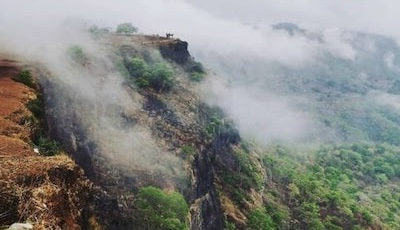
After reaching Tamia, we got our first distant glimpse of Patalkot. Standing at the edge of the plateau and looking down into the valley was an experience that words struggle to capture. It appeared as if the earth had cracked open, revealing a vast, horseshoe-shaped depression filled with dense greenery. The valley stretched deep, almost 1700 to 3000 feet below the surface, creating an illusion of stepping into another realm altogether. From above, it felt less like a valley and more like a hidden civilisation breathing quietly within the womb of the earth. We began our trek the next morning.
Day 1: Descent into the unknown
The descent into Patalkot was not easy. Narrow, steep trails wound their way down through thick vegetation. Every step required caution, but also brought with it a sense of thrill. The deeper we went, the more the outside world faded away. Sunlight filtered through layers of foliage, and soon, even during midday, the valley felt dim, almost like twilight.
This phenomenon fascinated us. It is said that in certain villages within Patalkot, sunlight barely reaches the ground. Even on bright days, these places remain in a perpetual state of dusk due to the surrounding high hills and dense forests. Experiencing this firsthand was surreal; time seemed to slow down, and the rhythm of life followed nature rather than the clock.
By evening, we reached one of the tribal villages. The people belonged primarily to the Bharia and Gond tribes, who have lived here for centuries, largely untouched by the outside world. Their simplicity, warmth, and deep connection with nature were immediately evident. That night, under a sky barely visible through the canopy, we sat by a small fire, listening to stories passed down through generations.
Day 2: Life in the valley
The second day was dedicated to exploring the villages and understanding the lives of the people who called this valley home. There are about a dozen villages scattered across Patalkot, each separated by a few kilometres, yet connected by narrow trails and shared traditions.
What struck us most was their self-sustained way of living. The valley had its own rhythm, independent of modern infrastructure. The Doodhi River served as the primary source of water, and the forests provided everything else: food, shelter, and medicine.
Patalkot is often referred to as a treasure trove of medicinal herbs. The tribal healers, known as Bhumkas, possess remarkable knowledge of plants and their healing properties. They prepare medicines from roots, leaves, and extracts to treat a wide range of ailments, from common fevers to more serious diseases. Watching them at work felt like witnessing an ancient science, preserved through oral tradition rather than written texts.
We also noticed the strong spiritual beliefs embedded in their daily lives. Small sacred spaces known as Devghar were present in villages, where rituals and prayers were performed. The tribes worship various deities, including forms of nature and elements like the sun and fire. Their faith was not confined to temples but woven into their everyday existence.
Day 3: Myths, legends, and silence
As we ventured deeper into the valley, the mystical aura of Patalkot became even more pronounced. The locals shared stories that blurred the line between mythology and reality.
According to popular belief, Patalkot is connected to the ancient concept of Patal Lok mentioned in Hindu scriptures. It is said that Sita, from the Ramayana, entered the earth here, creating a deep cavern. Another legend speaks of Lord Hanuman passing through this region while on a mission to rescue Lord Ram and Lakshman.
There is also a strong association with Meghnad, the son of Ravana, who is believed to have worshipped Lord Shiva in this very valley. These stories are not just myths for the locals; they are part of their identity, their history, and their understanding of the world.
The silence of the valley added to its mystique. Unlike the silence of emptiness, this was a living silence, filled with the rustling of leaves, distant bird calls, and the occasional sound of flowing water. It was a silence that made you aware of your own presence, your own thoughts.
On the third day, we were extremely thirsty, and our water had completely run out. Just then, we spotted a small hut and walked towards it, but there was no one in sight. We called out, and after a moment, an elderly woman stepped outside. Her hair was completely white, and she was dressed in a simple white saree. There was a remarkable glow on her face. She carried a vessel filled with water, which she kindly offered to us. We drank gratefully and continued our journey.
Later, when we reached a nearby village, we learned that the woman was over a hundred years old. Yet, she looked no more than fifty, her face smooth, without a single wrinkle. Hearing this sent a shiver down our spines.
By afternoon, we reached one of the deeper villages where sunlight barely touched the ground. Even though it was midday, the surroundings felt like early evening. The play of light and shadow created an almost dreamlike atmosphere. It was here that the true essence of Patalkot revealed itself, not just as a geographical location, but as an experience.
Day 4: The ascent and reflection
The final day was reserved for the ascent back to the surface. Climbing up was physically demanding, but emotionally, it felt like leaving behind a world that had quietly embraced us.
As we climbed higher, sunlight gradually became stronger, the sky clearer, and the sounds of the outside world more distinct. With every step, we were returning to familiarity, but also carrying with us something intangible, something profound.
Reaching the top and looking back into the valley, we realised how isolated and self-contained Patalkot truly was. For centuries, it had remained cut off from the outside world, preserving its culture, traditions, and natural wealth.
Reflections on the journey
That four-day trek through Patalkot was not just a physical journey; it was a journey through time, culture, and consciousness.
What makes Patalkot unique is not just its depth or its geographical formation, but its ability to exist as a parallel world. A world where nature dictates life, where traditions are lived rather than remembered, and where the pace of life aligns with the rhythms of the earth.
The valley is rich not only in biodiversity but also in cultural heritage. Its forests house rare medicinal plants, some of which are now endangered and require protection. At the same time, increasing exposure to the outside world poses a challenge to its delicate ecological balance.
Even today, Patalkot remains a place that demands respect rather than mere curiosity. It is not just a tourist destination; it is a living ecosystem, a cultural sanctuary, and a reminder of how humans once lived in harmony with nature.
Looking back, that journey with my friend Kiran Singh in 1993 was more than just an adventure. He had visited this place before as well. It was an awakening. It taught us that there are still places in this world where time slows down, where stories breathe through the land, and where the earth itself seems to hold secrets waiting to be discovered.
Patalkot is not just a place you visit, it is a place you feel, a place that stays with you long after you have left. And perhaps, in some quiet corner of memory, we are still walking those narrow trails, descending once again into that hidden world beneath the earth.



Leave a comment