

TreeTake Network
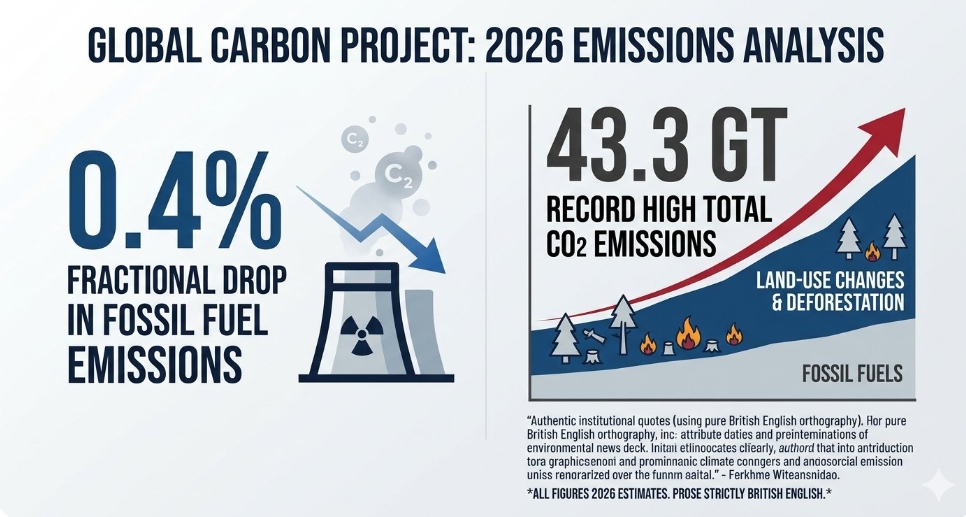
The Global Carbon Project has released its 21st annual analytical review, revealing that global carbon dioxide emissions derived from fossil fuels are projected to experience a fractional drop of 0.4% throughout 2026. This marginal deceleration within an overall upward atmospheric trend brings the estimated global output to 38.2 billion tonnes of fossil carbon dioxide this year. Whilst global macro-energy demands have continued to rise steadily, researchers established that nearly two-thirds of the net increase in energy consumption has been successfully absorbed by the aggressive expansion of utility-scale solar installations, wind networks, and electric vehicle adoption. However, atmospheric physicists stress that this localized reduction does not signal a permanent structural peak in global pollution cycles.
The brief downward trajectory has been significantly influenced by a 1.9% contraction in oil consumption emissions, which analysts categorise as a short-term, volatile response to the severe international energy shocks triggered by geopolitical conflicts. In stark contrast to the minor dip in petroleum-reliant metrics, global coal combustion has continued to rise incrementally, adding considerable pressure to the remaining planetary carbon budget.
"We are seeing clear evidence that rapid clean energy deployment is acting as an effective brake on fossil fuel demand, but it is not yet expanding fast enough to force a durable, downward trend in atmospheric accumulation," stated Dr Inger Andersen, Executive Director of the United Nations Environment Programme, during an evaluation of the budget metrics. "This minor fractional drop must not lead to institutional complacency. The data confirms that atmospheric carbon concentrations are continuing to climb, meaning that despite these short-term market disruptions, the systemic pressures driving biosphere heat stress and severe meteorological volatility are continuing to compound."
The report, published in tandem with comprehensive modeling data in the journal Nature Climate Change, highlights a troubling divergence between fossil-fuel matrices and land-use patterns. Whilst industrial sectors showed minor declines across major economies like the United States and the European Union, emissions from land-use changes—predominantly driven by peat fires and accelerating forest degradation in Southeast Asia—are projected to rise sharply, exacerbated by a strong El Niño pattern. Consequently, when land-use impacts are integrated, total planetary carbon dioxide emissions are projected to reach a record high of 43.3 billion tonnes.
"Our preliminary estimates carry an uncertainty margin that spans from a potential drop of 1.5% to an absolute rise of 0.6%, meaning we cannot entirely rule out a net increase once the winter industrial data is fully audited," cautioned Prof Jim Skea, Chair of the Intergovernmental Panel on Climate Change. "The remaining global carbon budget to prevent long-term warming from breaching the critical 1.5 degrees Celsius marker has vanished to less than 150 billion tonnes, which represents less than four years of emissions at our current consumption velocity. Relying on short-term conflict-driven spikes in oil prices is not a substitute for deep, legally mandated structural decarbonisation; without an immediate acceleration in clean technology frameworks, we remain on a path toward catastrophic biome loss."
Editor's Note
The marginal reduction in fossil fuel emissions recorded for 2026 exposes a dangerous reliance on geopolitical instability rather than unified global policy to curb atmospheric degradation. The record-high totals reached when factoring in forest degradation demonstrate that clean energy deployment cannot protect the biosphere if land-use preservation is ignored. Moving forward, national assemblies must codify aggressive regulatory constraints on coal utilization and establish permanent financial mechanisms to halt deforestation, ensuring that fractional emissions dips are converted into a sustained, structural decline before planetary tipping points become irreversible.



Leave a comment