

TreeTake Network
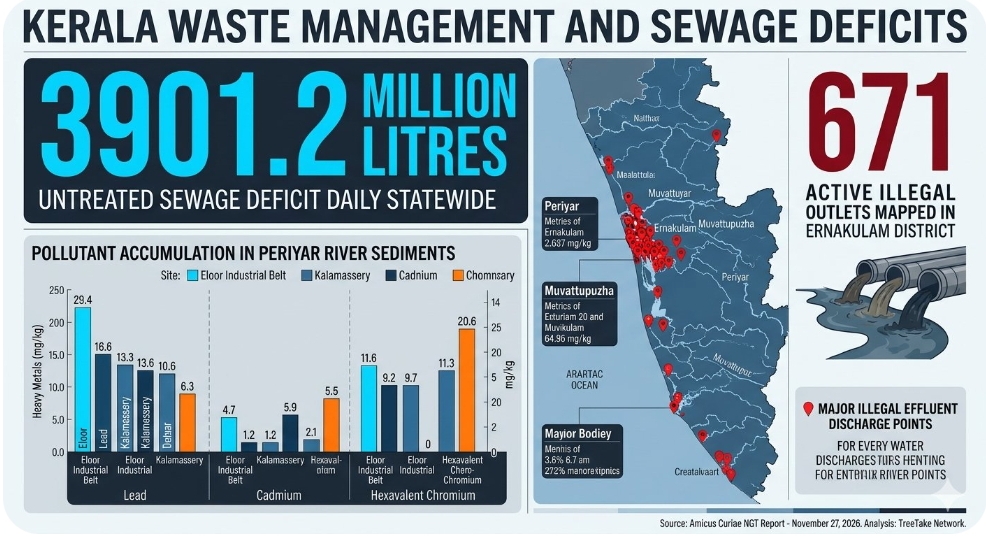
An amicus curiae compliance report submitted directly to the National Green Tribunal principal bench on November 27, 2026, has exposed profound operational deficits within Kerala’s solid and liquid waste management networks. The comprehensive judicial investigation reveals that approximately four-fifths of the state's daily municipal and sanitary waste remains completely untreated due to widespread infrastructural stagnation and broken processing pipelines. Most critically, the expert monitoring data highlights a massive regional deficit of 3901.2 million litres of completely untreated liquid sewage, which continues to enter local freshwater bodies, coastal lagoons, and pristine backwater networks daily.
The investigative findings detail an alarming lack of environmental compliance by localised bodies, creating severe hazards for public health and regional aquatic biodiversity. Field inspections conducted across four assessed southern districts mapped a vast network of unlawful discharge systems actively funnelling raw industrial and domestic effluents straight into major river networks. Out of 723 illegal outlets caught discharging hazardous wastewater into pristine river ecosystems, a staggering 671 active illegal outlets were mapped exclusively within the borders of Ernakulam district, highlighting a highly concentrated failure of urban municipal oversight.
Heavy metal toxicity and riverine ecosystem collapse
The unmitigated discharge of millions of litres of raw sewage has driven a catastrophic drop in dissolved oxygen levels across the Periyar and Muvattupuzha rivers. Water sampling data included in the judicial brief indicate that multiple monitoring stations registered biochemical oxygen demand levels far exceeding safe limits, triggering massive, recurring fish die-offs in commercial aquaculture zones. Furthermore, laboratory analysis of river sediments adjacent to industrial corridors detected highly dangerous accumulations of heavy metals, including lead, cadmium, and hexavalent chromium, which are now actively entering the local food chain through contaminated fish populations.
The amicus report notes that existing waste processing units are frequently operating at less than 30pc of their designed engineering capacity due to a lack of source-segregation mechanisms and poorly planned collection routes. Municipal corporations have routinely ignored statutory solid waste management rules, allowing thousands of tonnes of legacy plastic waste to sit exposed in unscientific landfills. During heavy monsoon showers, the toxic leachate from these open dumps flows entirely unhindered into surrounding groundwater aquifers, permanently contaminating the primary drinking water sources utilized by thousands of local families.
Judicial interventions and administrative penalties
The principal bench has directed the state administration to submit a comprehensive, time-bound remedial strategy within 15 days to halt further environmental degradation. The tribunal is reviewing the immediate deployment of heavy environmental compensation penalties against regional municipal commissioners found guilty of administrative negligence. Legal experts are pushing to establish independent, third-party monitoring committees to audit progress on sewage treatment plant construction across the highly critical Ernakulam industrial belt.
Distinguished environmental legal authorities and judicial officials have confirmed the absolute gravity of the ecological breakdown. Highlighting the critical nature of the findings, the amicus curiae official compliance note stated that of the 723 illegal outlets discharging raw effluent into pristine water networks across four assessed southern districts, a staggering 671 active illegal outlets were mapped exclusively within Ernakulam district, illustrating a total collapse of localised pollution control enforcement. Adding to this official perspective, senior environmental engineering specialists remarked that the present deficit of 3901.2 million litres of untreated sewage entering Kerala's water bodies daily represents an eco-toxicological emergency that cannot be resolved by minor superficial adjustments, requiring an immediate overhaul of the state's entire public sanitation infrastructure instead.
Editor's Note: The damning revelations contained in the amicus curiae report pierce the carefully cultivated public relations image of Kerala's decentralised governance model. The existence of hundreds of illegal effluent channels in a single industrial district proves that local self-government institutions have consistently prioritised rapid commercial expansion over baseline environmental safety; turning this crisis around demands that the National Green Tribunal shift from issuing symbolic administrative warnings to enforcing strict criminal accountability and personal financial liability upon the individual officials who permit this daily ecological vandalism.



Leave a comment