

TreeTake Network
The Indonesian Ministry of Forestry has officially intervened to halt immediate plans for translocating sections of the critically endangered Javan rhinoceros population from Ujung Kulon National Park to alternative habitats in Alas Purwo National Park. Vetted high-level operational briefs verified on November 27, 2026, confirm that the administrative suspension was implemented to allow for exhaustive, slow-paced scientific verification of the targeted safety parameters. The decision directly addresses rising international speculative discussions regarding potential funding interest from major global philanthropic groups, including the Bezos Earth Fund, by clarifying that no formal contractual partnership or implementation mechanism has been authorised.
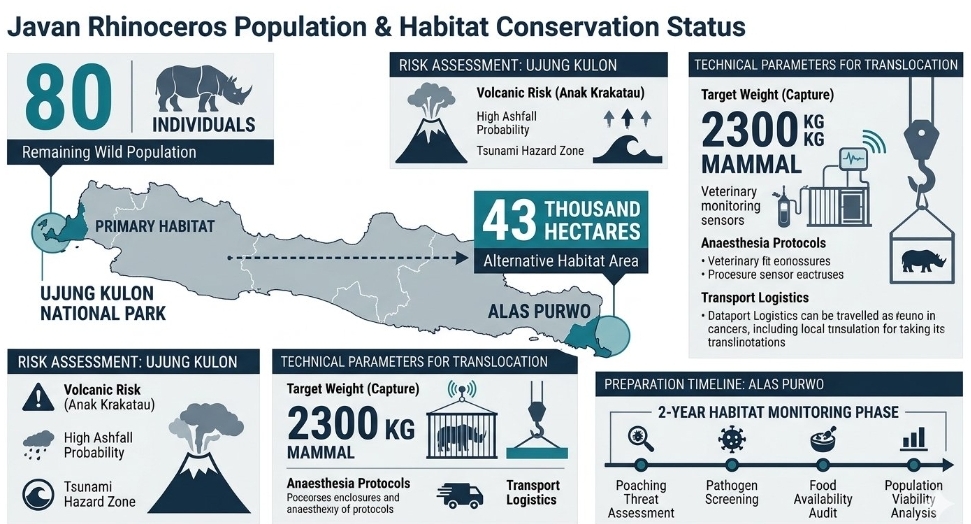
Conservation records indicate that Ujung Kulon National Park, situated on the westernmost tip of Java, houses the world's last remaining wild population of the species, consisting of approximately 80 individual rhinoceroses. The extreme concentration of the entire population within a single geographical zone leaves the species highly vulnerable to catastrophic events, such as a major eruption of the nearby Anak Krakatau volcano or sudden disease outbreaks. While ecological consortia have long advocated for a secondary habitat to safeguard genetic diversity, governmental authorities are emphasising that hasty movement without rigorous biological assessments could cause fatal stress to the animals during transit or lead to severe territorial conflict within the new zones.
Habitat evaluation and biological security criteria
The secondary site at Alas Purwo National Park, located at the easternmost tip of Java, spans an area of over 43 thousand hectares, presenting a vast territory that requires complete security preparation before any translocation can be sanctioned. Forest protection personnel have raised operational concerns regarding the presence of competing large herbivores and the necessity of establishing heavy anti-poaching infrastructure to match the standard maintained at Ujung Kulon. Biologists are currently mapping the density of native vegetation to ensure a sufficient food supply while checking for regional pathogens that could compromise the immune systems of the arriving animals.
The logistics of capturing and moving animals that weigh up to 2300 kilograms require highly specialised veterinary supervision and tailor-made transport enclosures. Ground teams are projecting that a minimum of two years of intensive baseline habitat monitoring will be mandatory before a single rhinoceros can be safely captured. The current freeze ensures that international funding streams are aligned exclusively with national regulatory protocols, preventing external agendas from dictating the timeline of highly sensitive ecological interventions.
Institutional oversight and scientific verification
The oversight framework will be managed by a dedicated team of domestic mammalian specialists alongside international technical advisors. Conservation working groups have emphasised that the survival of the Javan rhinoceros relies entirely on maintaining structural stability within their primary habitat while slowly building the capacity of alternative sanctuaries. The ministry has directed field agents to focus immediate resources on expanding the protected boundaries within Ujung Kulon itself, particularly the Javan Rhino Study and Conservation Area, to accommodate natural population growth while regional evaluations continue.
Official forestry leaders and international ecological specialists have confirmed the critical importance of a cautious approach. Emphasising the necessity of the administrative freeze, Dr Inger Andersen noted that the translocation of an apex species on the absolute brink of extinction cannot be rushed for political or financial convenience, as every single individual rhinoceros represents an irreplaceable fraction of the remaining global gene pool. Adding to this technical perspective, regional wildlife division directors remarked that while international philanthropic interest is highly welcome, all conservation operations must strictly follow national scientific timelines to ensure that alternative sanctuaries are fully secure before any physical movement is attempted.
Editor's Note: The decision to freeze the immediate translocation of the Javan rhinoceros reflects a commendable commitment to scientific caution over rapid institutional public relations victories. While the geographical vulnerability of Ujung Kulon remains an active danger, moving these hyper-sensitive mammals requires flawless field execution; the administration must utilise this period to completely eliminate poaching threats at Alas Purwo, ensuring that the establishment of a secondary population does not inadvertently accelerate the demise of the world's rarest rhinoceros.



Leave a comment