

TreeTake Network
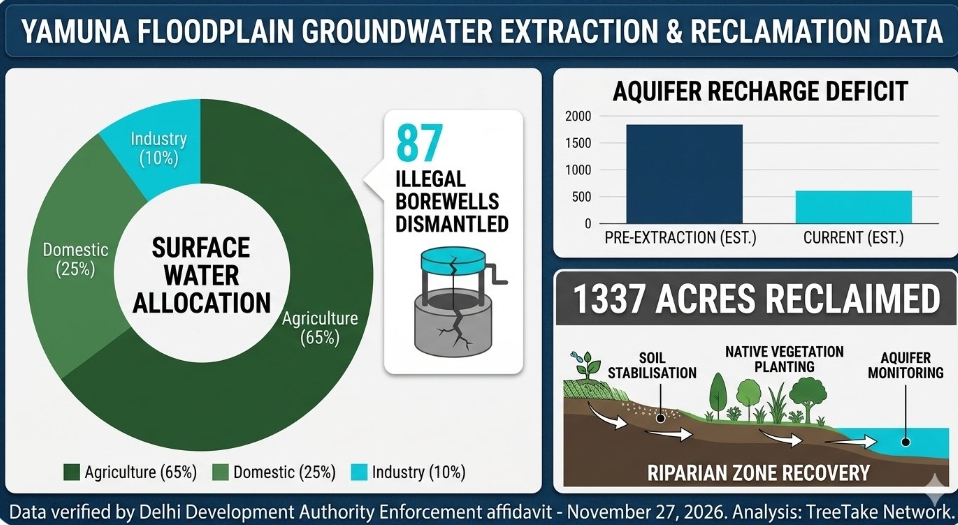
The Delhi Development Authority has submitted an official enforcement affidavit to the National Green Tribunal detailing extensive emergency operations executed to halt illegal commercial groundwater extraction along the fragile Yamuna floodplains. Legal and administrative briefs verified on November 27, 2026, confirm that multi-agency task forces have successfully dismantled 87 illegal high-capacity borewells operating unlawfully across sensitive river zones. The coordinated enforcement campaign has systematically cleared extensive commercial encroachments, completely reclaiming 1337 acres of protected floodplain ecosystem land from illegal commercial water tanker syndicates and unauthorised developers.
The comprehensive enforcement drive targeted multiple vulnerable river sectors where underground aquifers have faced severe depletion due to continuous, unauthorised commercial exploitation. Surveillance data indicated that these illegal borewells were pumping out millions of litres of groundwater daily, which was then distributed commercially across urban sectors through private tanker networks. The rapid and uncontrolled removal of water significantly reduced the local water table, preventing the natural replenishment of the river and causing extensive drying of the surrounding wetlands that serve as critical habitats for native migratory birds and aquatic wildlife.
Groundwater depletion and habitat restoration protocols
The systemic extraction of water from the floodplain aquifers has severely altered the hydrological balance of the river ecosystem. Hydrological experts involved in the reclamation drive explained that the floodplains act as a natural sponge, storing water during the monsoon seasons and slowly releasing it during dry periods to maintain the baseline structural flow of the Yamuna. By puncturing this delicate system with dozens of high-capacity commercial borewells, the illegal syndicates had critically compromised the river's self-rejuvenation capabilities, leading to increased pollution concentration and the steady destruction of native riparian vegetation.
Following the successful dismantling of the extraction machinery, environmental teams have initiated immediate ecological restoration protocols across the reclaimed 1337 acres. The recovery master plan focuses on sealing the damaged aquifer entry points with natural clay layers to prevent external contamination and reintroducing indigenous grass species to stabilise the riverbanks against severe soil erosion. Specialised artificial wetlands are also being carved out along the recovered zones to filter urban stormwater runoff naturally before it reaches the main river channel.
Judicial directives and long-term surveillance frameworks
The National Green Tribunal has ordered the immediate establishment of permanent security pickets and round-the-clock drone surveillance grids across the recovered floodplain sectors to prevent any attempts at re-encroachment. The judicial bench has directed regional power distribution companies to immediately disconnect electricity lines routed to unauthorised agricultural or commercial setups on the riverbed. Furthermore, the local administration has been instructed to fast-track criminal proceedings against the key operators of the water tanker syndicates under strict national environmental protection laws.
Senior judicial authorities and environmental specialists have confirmed the absolute necessity of these stringent field actions. Highlighting the critical ecological stakes, Justice Prakash Shrivastava, Chairperson of the National Green Tribunal, stated that halting the extraction of groundwater from illegal borewells is deeply critical because these illegal operations have severely depleted local water tables, directly threatening the native river ecology and altering the baseline structural flow of the Yamuna. Adding to this official position, senior water management directors remarked that the successful recovery of 1337 acres of encroached land marks a major victory for urban conservation, proving that the restoration of natural river floodplains must take absolute precedence over commercial exploitation.
Editor's Note: The aggressive clearance of illegal borewells by the Delhi Development Authority represents a vital and long-overdue step toward safeguarding the hydrological integrity of the Yamuna. However, a temporary enforcement drive cannot replace the necessity for permanent structural vigilance; unless the regional administration establishes automated, real-time aquifer monitoring networks and completely dismantles the economic incentives driving the unauthorised water tanker market, these deeply destructive syndicates will inevitably return to exploit the city's finite groundwater reserves.



Leave a comment