

TreeTake Network
Academic researchers, biodiversity conservationists, and environmental advocates gathered at Savar, Bangladesh, on November 27, 2026, for the formal inauguration of the 16th annual Butterfly Fair, leveraging the platform to demand structural policy changes against rapid habitat destruction. The daylong event, organised by the Entomology Branch of the Zoology Department at Jahangirnagar University, transformed the campus into a critical forum for ecological advocacy. Environmental specialists presented comprehensive field data demonstrating a severe decline in native insect pollinator populations, linking the biological crisis directly to ongoing infrastructure development corridors, aggressive commercial land clearing, and localised tree felling across regional forest patches.
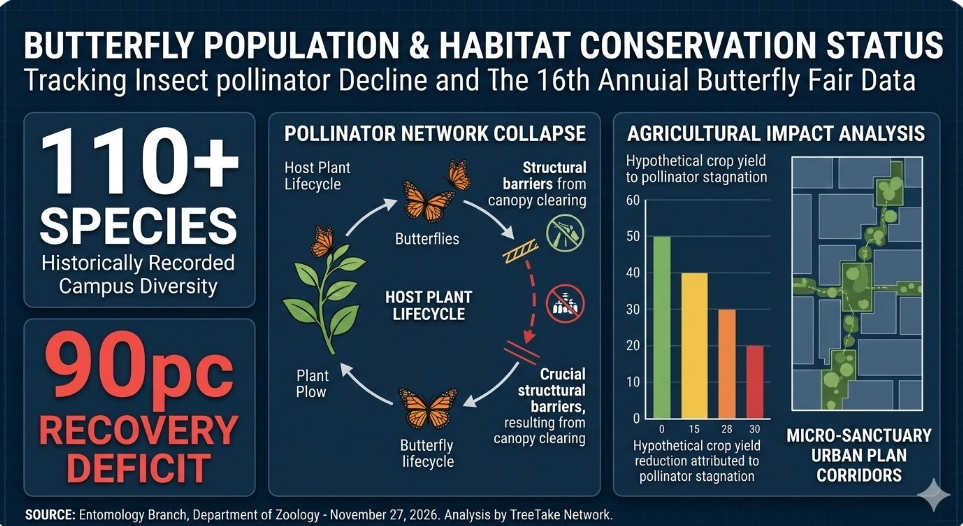
Ecological surveys presented during the opening technical sessions indicate that the university campus and its surrounding wetlands historically provided sanctuary to over 110 distinct species of butterflies. However, rapid microclimate alterations caused by the removal of old-growth canopy trees and the widespread introduction of non-native ornamental flora have disrupted the delicate life cycle of these insects. Academic teams warned that the destruction of specific host plants—vital for caterpillar feeding and egg deployment—has pushed several rare butterfly varieties, including the iconic Kaiser-i-Hind and various swallowtail lineages, toward regional extinction thresholds. The gathering emphasised that individual and collective behavioural shifts must be backed by institutional mandates to preserve remaining urban green spaces.
Insect pollinator decline and agricultural ripple impacts
The reduction in butterfly diversity is a critical bio-indicator of a much broader, systemic collapse within regional pollinator networks. Agricultural experts at the fair presented models showing that a drop in insect populations directly compromises the yield efficiency of local fruit and vegetable cultivation, threatening food security pipelines across surrounding rural districts. By mapping the exact migratory paths of local insects, researchers demonstrated that even a minor patch of tree felling can create a structural barrier, isolating breeding populations and leading to severe genetic stagnation within surviving colonies.
To combat the fragmentation of these fragile ecosystems, conservationists proposed the immediate establishment of protected biodiversity pockets within urban planning frameworks. These micro-sanctuaries, curated exclusively with native nectar-rich shrubs and indigenous trees, are designed to serve as stepping-stone corridors for insects traversing human-dominated landscapes. The fair also featured interactive exhibitions, photography competitions, and public awareness workshops aimed at educating community members on how to transform domestic gardens into viable insect habitats.
Collaborative research and institutional declaration
The academic forum concluded with the drafting of a formal conservation declaration to be submitted directly to national environmental ministries. The document calls for a complete ban on land-use changes within designated ecological hotspots and mandates the inclusion of entomological impact assessments prior to the approval of any major infrastructure project. The university research wings have committed to launching a digital mapping initiative to track remaining pollinator clusters across the deltaic region, ensuring that conservation efforts are guided by precise, real-time spatial data.
Distinguished academic entomologists and environmental specialists confirmed the urgent need for a coordinated response. Emphasising the critical nature of the insect decline, Prof Abdul Jabbar noted that the butterfly is not merely an aesthetic marvel but a foundational pillar of terrestrial ecosystems, meaning that when an administration permits the systematic clearing of host trees, it is effectively dismantling the biological infrastructure that sustains regional food production. Adding to this scientific perspective, regional wildlife conservation directors remarked that the university fair must serve as a legislative turning point, showing that the protection of small insect habitats carries the exact same ecological weight as massive forestry initiatives.
Editor's Note: The annual butterfly gathering at Jahangirnagar University provides a vital warning that cannot be ignored by regional planning authorities. While massive global climate summits dominate international headlines, the steady erasure of localised insect corridors represents a silent, immediate threat to global biodiversity; true conservation victory requires looking beyond large mammals to rigidly protect the fragile, micro-level habitats of the insect pollinators that silently anchor the entire human agricultural matrix.



Leave a comment