

TreeTake Network
The Standing Committee of the National Board for Wildlife convened its 92nd assembly on November 28, 2026, in New Delhi to review the implementation parameters of India’s marquee marine conservation programmes. Chaired by Union Environment Minister Bhupender Yadav, the high-level policy review showcased the definitive achievements of the National Marine Turtle Action Plan spanning the 2021 to 2026 operational timeline. Alongside macro-level updates, the committee recognised ground-breaking community-led stewardship models that have successfully stabilised vulnerable populations of the iconic whale shark along western coastal corridors and the Indian pangolin across subcontinental forest fringes.
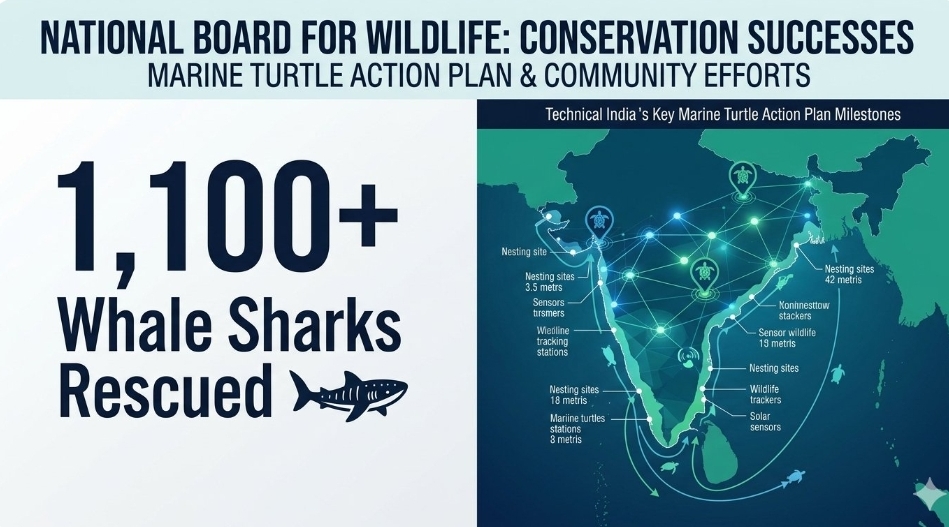
A core focus of the technical evaluations was the release of three milestone knowledge products engineered by the Wildlife Institute of India, including the Technical Protocol of Marking Marine Turtles, Tracking Marine Turtles in Indian Waters, and an updated status report on the Marine Turtles of India. These scientific toolkits standardise spatial tracking data and marking procedures across coastal states to minimise mortality caused by marine plastic accumulation, coastal construction, and accidental fishing net entanglement.
"We must appreciate that marine conservation requires a unique, highly adaptive matrix of community vigilance and strict enforcement frameworks," remarked Union Environment Minister Bhupender Yadav during his address to the board members. "The milestones achieved under the marine turtle action plan demonstrate that when scientific protocols are translated into field reality, we see measurable recovery. Our goal is to extend these frameworks across all vulnerable habitats, ensuring that developmental activities undergo comprehensive impact mitigation assessments before execution."
Coastal communities pioneer megafauna rescue networks
The national review shed critical light on the transformation of marine wildlife rescue through local partnerships. The committee presented the Community Conservation Award to the Shree Mahavir Machchhimar Sahakari Mandali Limited from Mangrol, Gujarat, for their unprecedented achievements in whale shark conservation. By collaborating with forest administrative branches and non-governmental organisations, local fishing collectives have formalised rapid-response protocols to safely disentangle and release the ocean's largest fish species when accidentally trapped in commercial trawl lines.
This decentralised framework has altered the survival index of marine megafauna. Over 1,100 whale sharks have been successfully rescued and released along the Indian coastline since the initiation of targeted marine community campaigns.
"The success of the whale shark rescue network demonstrates that the fishing community is our strongest ally in maritime biosphere preservation," stated Dr Inger Andersen, Executive Director of the United Nations Environment Programme, in an associated review of India's coastal achievements. "By incentivising local fishers and introducing transparent compensation frameworks for damaged gear during rescues, India has constructed a scalable blueprint for community-led biodiversity stewardship. This model proves that economic welfare and apex marine conservation can successfully reinforce each other."
Community patrolling stabilises critical pangolin habitats
Shifting the focus to terrestrial ecosystems, the National Board for Wildlife highlighted regional successes in curbing the illicit trade of the Indian pangolin. Forest communities across central and southern India have organised local eco-development committees to establish round-the-clock anti-poaching networks. By utilising traditional tracking expertise, these rural protection squads have significantly reduced habitat disruptions and dismantled commercial snaring operations within multi-state forest corridors.
"Protecting small mammals like the pangolin requires grassroots monitoring that a formal department cannot achieve alone," noted Prof Jim Skea, Chair of the Intergovernmental Panel on Climate Change, whilst examining biodiversity-based climate resilience models. "Healthy pangolin populations are vital for forest soil aeration and insect population regulation, which structurally underpins ecosystem stability. The community successes highlighted by India's top wildlife advisory body show that empowering local forest dwellers is the single most effective methodology to safeguard ecosystems from the twin pressures of habitat fragmentation and wildlife exploitation."
Editor's Note
The milestones highlighted by the National Board for Wildlife demonstrate that top-down policy actions are only as strong as the bottom-up community participation backing them. Whether deploying telemetry protocols for sea turtles or managing anti-poaching patrols for pangolins, long-term conservation relies on converting local communities from passive bystanders into well-compensated ecosystem guardians. Moving forward, the financial framework governing conservation areas must systematically integrate local community cooperatives into budgetary planning, ensure prompt compensation for livelihood losses, and modernise grassroots field tools to secure India's rich biodiversity.



Leave a comment