

TreeTake Network
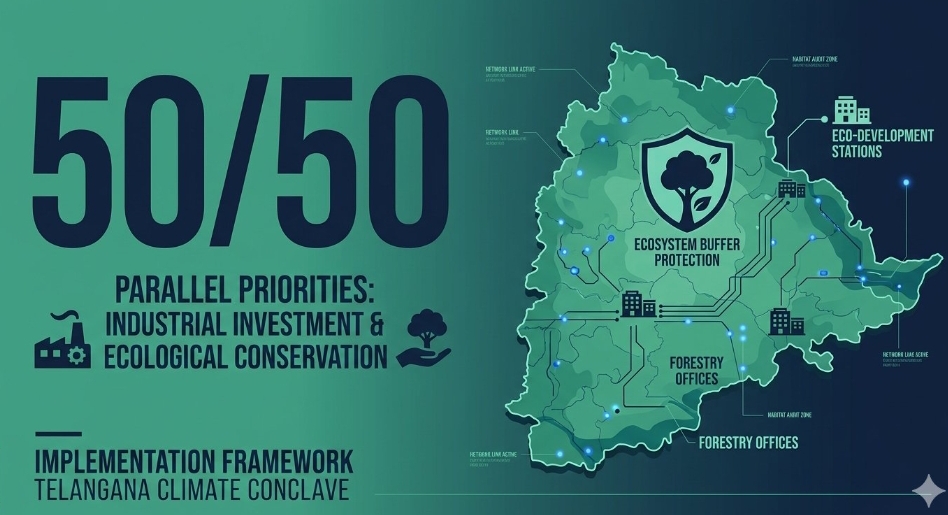
The state government of Telangana has formally pledged to execute an absolute parallel balancing act between incoming economic investments, aggressive industrialisation, and proactive ecological preservation. Speaking on November 27, 2026, during the official curtain-raiser assembly for the upcoming Telangana Climate Conclave in Hyderabad, Chief Minister A Revanth Reddy declared that economic development and environmental safety represent the two eyes of the state's governance framework. The executive policy brief outlines a structural shift designed to proactively address environmental anxieties by integrating grass-roots ecological feedback directly into state-level industrial allocations, thereby preempting the multi-regional climate protests frequently observed at international investment summits.
The strategic administrative declaration arrives as regional assemblies prepare for extensive winter environmental reviews. By formalising direct communication channels between grassroots climate organisations and industrial planners, the regional framework seeks to prevent the degradation of native forest systems whilst simultaneously accelerating the state's transition toward low-carbon technology hubs.
"I have explicitly instructed my officers and ministerial colleagues that investment and the environment are strictly parallel priorities for our administration," stated Chief Minister A Revanth Reddy during his address to environmentalists and industry leaders. "We have to balance environment and investments. There is absolutely no requirement for environmental activists to conduct street protests within Telangana, as they can directly convey their analytical versions, data, and policy suggestions to the government through our institutional channels."
Emphasising the strategic value of incorporating ecological metrics into regional infrastructure frameworks, state environmental coordinators noted that the upcoming conclave would map localised climate vulnerabilities. This initiative aligns with broader subcontinental objectives to fortify regional ecological buffers without throttling necessary industrial expansion.
"Architecting a climate-resilient future requires a complete departure from historical industrial protocols that treated nature as a secondary concern," noted Prof Jim Skea, Chair of the Intergovernmental Panel on Climate Change, whilst examining subcontinental green development matrices. "When regional administrations legally commit to balancing industrial volume with robust conservation frameworks, they create the necessary administrative space to implement nature-based solutions and safeguard local biodiversity. This parallel approach is an ecological necessity; if industrial deployment is not structurally tied to strict habitat preservation boundaries, local ecosystem fragmentation will inevitably worsen, accelerating the risks of localised biospheric collapse."
Editor's Note
The legislative commitment by Telangana to treat industrial expansion and ecological conservation as parallel priorities provides a progressive template for regional governance amidst the climate crisis. Abstract economic development can no longer be pursued at the cost of irreversible habitat loss or the degradation of critical watersheds. Moving forward, state planning bodies must codify these promises into statutory regulations, mandating transparent environmental impact audits for all new manufacturing corridors and ensuring that local communities are actively utilised as the primary guardians of regional biodiversity.



Leave a comment