

Talking Point
TreeTake Network
Air quality monitoring infrastructure across multiple northern states has continued to record highly elevated particulate matter concentrations, with several major urban hubs tracking air quality indices well above the 200 threshold. Environmental monitoring data verified on November 27, 2026, confirm that a dense layer of toxic atmospheric haze has remained suspended over the National Capital Region and surrounding plains throughout the week. The persistent atmospheric stagnation has been exacerbated by a sharp drop in regional winter temperatures, trapping vehicular emissions, industrial smoke, and domestic biomass burning products close to the ground.
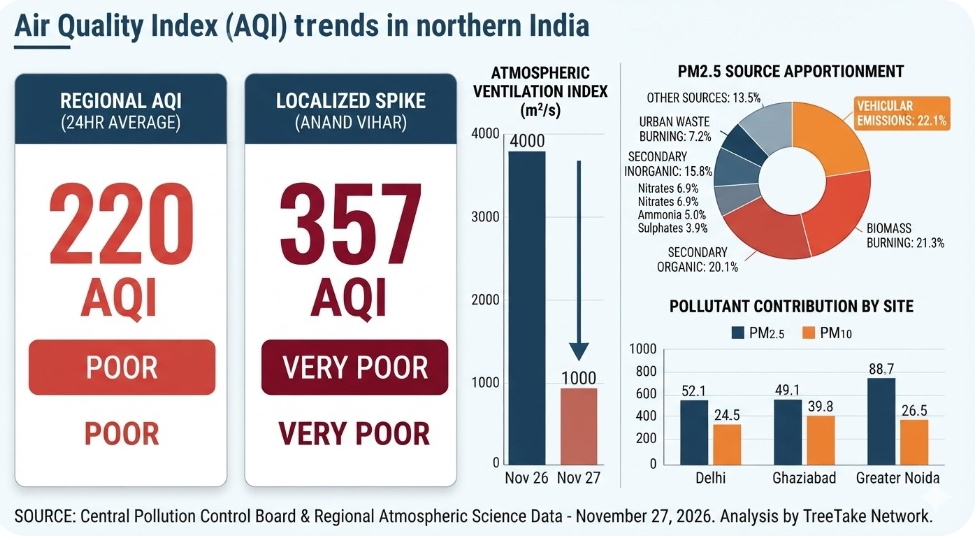
Data compiled by central monitoring applications indicate that while the national capital managed to avoid peaking into the technical "severe" classification for the first 26 days of the month, it has recorded 12 distinct days of "very poor" air quality. On November 27, 2026, the central reading settled at 220, placing the metropolis firmly within the "poor" category for the 11th consecutive day. Detailed chemical characterisation from 58 operational monitoring stations revealed that fine particulate matter, measuring under 2.5 micrometres in diameter, remained the absolute dominant pollutant on 24 days. High-density monitoring pockets like Anand Vihar recorded significantly worse localised spikes, registering an index of 357.
Regional pollution profiles and satellite data
The environmental stress extends significantly into neighbouring industrial and residential zones. In Ghaziabad, automated sensors registered 20 days of "poor" air and five days of "very poor" air during the month, with an index of 253 on November 27, 2026. Particulate matter tracking in Ghaziabad showed PM2.5 leading on 17 days, while larger coarse dust fractions, classified as PM10, emerged as the primary pollutant on nine days. Concurrently, Greater Noida reported a highly fluctuating pollution profile, logging four "very poor" days, 16 "poor" days, and six "moderate" days, before rising back to an index of 228 by late morning.
Source apportionment analyses conducted by regional atmospheric scientists identified the exact percentage breakdown of the toxic envelope. Vehicular emissions emerged as the largest single contributor to the fine particulate load, accounting for 22.1pc of the total concentration. This was followed closely by biomass burning, encompassing agricultural stubble clearance and domestic solid biofuel use, which accounted for 21.3pc. Secondary organic aerosols formed through complex chemical interactions in the lower atmosphere contributed 20.1pc, while secondary inorganic pollutants comprised 15.8pc. Within the inorganic fraction, nitrates contributed 6.9pc, ammonia accounted for five per cent, and sulphates made up 3.9pc. General urban waste burning, including municipal solid waste and hazardous plastic or rubber combustion, added another 7.2pc to the atmospheric burden.
Unfavourable meteorological parameters
The structural stability of the smog layer is directly tied to highly restrictive weather patterns. The atmospheric ventilation index, which calculates the ability of the sky to disperse concentrated surface emissions, plummeted to 4000 square metres per second on November 26, 2026, and dropped further to a highly critical 1000 square metres per second by November 27, 2026. This constriction, combined with average surface wind speeds remaining consistently below 10 kilometres per hour, has prevented any meaningful horizontal movement of clean air. Furthermore, the maximum mixing depth, representing the vertical space available for smoke to rise, shrivelled from 1300 metres down to 1050 metres over the same 48-hour window, effectively compressing the toxic gases into a narrow surface layer.
Official scientific assessments confirm the critical nature of these meteorological limitations. High-level technical specialists have emphasised that standard urban activities become highly toxic under these specific winter conditions. Discussing the data, Dr Mrutyunjay Mohapatra noted that the combination of dropping temperature levels and calm wind conditions completely prevents the vertical or horizontal dispersion of particulates, meaning that even a minor local emission source becomes trapped directly at breathing level. Adding to this assessment, regional environmental division heads remarked that the current numbers show an acute seasonal vulnerability where the atmosphere can no longer clean itself, highlighting that emergency restrictions are merely treating the external symptoms of a deeper structural layout.
Editor's Note: The ongoing air quality crisis across northern India underscores the systemic failure of seasonal emergency protocols like the Graded Response Action Plan to address foundational, year-round pollution drivers. While capping construction dust or tracking stubble fires provides temporary relief, true atmospheric recovery requires a permanent structural overhaul of urban transport grids, rigid enforcement of industrial emissions caps, and the rapid deployment of clean biofuel alternatives for rural household cooking.



Leave a comment