

TreeTake Network
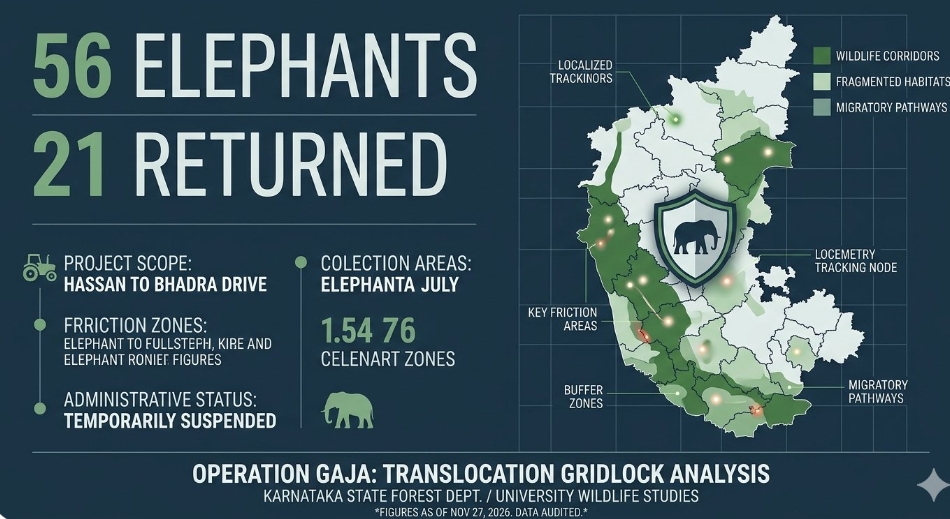
The Karnataka Forest Department has officially paused its massive wildlife translocation framework, known as Operation Gaja, following escalating political friction and intense public backlash. The controversial operation, which was legitimised to capture and relocate 56 wild elephants from the conflict-prone Belur and Sakleshpur taluks in Hassan district to the Bhadra Wildlife Sanctuary in Chikkamagaluru, has encountered severe resistance from farming communities and elected representatives across district borders.
The relocation drive was initially fast-tracked by the state after a highly volatile week marked by two fatal human-elephant encounters in Hassan, where wild tuskers killed locals. While forest administrative units deployed wildlife veterinarians, trained camp elephants, and thermal drone technology to capture two wild males successfully, the broader initiative to move dozens of remaining elephants triggered immediate panic in neighbouring Chikkamagaluru, where coffee plantation owners fear a spillover of human-wildlife conflict.
"We cannot take a one-sided decision; we must protect the interests of people in both districts," stated Karnataka Chief Minister D.K. Shivakumar whilst addressing reporters in Bengaluru regarding the suspension of the operation. "The geographical boundaries of Hassan and Chikkamagaluru are interconnected, and this relocation exercise could severely affect plantations in the recipient zone. Elephant movements cannot be arbitrarily controlled, and the concerns raised by the local legislators must be resolved through comprehensive consultations before any further field steps are taken."
Ecological auditing challenges reactive translocation policies
The sudden breakdown of Operation Gaja highlights deeper systemic questions regarding the long-term efficacy of moving wide-ranging megafauna across fragmented subcontinental biomes. Independent conservation specialists and scientific telemetry reports indicate that short-term captures fail to address the core driver of the crisis: the severe degradation of traditional migration corridors. Decades of infrastructure expansion, railway fencing, and the spread of invasive weed species have suppressed native fodder diversity, forcing herds to adapt permanently to agricultural mosaics.
Elected officials from Chikkamagaluru's coffee-growing constituencies, including Mudigere MLA Nayana Motamma, mounted significant political pressure against the Forest Department, even going as far as submitting conditional resignations to protest the unilateral transfers. Wildlife biologists have mirrored these anxieties, noting that elephants have highly developed spatial memory and moving herds accustomed to foraging in crop fields into a new sanctuary does not alter their behaviour, risking a displacement of the conflict zone rather than its resolution.
"Our primary objective must shift from reactive capture drives to long-term landscape-level interventions," noted a senior wildlife official reviewing the Western Ghats habitat logs. "The verified field data on habitat fragmentation confirms that our ecological margins are shrinking rapidly. If state industrial strategies and linear infrastructure projects are not legally aligned with strict environmental protection boundaries, the stability of our remaining ecological buffers will be permanently compromised, leaving farming communities and wild herds to bear the costs of a collapsing system."
Editor's Note
The suspension of Operation Gaja highlights that short-term translocation strategies cannot substitute for comprehensive habitat restoration. As the regional forest units pause active capture drives, policy focus must pivot toward establishing permanent biological corridors and elephant-proof barriers across the Western Ghats. State planners must utilise field telemetry data to design community-inclusive mitigation strategies, ensuring that upcoming conservation budget allocations directly address the economic concerns of agricultural zones in Hassan and Chikkamagaluru.



Leave a comment