

TreeTake Network
Institutional real estate investment paradigms have undergone a major regulatory transformation following the official launch of a unified global carbon accounting framework designed to eliminate rampant greenwashing across commercial property portfolios. On November 25, 2026, the Climate Bonds Initiative, based in London, and the Carbon Risk Real Estate Monitor Foundation announced the formal integration of their technical standard architectures at a senior briefing of international institutional underwriters. The newly minted framework unifies empirical transition pathways with fixed debt-issuance parameters, addressing a critical market failure where trillions of pounds in allegedly green real estate funds have historically relied on unverified, self-reported sustainability metrics.
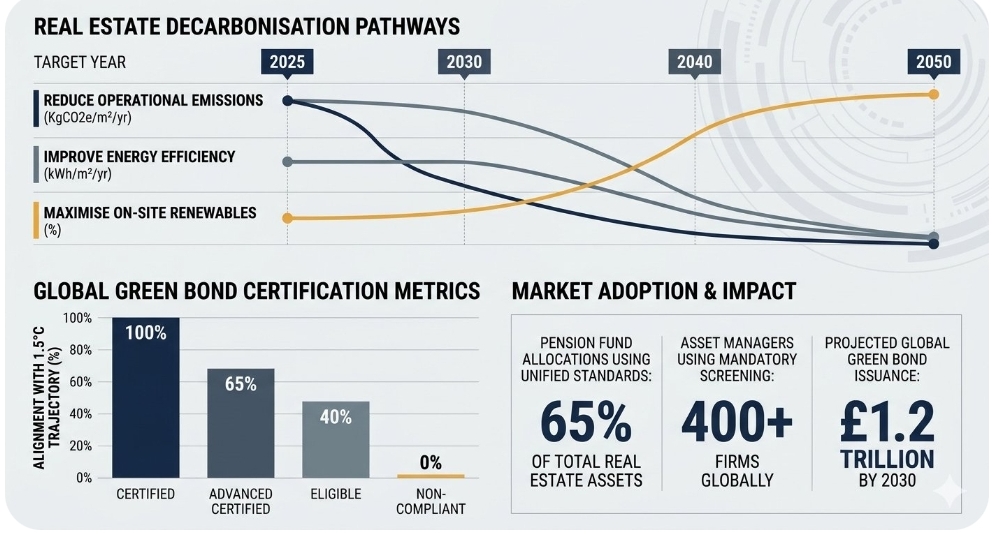
The real estate sector is currently responsible for approximately 39pc of global energy-related carbon emissions, with operational inefficiencies accounting for 28pc of that total. Under the new alignment, any property asset seeking climate-certified status or green bond financing must satisfy rigorous science-based reduction thresholds that scale downwards annually in accordance with a strict 1.5-degree Celsius global warming trajectory. Assets failing to hit these precise interim targets will face automated market penalties, including rapid credit downgrades and the immediate triggering of step-up interest rates for corporate bond issuers.
Standardised Pathways Stop Portfolio Devaluation
The lack of unified metrics has left global property funds highly exposed to sudden asset stranding, as municipal authorities tighten regional building emissions rules. The joint framework addresses this structural vulnerability by integrating predictive asset-level analytics directly into fixed-income underwriting software. This allows global banking consortiums to continuously stress-test real estate debt against real-time decarbonisation baselines, forcing property groups to choose between comprehensive retrofitting and market isolation.
Sean Kidney emphasized that the era of voluntary, self-styled green metrics in property investment has come to an end, stating that the new joint architecture creates an undeniable, scientifically verified threshold for international capital markets to identify genuinely low-carbon buildings. Professor Dr Sven Bienert added that providing a clear roadmap allows institutional investors to safeguard commercial real estate portfolios from massive structural devaluations driven by policy shifts.
Global Capital Mandates Enforce Compliance
The deployment of the unified standard comes amid a broader clampdown by financial watchdogs on misleading corporate sustainability claims. By aligning the monitor's rigorous asset-level projections with the initiative's internationally recognised certification badge, the partnership creates an unambiguous compliance template for major green debt markets. Asset managers managing pension funds and insurance capital across Europe and Asia have already indicated they will utilise the new criteria as a mandatory screening tool for all future real estate infrastructure allocations.
Financial Repercussions for Inaction
For global property corporations, the commercial implications of this framework are immediate and severe. Assets that fall behind their allocated decarbonisation curve will see their capital costs rise exponentially. Major banking groups have confirmed they are incorporating these specific transition pathways into their risk assessments, meaning that carbon-intensive properties will find it increasingly difficult to secure affordable refinancing options.
Editor's Note: The unification of these standard frameworks bridges the gap between environmental science and institutional finance. By transforming carbon trajectories into legally binding debt conditions, the market is finally positioning carbon efficiency as an undeniable element of fiduciary responsibility.



Leave a comment