

TreeTake Network
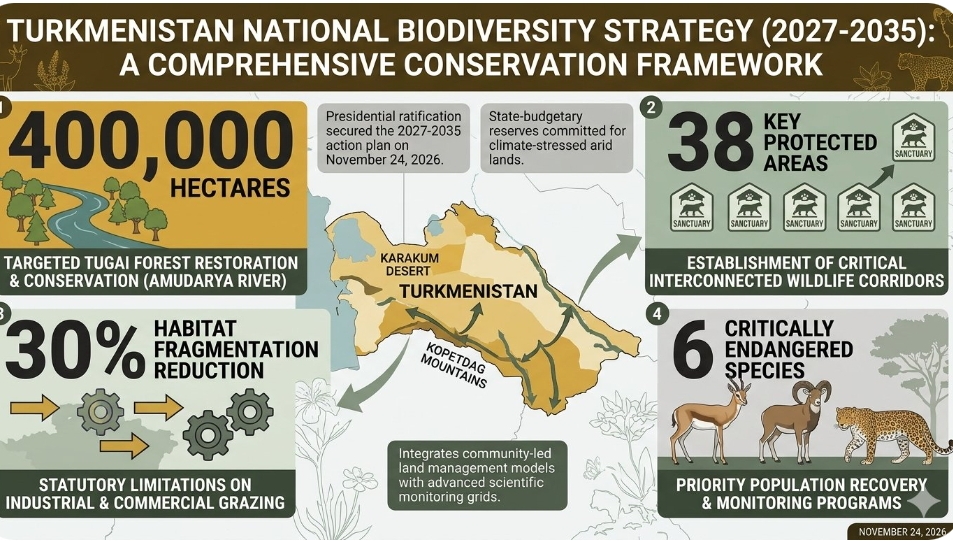
The Central Asian ecological landscape has received a transformative regulatory shield following the formal presidential ratification of Turkmenistan's new sweeping conservation blueprint. On November 24, 2026, the state administration sealed the statutory framework designed to systematically halt habitat fragmentation and shield vulnerable desert and mountain species across the nation. The expansive multi-year programme positions ecosystem restoration as a non-negotiable legal parameter, setting an ambitious regional precedent for cross-border wildlife conservation in highly arid terrains.
Legal barricades against habitat fragmentation
The newly enacted strategy introduces strict structural limitations on industrial expansion, mineral exploration, and commercial agricultural grazing within designated nature reserves and state sanctuaries. By mapping out interconnected biological corridors, the legislative text guarantees that wide-ranging migratory species can traverse natural terrains without encountering artificial barriers. The state has committed significant budgetary reserves to fund the direct restoration of degraded tugai forests along the Amudarya River and to combat desertification in the Kopetdag mountain ecosystems.
Ministry of Environmental Protection Specialist Dr Berdi Berdiyev hailed the policy shift during an official address in Ashgabat. Dr Berdi Berdiyev stated that the adoption of the 2027 to 2035 strategy marks a decisive departure from reactive conservation efforts, emphasising that for the first time, every single industrial development proposal will be legally subservient to national biodiversity preservation targets. Dr Berdi Berdiyev added that the country is fully prepared to enforce these rigid protection zones to reverse decades of arid soil degradation.
Preserving rare endemic desert wildlife
The conservation roadmap targets the immediate population recovery of several highly endangered species endemic to the Karakum Desert and adjacent highland frontiers. Academic institutions will work alongside state rangers to establish technology-driven tracking grids to monitor the elusive transboundary movements of the goitered gazelle, the Urial wild sheep, and the critically endangered Central Asian leopard.
United Nations Development Programme Regional Biodiversity Consultant Dr Elena Vasilyeva praised the rigorous technical parameters embedded within the national action plan. Dr Elena Vasilyeva noted that the strategy integrates advanced scientific monitoring frameworks with local community-led land management models, which is the only viable way to build landscape resilience in climate-stressed regions. Dr Elena Vasilyeva further observed that by safeguarding these fragile habitats, Turkmenistan is effectively protecting critical regional carbon sinks that prevent broader atmospheric destabilisation.
Editor's Note
Turkmenistan's aggressive move to codify biodiversity targets into a statutory national strategy represents the exact standard of environmental governance required to combat the global extinction crisis. True conservation cannot exist as a secondary consideration; it must serve as the foundational floor upon which all state development and resource use is planned. By making industrial players legally and financially accountable for habitat integrity, this framework demonstrates how legislative power can be successfully utilised to defend irreplaceable natural assets.



Leave a comment