

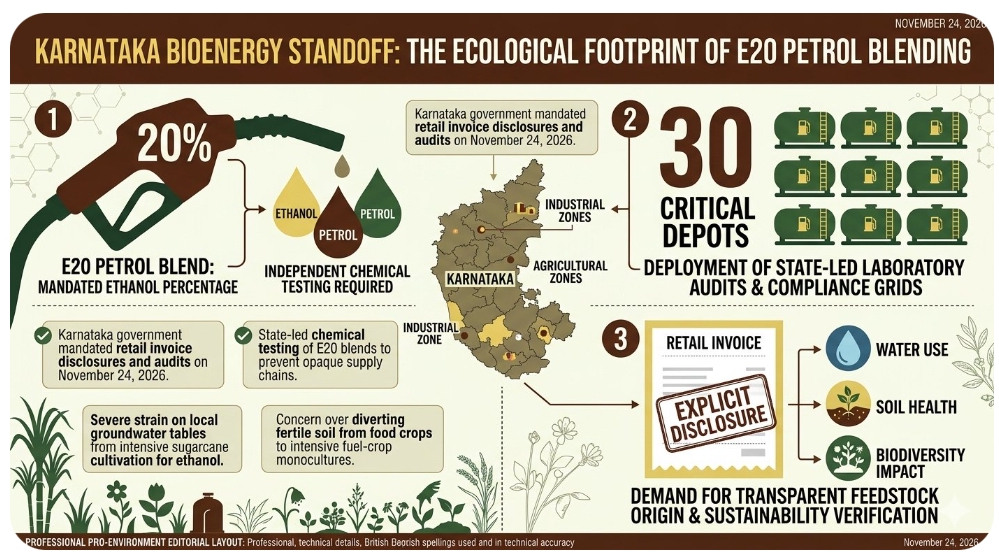
The environmental and economic cross-currents of India's aggressive biofuel transition have culminated in a fierce regulatory standoff between regional administrators and major state-backed oil marketing corporations. On November 24, 2026, the Karnataka state government escalated its oversight actions by demanding immediate, independent laboratory audits and explicit retail invoice disclosures for all 20 per cent ethanol-blended petrol commercialised across the province. The stringent policy push aims to protect consumers and fragile local ecosystems from unverified biomass sourcing amidst ongoing regional water and agricultural drought stresses.
Demanding absolute transparency in bioenergy supply chains
The administrative clash highlights growing anxieties over the ecological footprint of raw feedstocks utilized to meet federal biofuel targets. While biofuel blending is promoted as a pathway to reduce transport emissions, the intensive cultivation of water-guzzling sugarcane and food grains for ethanol production has placed immense strain on Karnataka's depleted groundwater tables. The state's new directive mandates that all fuel stations clearly print the exact percentage of ethanol blend on retail receipts and provide public verification certificates detailing the sustainable origin of the mixed agricultural biomass.
Karnataka Food and Civil Supplies Department Director Sri L Kumar issued an unyielding statement outlining the state’s enforcement mechanisms. Sri L Kumar stated that the state administration will not permit oil companies to operate behind an opaque veil while utilising local agricultural land, emphasising that independent chemical testing grids will be deployed at 30 critical storage depots to ensure that the commercialised E20 blends strictly match statutory ecological compliance standards.
Ecological anxieties over intensive feedstock farming
The regulatory battle underscores a deeper structural crisis within regional land-use policies. Environmental economists warn that diverting massive tracts of fertile soil from essential food crops to intensive fuel-crop monocultures degrades native biodiversity and exacerbates soil nutrient depletion during severe weather cycles.
Centre for Environmental Studies Senior Fellow Dr Hema Ramachandran strongly supported the state’s demand for transparency. Dr Ramachandran noted that without rigorous tracing mechanisms, the mass production of bioethanol can inadvertently accelerate local ecological bankruptcy by draining rivers and driving intensive chemical fertiliser run-off into sensitive river basins. Dr Ramachandran added that bioenergy programs must remain strictly subservient to local water security and soil preservation frameworks to be genuinely green.
Editor's Note: The regulatory friction in Karnataka serves as a timely reminder that the global transition to renewable fuels must not be achieved at the cost of local ecological collapse. For biofuels to function as a viable tool for climate mitigation, supply chains must be perfectly transparent, and feedstock cultivation must never override the non-negotiable protection of groundwater resources and regional food security.



Leave a comment