

TreeTake Network
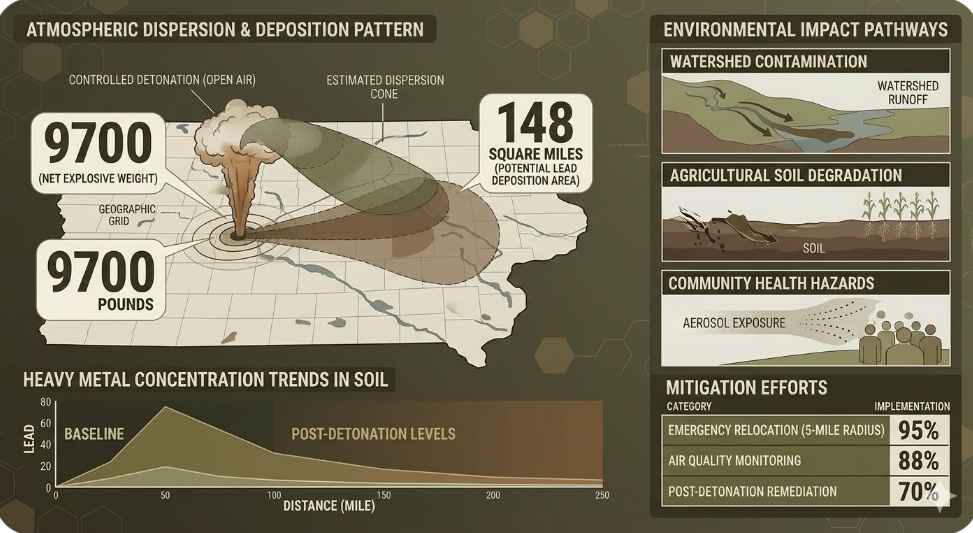
A tense environmental standoff in the midwestern United States has reached a critical juncture following a federal appeals court ruling that cleared the United States Army to proceed with an emergency open-air destruction sequence of highly toxic military explosives. On November 25, 2026, tactical ordnance specialists at the Iowa Army Ammunition Plant in Middletown, Iowa, initiated technical preparations for the controlled, in-place detonation of approximately 68 industrial drums containing degraded lead azide. The operation, which involves liquid nitration and intentional shock-treatment of nearly 9700 pounds net explosive weight of the primary blasting compound, has triggered severe public health alerts and mandatory community relocations across a five-mile emergency radius. Regional agricultural networks and conservation groups have expressed profound concern over the impending release of a massive atmospheric dust plume heavily contaminated with concentrated lead particles.
The controversy intensified after leaked internal communications revealed that contractor elements operating within the 19000-acre military installation had flagged signs of severe chemical crystallisation and material destabilisation months before the Department of Defence publicised the emergency. Lead azide, a highly sensitive chemical compound used to trigger secondary charges in artillery shells and cartridges, becomes hyper-vulnerable to catastrophic spontaneous explosion when allowed to dry out or interact with moisture inside earth-covered storage magazines. Because the structural deterioration has advanced past the point of safe mechanical transport, federal environmental regulators issued an extraordinary emergency permit bypassing standard containment rules, allowing the Army to vaporise the hazardous materials directly into the open atmosphere.
Atmospheric Dispersion Models Project Widespread Deposition
Consequence management modelling developed by the Defense Threat Reduction Agency indicates that the upcoming open-air blasts will generate a severe aerosolised plume. Computerised mapping released by emergency planners shows that lead dust levels exceeding the United States Environmental Protection Agency baseline safety limits could blanket an area spanning approximately 148 square miles. This extensive deposition footprint threatens to contaminate local premium topsoil, pollute regional watersheds draining into the Mississippi River basin, and leave persistent heavy metal residues across residential spaces.
Lori McFate clarified the tactical necessity of the operation, stating that out of an abundance of caution, the military is supporting the recommended relocation of all residents within the designated five-mile cone to prevent any direct exposure during the execution windows. Public health representatives remain highly critical of the administrative timeline, pointing out that heavy metal pollutants do not degrade naturally over time. Dr Meg Harris noted that the long-term environmental burden of allowing five tons of aerosolised lead to settle over eastern Iowa communities will create an enduring soil remediation challenge that local infrastructure is simply not equipped to handle.
Corporate Oversight Gaps Face Legal Scrutiny
As regional emergency teams establish real-time air monitoring arrays along the facility boundary lines, legal coalitions representing local landowners are preparing post-detonation litigation against the Department of the Army. Investigators are focusing heavily on the institutional failure that allowed such a massive quantity of primary military explosives to degrade into a volatile public hazard without timely intervention. Leaked logs demonstrate that repeated administrative delays in procuring stabilising chemical agents directly contributed to the material crystallisation.
Editor's Note: The Iowa ammunition crisis highlights a dangerous regulatory loophole where military exigency routinely overrides foundational environmental protections. Allowing open-air detonations of heavy metal compounds sets a damaging precedent, shifting the ecological and health costs of inadequate ordnance inventory management directly onto civilian populations and regional ecosystems.



Leave a comment