

Thinking Point
Brij Khandelwal
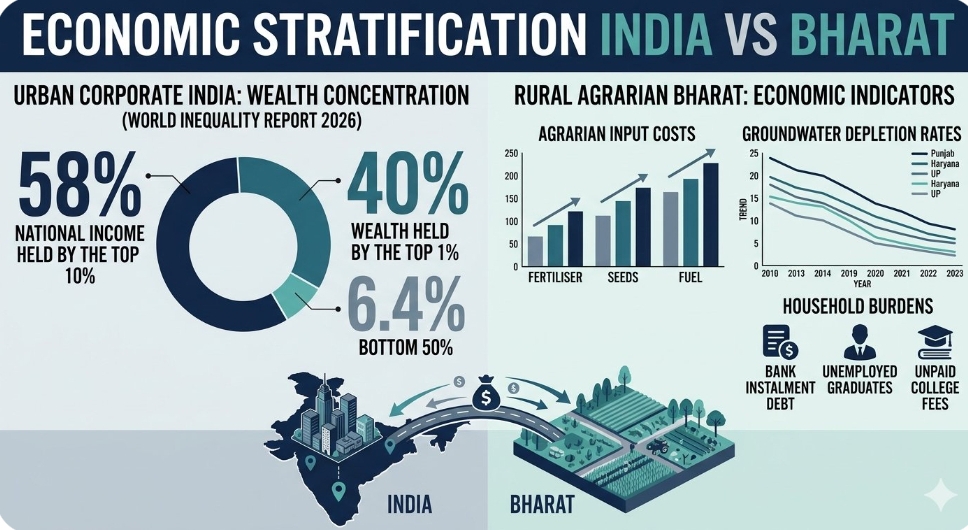
The relentless pursuit of a seven or eight per cent gross domestic product growth rate is proving to be both ecologically unsustainable and socially destructive for the vulnerable landscapes of rural India. On November 25, 2026, an unsettling internal rift has widened between 'India'—the hyper-industrialised, urban corporate core—and 'Bharat'—the struggling, nature-dependent agrarian countryside. While corporate treasuries report record-breaking profits, the smallholder farmers and indigenous communities who safeguard the nation's soil, water, and forests are being left entirely empty-handed. This aggressive economic expansion, heavily reliant on resource-intensive infrastructure, is systematically cannibalising natural ecosystems, depleting regional groundwater tables, and transforming fertile multi-crop agricultural belts into concrete industrial corridors.
The environmental crisis is unfolding across the rural heartlands, where the changing climate has combined with predatory economic policies to trap families in perpetual debt. As topsoil fertility degrades under the weight of industrial chemical inputs and changing weather patterns, smallholders face soaring cultivation costs alongside highly volatile crop yields. While state narratives celebrate massive expressways and multi-billion-pound corporate hubs, the fundamental ecological systems that sustain local communities are collapsing, proving that modern economic metrics fail to register the rapid destruction of natural capital.
Thinking Point: The Ecological Illusion of Gross Domestic Product
The core illusion of modern statecraft lies in measuring national progress through an abstract percentage that accounts for industrial output but completely ignores environmental liquidation. When a pristine forest is cleared for a commercial mining lease, or a natural wetland is paved over for a luxury real estate project, the gross domestic product rises, yet the permanent loss of carbon sinks, biodiversity, and community water security is recorded as zero. True development cannot be evaluated by the volume of poured concrete and steel; it must be measured by the purity of local rivers, the stability of topsoil, and the long-term ecological security of the people who cultivate the land.
Global Capital Drives Unprecedented Wealth Disparity
The environmental degradation of rural landscapes directly mirrors the severe socio-economic stratification captured in recent metrics. According to data from the World Inequality Report 2026, the wealthiest 10pc of the population currently controls approximately 58pc of the national income, while the bottom 50pc is left with a meagre 15pc. This extreme concentration of wealth is even more pronounced in property ownership, where the top 10pc commands nearly 65pc of total assets, leaving the lower half of the population with just 6.4pc of the country's wealth.
This highly distorted distribution means that the environmental penalties of rapid industrialisation—such as contaminated aquifers, severe toxic air pollution, and unchecked soil erosion—are disproportionately forced upon rural communities, while the financial rewards are concentrated within insulated urban boardrooms. The service-driven economic model rewards elite, capital-aligned classes while completely decoupling financial growth from regional employment creation or environmental stewardship.
Structural Exclusion and the Destruction of Agrarian Autonomy
The enforcement of uniform consumption taxes like the Goods and Services Tax has further burdened lower-income rural households, who spend nearly their entire income on daily essentials, leaving zero financial buffer for health crises or crop failures. Millions of youths holding technical degrees find themselves stranded in long queues for volatile gig-economy jobs, while traditional, low-impact village industries are pushed to the wall by state-subsidised industrial conglomerates.
Professor Parasnath Choudhary noted that if the rising tide of economic prosperity merely lifts the luxury yachts of the ultra-wealthy while drowning the small craft of artisanal fishers and marginal farmers, it cannot be called human welfare. He emphasised that a system where privileges accumulate faster than opportunities represents a profound structural failure.
Gandhian economic philosophy provides a direct alternative, stating that those who work the land must retain equitable control over the wealth it produces. Land, water, and local biodiversity are shared community heritages, not commodities to be sacrificed for short-term corporate gains.
Editor's Note: Relying on a seven or eight per cent growth rate driven by environmental exploitation and corporate concentration is a path toward long-term ecological bankruptcy. India must shift from an extractive economic framework to a regenerative model that prioritises real wages, asset equity, and natural capital accounting. True national progress is defined not by how far the wealthiest segments can outpace the rest, but by how effectively the state protects the ecological foundations and livelihoods of its most vulnerable citizens.


Leave a comment