

TreeTake Network
The regulatory framework governing solid waste management across Southeast Asia is trending towards a major legislative expansion following a comprehensive policy blueprint unveiled in Singapore. On November 25, 2026, the Singapore Environment Council officially published a seminal technical roadmap titled Beyond BCRS: A Roadmap to Comprehensive Packaging Responsibility. The detailed technical document explicitly advocates for the immediate expansion of the state’s current Extended Producer Responsibility framework to encompass every category of commercial packaging material distributed nationwide. This aggressive strategy introduces a system of eco-modulated fees targeting multinational consumer brands, domestic manufacturers, and prominent marketplace importers to penalise non-recyclable product components at source.
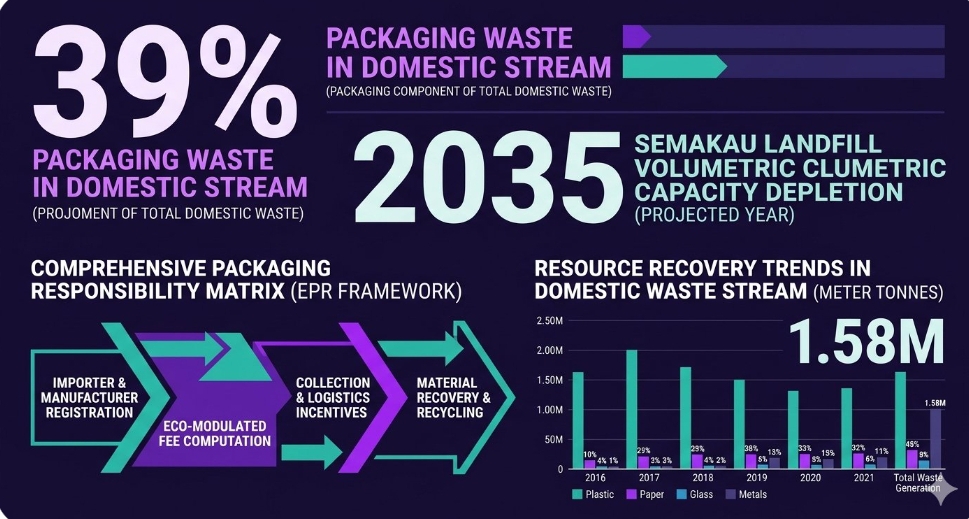
Packaging waste currently constitutes approximately one-third of the total domestic waste streams generated within the island nation. The state's singular offshore waste disposal repository, the Semakau Landfill, is officially projected to hit absolute volumetric capacity by 2035. Under the recommended guidelines, corporate entities exceeding an annual commercial turnover threshold of 10 million dollars will face statutory financial charges directly calibrated to the net environmental impact and physical volume of the specific packaging configurations they introduce into the local marketplace. This mechanism replaces standard flat-rate waste management fees, using sliding-scale pricing models to reward industrial designs that integrate biodegradable compounds and high-purity recycled polymers.
Expansion Targets Multi-Material Single-Use Waste
The proposed policy shift purposefully addresses the structural limitations of the existing Beverage Container Return Scheme, which commenced operations across urban centres earlier this year. While that initial programme successfully penalised unrecovered plastic and aluminium drink containers via a deposit-refund model, it left nearly 94pc of all commercial product wrapping entirely unregulated. The council’s expanded directive formally brings mixed-laminate films, shipping cardboard, rigid glass containers, and composite paperboard substrates into a unified fiscal enforcement matrix.
Dr Janil Puthucheary stated that for a resource-constrained nation like Singapore, with limited space for landfill use and recycling operations, the country must continue to push on reducing resource consumption. He noted that while implementing the foundational beverage scheme efficiently remains the primary state focus, the government is actively reviewing the Zero Waste Masterplan to explore how the country can move towards greater resource circularity. Executive representatives from regional environmental protection bodies emphasised that voluntary industry protocols have failed to generate real change, noting that only six per cent of the 1.58 million tonnes of domestic waste generated gets successfully recycled.
Eco-Modulated Fee Structures Disincentivise Excessive Packaging
Under the technical definitions outlined within the 23-page report, the eco-modulated financial levy will be computed as a direct product of put-to-market total volume and material lifecycle assessment ratings. Consumer goods conglomerates utilising complex multi-layered packaging that defies automated mechanical segregation will be subject to the highest pricing tiers. The accumulated financial revenues are legislatively ring-fenced to subsidise municipal sorting infrastructure, fund regional chemical recycling research initiatives, and expand public-private material recovery operations across the metropolitan core.
The administration intends to introduce these financial adjustments over a phased three-year timeline, using localised pilot schemes to build baseline datasets across industrial logistics channels. Multi-national e-commerce platforms operating in the territory are already modifying infrastructure configurations to comply with the upcoming reporting requirements, anticipating that neighbouring Southeast Asian markets will replicate Singapore's mandatory framework to protect their own strained waste-handling structures.
Editor's Note
The Singapore Environment Council’s technical roadmap transitions producer responsibility from a conceptual climate goal into an undeniable corporate liability. By establishing clear eco-modulated financial penalties, Singapore is creating an automated market mechanism that forces commercial operators to choose between packaging right-sizing and compounding operational costs.



Leave a comment