

TreeTake Network
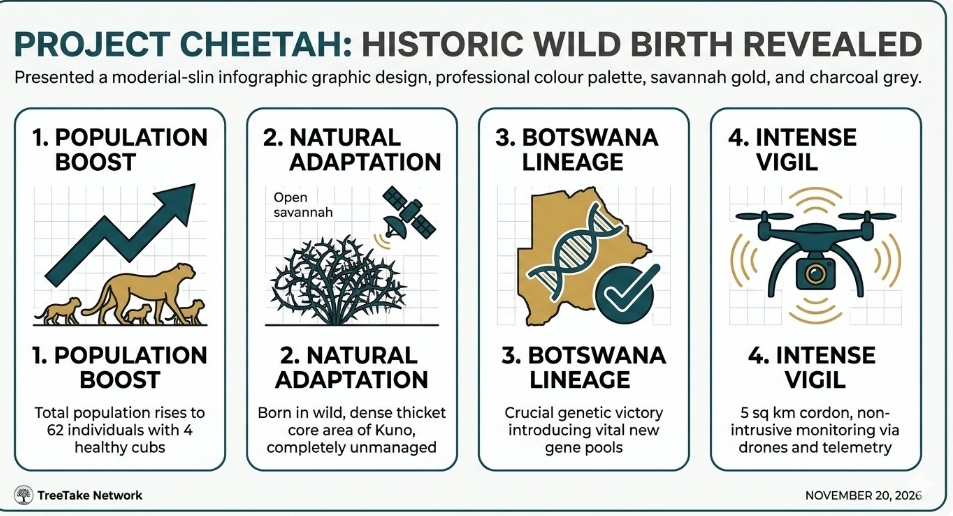
India's ambitious reintroduction initiative achieved an extraordinary conservation milestone on November 20, 2026, when a two-and-a-half-year-old female cheetah translocated from Botswana successfully gave birth to four healthy cubs in the wild. Project scientists and field trackers identified the cheetah as KOMG 3, and she delivered her litter in a highly secluded, dense thicket deep within the core area of Kuno National Park in Madhya Pradesh. Field teams monitoring her via satellite telemetry and visual tracking confirmed that both the mother and all four cubs appear to be in stable, excellent physical condition. Field staff observed the cubs suckling normally, indicating that the young mother has naturally adapted to her maternal instincts despite being a first-time mother in an entirely unfamiliar geographic terrain. This successful birth elevates the total population of reintroduced cheetahs in the country, including both adults and wild-born cubs, to 62 individuals, providing a significant demographic boost to the fragile, world-first intercontinental translocation programme.
Natural Birth Marks a Shift Toward Population Sustainability
Unlike several earlier litters born within the heavily managed confines of large, predator-proof acclimatisation enclosures, KOMG 3 chose a completely natural, unmanaged wilderness site to construct her denning spot. Field biologists note that this specific behaviour indicates a deep psychological and physical adaptation to the local landscape, proving that the African animals are effectively learning to establish home ranges, avoid native predators, and find secure shelters within the Indian ecosystem. The birth represents a crucial genetic victory, as KOMG 3 was part of a carefully curated batch of wild felines selected from Botswana to diversify the existing founder gene pool, which initially relied heavily on cheetahs brought over from Namibia in September 2022.
The forest department has immediately cordoned off a 5-square-kilometre radius around the maternal denning site to protect the mother and her highly vulnerable cubs from accidental disturbances, stray feral dogs, and larger sympatric predators like leopards. Specialised tracking teams equipped with drone cameras and high-definition long-range binoculars have been deployed at a non-intrusive distance to continuously monitor the family's health and movement patterns without altering their natural wild instincts.
Conservation Authorities hail Successful Adaptation and Genetic Resilience
The unexpected arrival of the four cubs has injected tremendous optimism into the wildlife community, validating years of intensive habitat management and multi-state administrative cooperation.
"This is an absolutely exhilarating moment for everyone involved in Project Cheetah," stated Uttam Kumar Sharma, the Field Director of Kuno National Park, during a morning press briefing. "The fact that a young female translocated from Botswana has chosen to den and give birth entirely on her own terms in the open wild environment proves that the habitat offers excellent cover and an abundant prey base. Our field tracking teams are keeping a very close, non-invasive vigil around the clock, and we are ensuring that absolutely zero human interference occurs anywhere near her chosen sanctuary".
Senior wildlife scientists involved in the technical implementation of the programme emphasised that successful wild-born generations are the only true metric for determining the long-term viability of the reintroduction experiment.
"We are witnessing the slow but steady naturalisation of the African cheetah into the Indian landscape," stated Dr S.P. Yadav, the National Tiger Conservation Authority's chief coordinator for the cheetah project. "Every wild birth lowers the statistical risk of population collapse and proves that the animals can adapt to local monsoon cycles, native parasites, and seasonal prey shifts. Our long-term goal remains focused on establishing a self-sustaining metapopulation, and this Botswana lineage will introduce vital genetic robustness needed to prevent inbreeding depression in the future".
Editor's Note: The birth of four wild cheetah cubs to a Botswana-sourced female is a monumental triumph for global reintroduction biology, yet it must not mask the acute structural challenges that remain for Project Cheetah. While localised reproductive success at Kuno National Park is highly encouraging, the long-term survival of the species in India depends entirely on the urgent expansion of secure, unfragmented habitats across regional boundaries. The way forward requires environmental ministries to rapidly operationalise the alternative sanctuaries at Gandhi Sagar and Nauradehi and establish secure wildlife corridors that let dispersing sub-adult felines roam safely without fatal human-wildlife conflict or unmanageable territorial battles within Kuno's restricted borders.



Leave a comment