

TreeTake Network
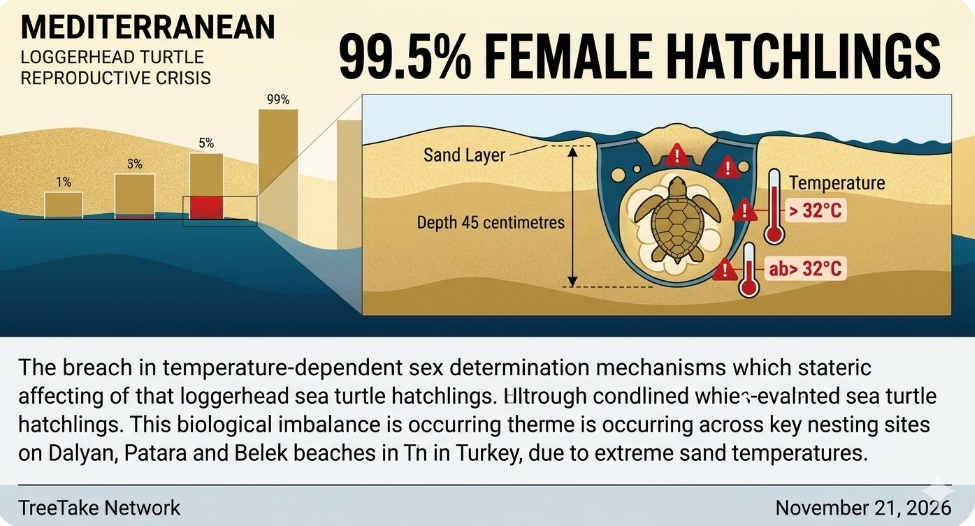
A profound ecological crisis has surfaced along the eastern Mediterranean shoreline, as marine biology research wings presented alarming field data at the COP31 biodiversity pavilions in Antalya on November 21, 2026. Long-term micro-sensor arrays embedded across critical loggerhead sea turtle nesting sanctuaries—including the highly protected conservation beaches of Dalyan, Patara, and Belek in Turkey—revealed that a severe, sustained spike in nesting sand temperatures has systematically disrupted the species' biological reproductive equilibrium. The extreme thermal profiles recorded throughout the core incubation windows have skewed the sex ratios of emerging hatchlings to a critical threshold approaching nearly 100 per cent female, threatening the species with total reproductive termination within generations.
Temperature-Dependent Sex Determination Breaches Biological Thresholds
Loggerhead sea turtles exhibit temperature-dependent sex determination, a biological mechanism where the ambient temperature of the surrounding sand matrix during the middle third of the incubation cycle dictates the final sex profile of the clutch. The pivotal nesting equilibrium temperature that produces an even division of male and female hatchlings sits precisely at 29 degrees Celsius. High-resolution geological telemetry logs presented by researchers showed that sand layers at a standard nesting depth of 45 centimetres systematically breached 32 degrees Celsius for 54 consecutive days during the peak seasonal breeding cycle, completely eliminating the thermal window required for male development.
"The field telemetry data across all major Mediterranean monitoring stations indicates a near-total absence of male hatchlings emerging from the monitored nests," stated Prof Yakup Kaska, Director of the Sea Turtle Research, Rescue and Rehabilitation Centre. "With sand profiles consistently surpassing 32 degrees Celsius, the biochemical pathways that guide male gonad differentiation are completely suppressed. Out of more than 14,000 documented hatchlings evaluated across our primary index beaches this season, less than zero point five per cent were confirmed as male, exposing a severe demographic bottleneck that could freeze reproductive capability entirely within the next two decades."
Geographic Thermal Mapping and Critical Nest Shading Interventions
The critical data release has sent shockwaves through the international conservation groups active at the Antalya summit, prompting field personnel to deploy immediate, non-invasive physical mitigation grids across the remaining late-season clutches. Marine rescue teams have initiated high-intensity beach management programs, utilizing specialized mesh fabric shields to provide artificial canopy cover above high-risk nesting zones. Initial control experiments tracked by local field stations confirmed that installing these custom shading arrays effectively reduced localized sand matrix measurements by two point five degrees Celsius, successfully restoring the incubation environment to tolerable reproductive parameters.
"We are executing emergency localized intervention protocols to physically shield the remaining active nesting profiles from direct solar radiation," reported Dr Inger Andersen, Executive Director of the United Nations Environment Programme. "However, these temporary beach-shading initiatives represent a highly localized, short-term buffer mechanism that cannot substitute for comprehensive global biosphere stabilization. The extreme thermal saturation of Mediterranean shorelines is a direct consequence of macro-scale ocean warming anomalies, and without a major reduction in regional coastal development and carbon-intensive industry footprints, these key nesting sanctuaries will cease to function as viable reproductive zones."
Long-Term Demographic Risks and Marine Protection Upgrades
The long-term survival of the Mediterranean loggerhead population depends on the continuous availability of mature male individuals to maintain genetic diversity and ensure successful fertilization across distinct breeding colonies. Field biologists tracking maritime migration vectors warned that while mature female sea turtles can lay multiple clutches per season, a severe scarcity of male mates will rapidly accelerate the incidence of unfertilized nesting attempts, triggering a rapid collapse in overall population recruitment metrics. Conservation coalitions are utilizing the live scientific presentation to demand that the Turkish Ministry of Environment, Urbanisation and Climate Change formally declare these thermal hotspots as strict, non-commercial marine enclaves.
"The data presented today must serve as an immediate catalyst for transforming our coastal protection paradigms," stated Prof Yalçın ER, Senior Climate Policy Advisor. "We can no longer limit our conservation focus to simply preventing the physical destruction of turtle nests by tourists or local predators. The strategic way forward dictates that we must actively manage the micro-climate of the nesting beaches themselves. Securing permanent legal protection against commercial beachside infrastructure development and installing automated, solar-powered misting networks to regulate sand dampness will be absolutely mandatory to preserving the biological future of the Mediterranean loggerhead population."
Editor's Note
The dramatic skewing of loggerhead sea turtle hatchling ratios in Turkey serves as a stark warning of how climate anomalies can silently drive a species toward extinction by disrupting fundamental biological mechanisms. While traditional conservation programs have successfully protected coastal nesting sites from physical destruction, they remain entirely unequipped to manage the invisible threat of thermal saturation within the sand matrix. The strategic way forward must involve the integration of micro-climate engineering protocols into global wildlife protection strategies, combining physical shading infrastructure with automated sand-cooling networks. Failure to transition from passive habitat preservation to active, technologically assisted biosphere management will ensure the total reproductive collapse of the Mediterranean's most ancient marine species.



Leave a comment