

TreeTake Network
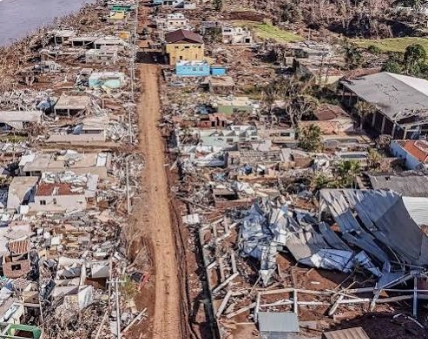
A powerful and highly destructive convective storm system swept across the southern state of Rio Grande do Sul in Brazil on November 21, 2026, triggering widespread structural devastation and claiming three civilian lives. The State Civil Defence department confirmed that extreme atmospheric instability generated intense wind gusts exceeding 100 kilometres per hour, accompanied by a sudden deluge of large-diameter hail and flash flooding anomalies. Emergency relief wings have rushed personnel to the hardest-hit municipal sectors, where approximately 5000 residential dwellings have been completely unroofed or structurally compromised, displacing thousands of families and severing critical regional power transmission grids.
Severe Atmospheric Instability Triggers Catastrophic Microbursts
Meteorological monitoring centres in South America tracked the development of an intense squall line that rapidly organised over the border areas of Uruguay and Argentina before moving into southern Brazil. Driven by a deep thermal low-pressure cell interacting with high tropical humidity, the system produced severe localised microbursts that ripped through rural and urban communities alike. Telemetry arrays recorded a peak wind speed of 104 kilometres per hour in the municipality of Soledade, while neighbouring agrarian belts witnessed prolonged hailstorms that systematically decimated emerging winter grain crops and commercial agricultural greenhouses.
"The structural damage is incredibly severe because the convective system manifested a series of high-velocity microbursts that directly impacted vulnerable residential roofing infrastructure," stated Lieutenant Colonel Santiago Ferreira, Operational Coordinator for the Rio Grande do Sul Civil Defence. "Our tracking data showed the squall line moving with immense translational speed, leaving communities with less than 15 minutes of advance localised warning. Our immediate technical priority is deploying emergency tarpaulins to protect the exposed interiors of roughly 5000 compromised structures as residual rains persist across the multi-district disaster zone."
Structural Disruption, Grid Failures, and Casualty Realities
The extreme kinetic energy of the storm system caused an immediate, widespread collapse of regional utility networks. Uprooted native eucalyptus trees and flying structural debris severed multiple sub-transmission lines, plunging over 3.20 lakh consumers into complete electrical darkness across the state. Localised emergency response teams confirmed that the three fatalities occurred in separate municipal zones: two individuals lost their lives due to structural collapses of unreinforced masonry walls in rural dwellings near Alegrete, while a third civilian was fatally struck by a falling high-voltage utility pole along a major transit route in Santa Maria.
"We are working in close coordination with municipal engineering cells to safely clear fractured trees from primary transport veins," reported Eduardo Leite, Governor of Rio Grande do Sul. "The physical destruction of the distribution grid is extensive, and utility corporations have deployed over 150 specialised repair teams on a war footing. While we have opened temporary community shelters to accommodate the immediate needs of the thousands of displaced citizens, we are urging extreme caution as multiple regional roadways remain blocked by unstable timber and low-hanging live electrical circuits."
Regional Climate Trends and Macro-Scale Infrastructure Resilience
The violent nature of this convective event aligns with an observed escalation in severe weather intensity across the southern cone of South America, where shifting tropical moisture pathways are frequently fueling more volatile spring storms. Environmental specialists presenting data on regional climate anomalies emphasised that the increasing frequency of these multi-district windstorms requires an immediate, comprehensive overhaul of municipal building codes across southern Brazil. Local administrators are calling for dedicated structural funding programs to reinforce rural housing projects, ensuring they can withstand severe localised wind shear without facing total collapse.
"The sheer footprint of this storm demonstrates that our regional infrastructure is facing atmospheric forces that systematically exceed historic baseline design parameters," stated Dr Carlos Nobre, Senior Climate Scientist and Earth System Specialist. "A convective system unroofing 5000 homes in a single morning is a clear indicator that regional building frameworks must transition toward wind-resilient engineering standards. The strategic way forward dictates that post-disaster reconstruction funds must not merely replicate old structural vulnerabilities; we must actively subsidise the integration of reinforced roof-to-wall anchoring systems across all high-risk subtropical climate corridors."
Editor's Note
The catastrophic impact of the convective storm system in Rio Grande do Sul highlights a critical gap between evolving meteorological risks and current residential infrastructure durability in South America. As climate anomalies intensify the thermodynamic energy available for microbursts and squall lines, standard construction methods are proving increasingly inadequate to protect human life and property. The strategic way forward must prioritise the establishment of national emergency infrastructure funds dedicated exclusively to climate-proofing vulnerable communities before disaster strikes. Integrating advanced localised radar networks with real-time mobile warning systems will be essential to giving citizens the vital minutes needed to seek proper shelter during subsequent severe atmospheric events.



Leave a comment