

TreeTake Network
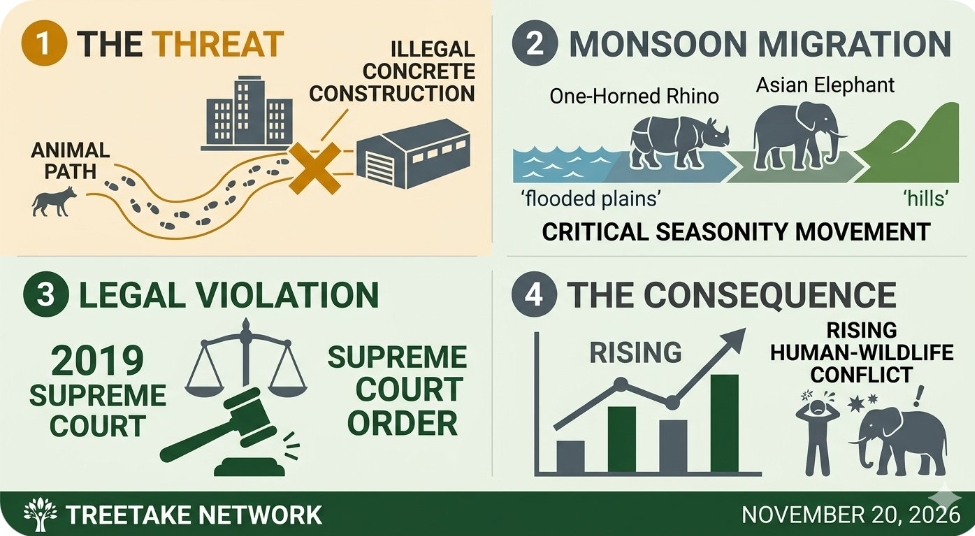
An escalating ecological crisis in Assam has reached the highest legal channels on November 20, 2026, as prominent environmental advocates filed a formal contempt petition with the Supreme Court-appointed Central Empowered Committee. The comprehensive legal filing alleges rampant, unauthorised commercial and residential construction directly inside the Haldhibari Wildlife Corridor. This critical strip of land serves as an indispensable ecological lifeline connecting the flood-prone grasslands of Kaziranga National Park to the safety of the Karbi Anglong hills. The petition presents definitive photographic and geospatial evidence showing newly constructed concrete pillars, commercial warehouses, and tourism-related structures built over recent months. Activists argue that these developments represent a blatant and direct violation of the historical 2019 Supreme Court order, which strictly prohibited any new construction activity along all nine identified wildlife animal corridors of Kaziranga to secure safe passage for migratory fauna.
Blocked Migratory Routes Expose Endangered Mega-Fauna to Acute Risks
The active construction work within the Haldhibari stretch has severely compromised the natural movement patterns of endangered wildlife species. During monsoon submergence events, thousands of animals—including Indian one-horned rhinoceroses, Asian elephants, Royal Bengal tigers, and various deer species—are ecologically hardwired to cross National Highway 37 via the Haldhibari corridor to seek higher, safer ground in the adjoining hills. With structural barriers, artificial night lighting, and increased human presence blocking these traditional paths, animals are increasingly forced onto unprotected roads or stranded in deep water, resulting in a marked escalation in fatal vehicle collisions and severe human-wildlife conflict incidents in surrounding fringe villages.
Field surveys conducted by local conservation networks reveal that local administrative authorities have systematically turned a blind eye to these unauthorised commercial projects. The petition argues that by issuing commercial permits and ignoring the rapid expansion of permanent concrete footprints within a legally protected ecological buffer zone, state and local officials are actively participating in the fragmentation of a globally recognised World Heritage site.
Legal Advocates and Conservation Specialists Demand Immediate Demolition
The legal action has drawn strong support from the Indian conservation community, with experts warning that structural inertia will lead to the irreversible collapse of Kaziranga's seasonal migration dynamics.
"We have submitted clear, undeniable evidence to the Central Empowered Committee showing how the Haldhibari corridor is being systematically choked by concrete," stated Rohit Choudhury, the pioneering Assam-based environmentalist and principal petitioner in the case. "The 2019 directives from the highest court were absolute and non-negotiable. Yet, local departments have chosen to prioritise short-term commercial gains over environmental law. We are demanding the immediate demolition of all post-2019 structures and the strict prosecution of the violating officials who allowed this destruction to occur".
Senior wildlife biologists specialising in landscape ecology have emphasised that preserving corridor integrity is just as critical as protecting the core national park itself.
"A wildlife sanctuary cannot survive as an isolated island," stated Dr Firoz Ahmed, a veteran wildlife scientist based in the region. "The Haldhibari corridor is a vital functional link. If you place permanent commercial structures directly in the path of migrating elephants and rhinos, you do not just disrupt their movement—you actively trigger catastrophic human-wildlife encounters. The rule of law must be enforced immediately to safeguard these evolutionary pathways before they are permanently lost to commercial urbanisation.
Editor's Note: The continuing commercial encroachment within the Haldhibari Wildlife Corridor exposes a profound failure of local environmental enforcement and highlights the systemic vulnerability of India's most celebrated conservation landscapes to illegal commercial exploitation. Passing landmark judicial orders is completely meaningless if the ground-level bureaucracy routinely fails to implement them against influential commercial actors. The way forward requires the Supreme Court to initiate exemplary punitive action against the top district administrative officers, alongside ordering an immediate, state-enforced demolition drive to completely clear the Haldhibari corridor, thereby establishing a firm legal precedent that prioritises long-term ecological survival over short-term commercial interests.



Leave a comment