

Talking Point
TreeTake Network
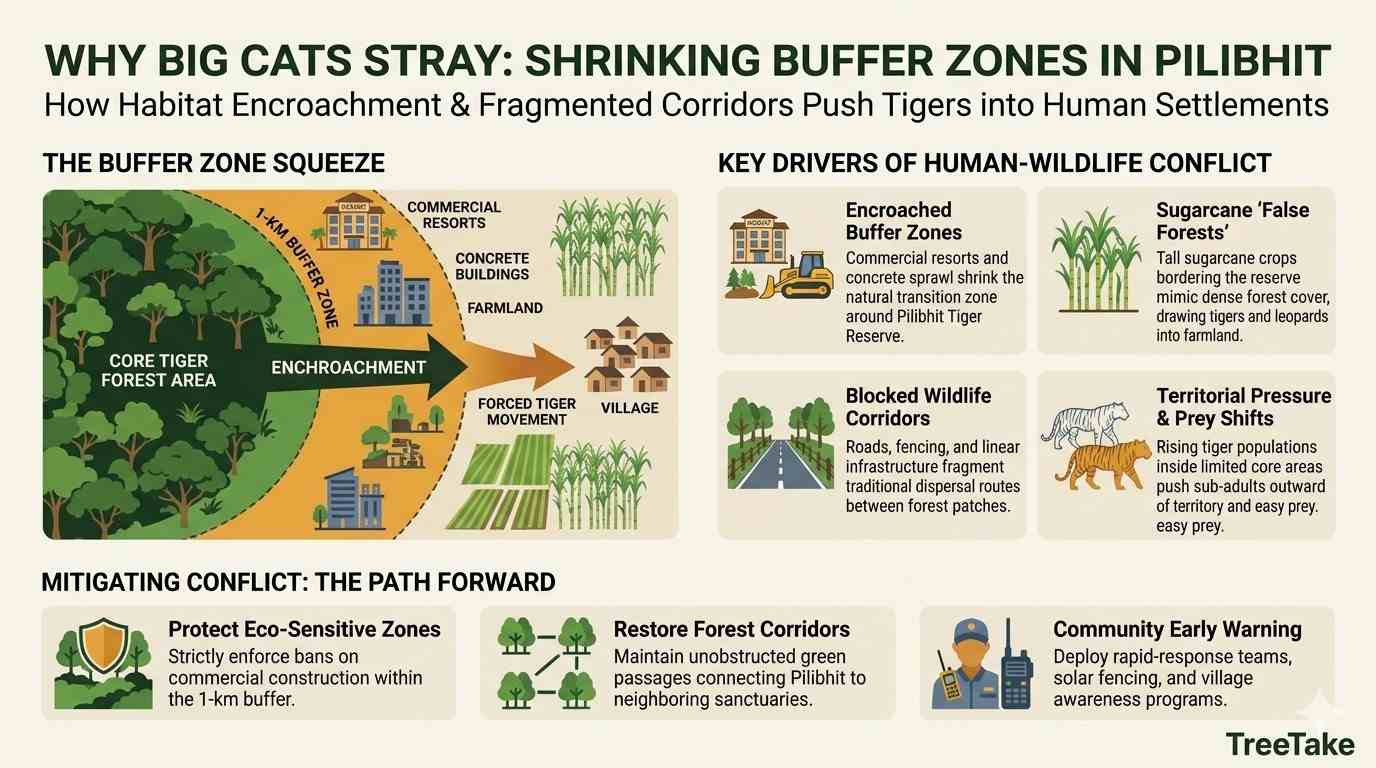
Widespread commercial encroachment, unauthorised resorts and decades-old land disputes are actively threatening the Eco-Sensitive Zones (ESZ) and wildlife corridors of Uttar Pradesh’s protected tiger habitats, triggering intense legal battles from district revenue courts to the National Green Tribunal (NGT). Situated along the trans-boundary Terai Arc Landscape, reserves such as Pilibhit act as critical ecological lifelines connecting Indian forests with protected wildlife habitats in Nepal. When concrete structures and commercial compounds encroach upon these narrow peripheral zones, they sever vital migration routes, shrink available prey habitats and push large carnivores closer to agrarian settlements.
Official investigations and panel findings
Concerns over unregulated construction bordering the Pilibhit Tiger Reserve (PTR) first formally surfaced in November 2021, when the then-PTR Divisional Forest Officer Naveen Khandelwal issued a stop-work notice against an unauthorised farmhouse near the critical Mahof forest range. Despite that early administrative directive, commercial development continued to expand steadily along the forest boundary, driven by a post-pandemic surge in wildlife tourism, rising land speculation near popular safari entry gates and weak inter-departmental enforcement on the ground.
In January 2026, acting on a petition filed by Lucknow-based advocate Shashank Singh, the NGT constituted a joint inspection committee comprising senior officials from the National Tiger Conservation Authority (NTCA), Katarniaghat Wildlife Sanctuary and the Pilibhit district administration. Following a comprehensive two-day field survey in July 2026, the committee reported widespread regulatory breaches within the mandatory 1-kilometre Eco-Sensitive Zone of PTR’s core area:
32 permanent structures and 35+ facilities: Inspectors catalogued 32 permanent concrete structures—including private resorts, hotels, farmhouses, and a police guest house—alongside more than 35 commercial tourist facilities operating without mandatory clearances from forest authorities or environmental regulators.
Regulatory loopholes: The panel found that commercial operators were systematically exploiting community-based "homestay" provisions by artificially subdividing larger plots of land or adopting the homestay label to bypass Supreme Court guidelines and environmental restrictions on commercial establishments. Rather than empowering local rural households as envisioned under state eco-tourism policies, these large-scale hospitality ventures introduced heavy vehicular traffic, bright artificial floodlighting, groundwater extraction and high-decibel noise directly against the sensitive forest edge.
Speaking to TreeTake, DFO, Pilibhit Tiger Reserve, Manish Singh said: “ In Pilibhit Tiger Reserve, there are about 1170 hectares of land on which there are old encroachments. Various cases are going on from the district to the high courts in this regard, and the tiger reserve is pursuing the cases. There is some land on which efforts have been made to remove encroachments and there has been some success. Under the Deoria Range, we have vacated about 43 hectares of land in February-March, 2026. Plantation has been carried out here. Investigation is on in certain other cases. So where litigation is on, we are pursuing the cases, and in places where the district administration has got encroachments removed, we are carrying out plantations.”
Confirming the findings to the Press, DFO and NGT committee member Apoorv Dixit stated: "The committee has identified over 35 tourist facilities with permanent structures within 1 km of the reserve's core forest area that lacked valid permission from the competent forest authority, at the very least the DFO."
Perspectives from conservationists, NGOs and petitioners
Wildlife experts, conservation organisations and legal petitioners emphasise that concrete barriers and shrinking buffer zones are driving severe ecological fragmentation and fatal human-wildlife conflict across the Terai landscape. Because Eco-Sensitive Zones are specifically designed to act as shock absorbers for protected areas, any commercial hardening of the forest perimeter alters animal behaviour and increases stress on dispersing tigers and elephants. On shrinking buffer zones: Explaining why big cats frequently stray into human settlements around Pilibhit, Pilibhit-based wildlife expert and social activist Durgesh Prajapati noted: "Another reason that results in the animals coming out of forest areas is a very narrow and almost non-existent buffer zone around the PTR. Villages in Pilibhit and the fields are located just at the boundary of the forest."
On community conservation vs. encroachment: Mudit Gupta, head of the Terai Arc Landscape (TAL) at the World Wide Fund for Nature (WWF), warned against the twin pressures of human infiltration and conflict in the region, urging Uttar Pradesh to adopt participatory models like neighbouring Nepal: "As community-based wildlife programmes produced outstanding results in Nepal, they should be followed in UP with initiation at Pilibhit Tiger Reserve, which is facing man-tiger conflict and massive human infiltration in core forest areas."
On ecological damage: In his submissions before the tribunal, petitioner Shashank Singh highlighted how resorts degraded the fragile fringe ecosystem: "Unregulated construction in the ESZ threatens wildlife and human safety by fragmenting habitats, disrupting animal corridors and increasing the risk of human-wildlife conflict."
Ground reality, staff collusion and local protests
On the ground, official records and local agitations point to direct habitat intrusion, internal complicity and growing pushback from fringe villagers who bear the brunt of both ecological disruption and lost access to traditional community spaces:
Direct habitat intrusion: In December 2025, a resort near the Mahof range was caught transporting heavy construction material directly through protected forest land and opening wastewater drainage outlets straight into prime tiger habitat. Subsequent forest inquiries pointed to collusion by local field staff, prompting Range Officer Sahendra Singh Yadav to register a formal case under the Wildlife (Protection) Act against a labour contractor and a Class IV forest worker.
Local resistance against resort encroachments: In April 2026, residents of Mainkot village in Pilibhit staged vocal protests after an under-construction resort allegedly encroached upon the historic three-acre Sagartal reservoir and temple site. Local resident Om Pal publicly alleged that an outside businessman had walled off the centuries-old community water body to absorb it into his upcoming luxury resort project near the reserve, prompting Sub-Divisional Magistrate Pramesh Kumar to order revenue officials to demolish the illegal boundary wall within 24 hours.
Encroachment and casualties: Right to Information (RTI) disclosures from July 2026—submitted in a separate NGT petition by Pilibhit-based lawyer Shivam Kashyap—revealed that 1,172.8 hectares of land inside PTR remained under encroachment. Kashyap's petition noted that physical barriers across traditional elephant migration routes, combined with tall sugarcane cultivation along the forest fringe that mimics natural grass cover for big cats, had heightened human-wildlife encounters, contributing to roughly 60 human-tiger conflict deaths over the past decade.
Multi-tiered legal action: From district courts to the NGT
Enforcement and conservation efforts are currently unfolding across multiple judicial tiers, testing coordination between revenue authorities, local law enforcement and state forest departments.
National Green Tribunal crackdown: Reviewing the joint committee’s inspection report in July 2026, an NGT bench headed by chairperson Justice Prakash Shrivastava ordered strict action against the identified violators and permitted impleading the resort owners directly in the legal proceedings. After consolidating related encroachment petitions in October 2026 to ensure uniform oversight, the tribunal issued formal notices to the Union Home Ministry, the Environment Ministry, the NTCA and the Uttar Pradesh government, scheduling a joint compliance hearing for January 8, 2027.
Legacy land litigation: Alongside newly built commercial resorts, multi-decade land disputes continue to stall critical conservation infrastructure and habitat restoration projects. A planned Rs 48-crore leopard safari project in Gopalpur remains delayed due to ongoing litigation over 30.53 hectares of reserve land improperly leased to villagers in 1983. Although lower revenue courts and a division bench of the Allahabad High Court previously cancelled those disputed lease deeds, subsequent appeals remanded the matter back to the court of the Pilibhit Additional District Magistrate (Judicial), where proceedings remain ongoing, according to PTR DFO Bharat Kumar DK.
Way Forward
With the National Green Tribunal closely monitoring administrative compliance ahead of its January 2027 hearing and district revenue courts adjudicating legacy land titles, regulatory agencies face mounting judicial and public pressure to dismantle illegal commercial infrastructure and restore intact buffer zones across Uttar Pradesh's tiger reserves. Ultimately, the outcome of these coordinated legal interventions will set a vital precedent for conservation governance across northern India, determining whether state authorities can reconcile surging eco-tourism demand with the strict ecological boundaries required to safeguard thriving tiger populations and adjacent rural communities.



Leave a comment