

TreeTake Network
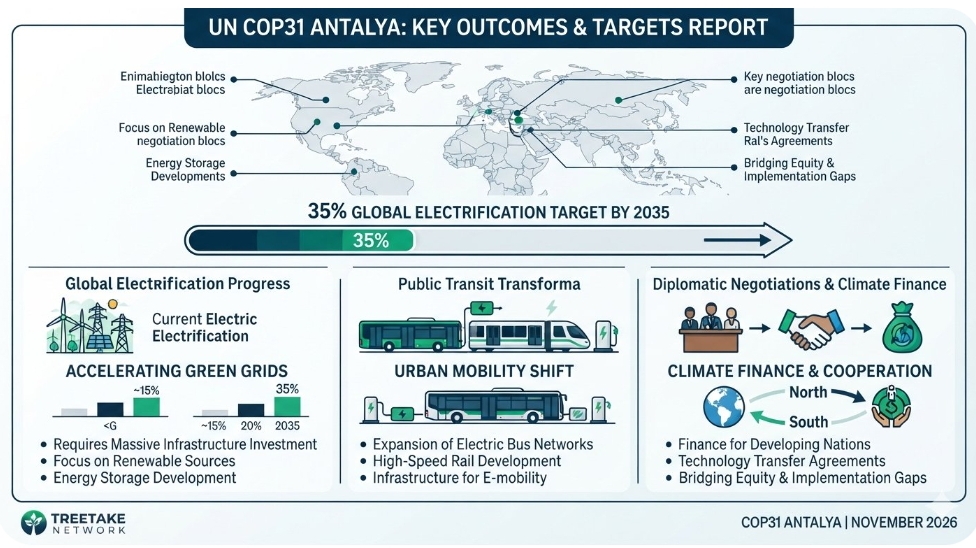
The ongoing United Nations COP31 climate summit in Antalya has descended into intense structural negotiations following a historic yet deeply contested joint electrification declaration. In an unexpected turn during the high-stakes ministerial sessions, the host nation, Türkiye, alongside Australia, formally introduced the Global Electrification Pathway Pact. The ambitious multinational blueprint mandates a legally binding 35 per cent global electrification target across all public transport and industrial infrastructure by the year 2035. Whilst the framework has garnered robust endorsement from several European and North American delegations, it has triggered immediate resistance from major developing economies, most notably India, over deep-seated climate justice and financial equity concerns. The resulting diplomatic impasse has exposed structural fissures within the international governance framework, threatening the integrity of the broader multilateral negotiations as the summit transitions into its final legislative phase.
The Electrification Blueprint and Technical Imperatives
The core framework of the Global Electrification Pathway Pact demands an aggressive acceleration of domestic infrastructure modifications across all signatory states. According to the technical annexures distributed during the closed plenary session, the 35 per cent threshold applies uniformly to municipal transit systems, heavy rail networks, and thermal-intensive industrial sectors. Western negotiators argue that this baseline is an absolute mathematical necessity to maintain the global emissions trajectory within the boundaries established under the Paris Agreement. The proposal requires developed nations to reach the 35 per cent mark by 2032, whilst granting a brief three-year grace period to developing nations, establishing their hard deadline in 2035. To monitor compliance, the pact proposes the creation of an independent oversight body empowered to impose trade-related carbon penalties on nations failing to meet their annual installation targets.
Developing Nations and the Indian Stance on Climate Equity
Indian delegates, speaking from the plenary halls, expressed extreme dissatisfaction with the accelerated timeline, asserting that the pact deliberately ignores the historic carbon debts of developed countries whilst placing disproportionate infrastructure conversion costs on industrialising regions. The Indian delegation emphasised that transitioning complex, coal-dependent manufacturing grids to pure electrification within a short window remains an impossible feat without trillions of dollars in unconditional, non-debt climate financing. Officials from the Ministry of Environment, Forest and Climate Change argued that forcing a uniform timeline violates the core principle of common but differentiated responsibilities. They maintained that India’s domestic priorities must focus on poverty eradication and equitable economic growth, both of which rely on maintaining affordable, stable energy matrices during the transitional decade.
The Secretary-General Addresses a Deadlocked Assembly
The political gridlock prompted an extraordinary, unprompted intervention from United Nations Secretary-General António Guterres, who delivered an emotionally charged address to the deadlocked delegates. In a stark, unvarnished rebuke, the Secretary-General warned that the global community is running out of options to avert irreversible ecological collapse, describing the current trajectory as an unmitigated descent into a burning planet. Guterres insisted that minor market corrections and conditional loans are no longer sufficient to offset the cascading loss of biodiversity and the rapid acceleration of extreme weather events worldwide. He demanded that wealthy nations initiate massive debt cancellation models for climate-vulnerable territories, arguing that the true cost of inaction would completely dwarf any immediate financial sacrifices.
Geopolitical Alignments and Sovereign Impasses
The introduction of the pact has redrawn the geopolitical lines within the negotiation halls, creating distinct blocs that refuse to yield on structural terms. The European Union and Australia have formed a unified coalition, arguing that market-driven mechanisms will naturally lower the cost of electrification technologies over the next decade. Conversely, the Like-Minded Developing Countries group, aligned with the African Group of Negotiators, has raised serious concerns regarding sovereign autonomy and supply chain security. They point out that the critical minerals required for widespread electrification, such as lithium, cobalt, and rare earth elements, are heavily monopolised by a small number of global actors, leaving poorer nations highly vulnerable to severe trade imbalances and economic coercion.
Expert Operational Perspectives
"We cannot allow a well-intentioned environmental target to be converted into an economic weapon that suppresses the growth of the Global South," stated an expert analyst monitoring the closed-door negotiations closely. "If the developed world wants an electrified future, it must pay for the copper, the grids, and the storage facilities in the countries that it previously exploited. Without concrete technology transfers, this pact remains a piece of paper that exacerbates global inequality under the guise of green modernisation. The focus must shift to building local manufacturing capacities rather than enforcing external procurement mandates."
Official Declaration by United Nations Leadership
Addressing the assembly with visible urgency, António Guterres stated: "The world is tired of empty promises and clever legal loopholes whilst ecosystems perish before our eyes. We are standing on the precipice of a burning planet, and the global financial architecture is actively preventing vulnerable states from saving themselves. True leadership requires the immediate, total cancellation of climate debt for the poorest nations, alongside an unyielding commitment to finance the green transition where it is needed most. We cannot bargain with physics, and we cannot negotiate with a changing climate."
Editor's Note
The deadlock at the Antalya summit underscores the systemic failure of the international climate governance apparatus to bridge the gap between aspirational green targets and the stark realities of industrial development. By framing global electrification as a universal mandate without establishing robust, non-repayable financing mechanisms, developed nations are continuing a pattern of ecological colonialism that threatens to alienate crucial partners like India. Moving forward, the United Nations must transition away from aggregate global targets and focus exclusively on binding national commitments that are directly proportional to historic emissions. To break the impasse, the host country must introduce a tiered implementation mechanism that delays compliance deadlines for developing nations whilst legally binding wealthier states to upfront infrastructure capital provisions.



Leave a comment