

Thinking Point
Shreyansh Singh
Uttar Pradesh Pollution Control Board Headquarters, Lucknow, Uttar Pradesh
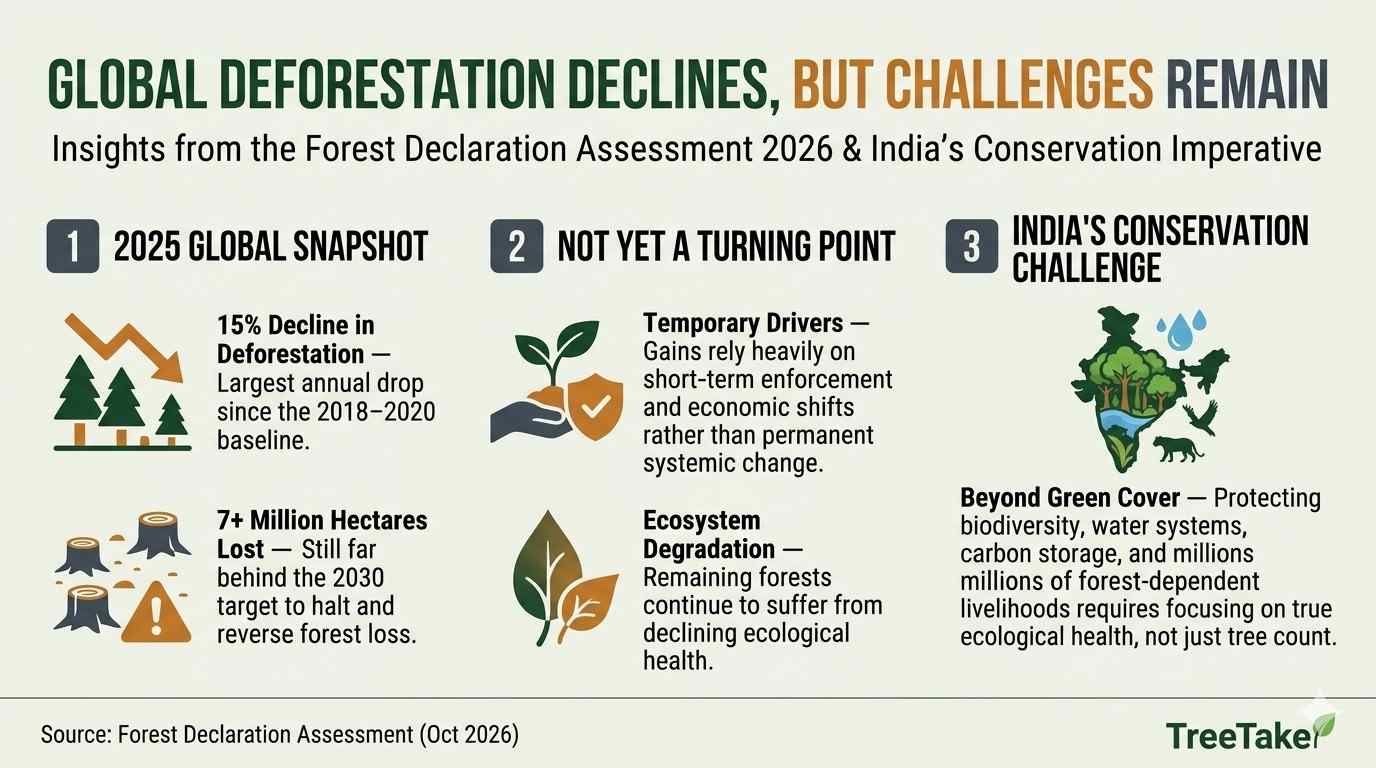
Global deforestation declined in 2025, offering a welcome sign of progress. Yet, with millions of hectares still disappearing, India's challenge is to protect not just the extent of its green cover, but also the ecological health of its forests.
The world's forests have received a small but significant reprieve. According to the Forest Declaration Assessment 2026, published on 13 October 2026, global deforestation declined by 15 per cent in 2025 compared with the previous year. This was the largest annual decline since the assessment's 2018–2020 baseline period. However, more than seven million hectares of forest were still lost to deforestation during the year, leaving the world considerably behind its commitment to halt and reverse forest loss by 2030. The findings present two contrasting realities. On one hand, the decline demonstrates that progress is possible. On the other, the continuing loss of forests reveals how far the world remains from achieving its environmental commitments. For India, a country where forests support biodiversity, regulate water systems, store carbon and sustain millions of livelihoods, this development offers an important opportunity to reconsider what successful forest conservation should mean.
A global improvement, but not yet a turning point
The Forest Declaration Assessment 2026, which tracks progress towards global forest goals, warns that a single year of declining deforestation does not necessarily represent a lasting change. Some of the improvement reflects stronger enforcement in certain countries and changing economic conditions rather than a permanent reduction in the pressures driving forest destruction. The assessment also highlights the continuing deterioration of forest ecosystems. In 2024, approximately 65.4 million hectares of forest worldwide shifted into a lower ecological integrity category. This illustrates why deforestation and forest degradation must be understood separately. Deforestation involves the conversion of forest to another land use, whereas degradation refers to a decline in a forest's ecological condition and functioning. A forest can therefore remain standing while losing biodiversity, becoming fragmented or experiencing declining ecological quality. The distinction is important for climate action. Forests absorb and store carbon, but their value extends beyond carbon sequestration. They provide habitats for wildlife, regulate local water cycles, protect soil, support pollinators and sustain communities that depend on forest resources. Losing these functions can have long-term consequences even when an area continues to appear green on a map. The assessment estimates that approximately 11.8 million hectares are under active forest restoration worldwide. Although restoration efforts are expanding, their scale remains insufficient to meet global ambitions. The report consequently calls for stronger forest protection, improved financial support, better supply-chain accountability and more effective recognition of the rights of Indigenous Peoples and local communities.
The message is clear: slowing forest loss is necessary, but protecting the ecological integrity of the forests that remain is equally important.
Understanding India's Forest Cover
India's forest statistics provide an essential starting point for understanding the national challenge. The India State of Forest Report 2023, released by the Union Minister for Environment, Forest and Climate Change on 21 December 2024, was published by the Forest Survey of India under the Ministry of Environment, Forest and Climate Change. According to the report, India's combined forest and tree cover was 827,357 square kilometres, representing 25.17 per cent of the country's geographical area.
This comprised 715,343 square kilometres of forest cover, or 21.76 per cent of the geographical area, and 112,014 square kilometres of tree cover, or 3.41 per cent. Compared with the 2021 assessment, the combined forest and tree cover increased by 1,445 square kilometres. These figures provide valuable information about India's green cover. However, they require careful interpretation. Under the Forest Survey of India's methodology, forest cover includes land parcels larger than one hectare with tree canopy density exceeding 10 per cent, irrespective of ownership or legal status. Consequently, the mapped category does not necessarily correspond to legally recorded forest land or exclusively to natural forests. The assessment also includes certain orchards, bamboo and palm areas.
Tree cover, meanwhile, captures trees outside the forest-cover category, including trees in agricultural landscapes and settlements. This does not make the statistics unimportant. Satellite-based assessments provide an essential national picture of changes in vegetation cover. Nevertheless, an increase in total forest and tree cover should not automatically be interpreted as an equivalent increase in natural forest ecosystems or biodiversity. A plantation, an agroforestry system and a mature natural forest may all contribute to green cover, but they can differ considerably in species composition, habitat quality, carbon storage, water use and ecological resilience. India's forest policy must therefore consider both the extent of tree cover and the condition of the ecosystems that sustain it.
Why forest quality matters as much as quantity?
Natural forests develop through complex ecological interactions among plants, animals, microorganisms, soil and climate. Their structure and composition vary according to rainfall, temperature, altitude, soil conditions and disturbance history. Replacing a diverse natural forest with a plantation of a few tree species may maintain some vegetation cover, but it cannot be assumed to reproduce the original ecosystem's ecological functions. This distinction is particularly relevant to forest restoration. Planting trees is often treated as a straightforward environmental solution, but restoration requires an understanding of the landscape being restored. Naturally open grasslands, wetlands and other non-forest ecosystems should not automatically be converted into tree plantations simply to increase tree cover or carbon storage. In appropriate locations, plantations can provide timber, support livelihoods, restore certain degraded lands and contribute to carbon sequestration. Natural regeneration can also be effective where ecological conditions and seed sources allow forests to recover with limited intervention. The appropriate approach depends on the original ecosystem, the extent of degradation, local biodiversity and the needs of surrounding communities. Forest fragmentation presents another challenge. Roads, mining, infrastructure development and changes in land use can divide continuous habitats into smaller patches. Even where some tree cover remains, fragmentation can restrict wildlife movement, isolate populations and alter ecological processes. For India, protecting existing natural forests, improving the quality of degraded forests and restoring connectivity between habitats must therefore complement efforts to increase overall green cover.
Climate change and the wider value of forests
The relationship between forests and climate change extends beyond the carbon stored in trees.
Forests influence water infiltration, soil stability, local microclimates and the movement of water through landscapes. Healthy forest ecosystems can support resilience to certain climate-related stresses, although their effectiveness depends on local conditions and cannot eliminate the risks associated with extreme weather. Climate change, in turn, can increase pressure on forests through heat stress, drought, changing rainfall patterns and altered fire conditions. The interaction between these pressures and human activities can make some ecosystems more vulnerable to degradation. India's forests are also closely connected to agricultural productivity and rural livelihoods. Forests can support pollinators, contribute to soil and water conservation, and provide food, fuel and other resources to communities. Their degradation can consequently affect both ecological stability and economic security.
These connections make forest conservation relevant to India's climate commitments, biodiversity objectives and sustainable development priorities. However, forests should not be treated as a substitute for reducing fossil-fuel emissions. Protecting and restoring forests must accompany, rather than replace, efforts to decarbonise the wider economy.
Turning commitments into measurable results
India has established programmes to support afforestation, restoration and forest management. The Green India Mission, the Compensatory Afforestation Fund Management and Planning Authority, and initiatives promoting urban green spaces are among the mechanisms intended to support these objectives. Their long-term value depends on how effectively they are implemented and monitored. A credible assessment of restoration should look beyond the number of seedlings planted. Relevant indicators include seedling survival, the recovery of native vegetation, changes in species diversity, soil condition, water availability and the persistence of restored habitats over time. Monitoring should also distinguish between newly planted areas and ecosystems that are recovering naturally. These processes can produce different outcomes and require different management strategies. Compensatory afforestation presents a related challenge. Planting trees elsewhere may provide benefits, but it cannot automatically replace an established natural forest cleared for another use. Differences in location, species composition, ecological maturity and habitat connectivity can make the two areas fundamentally unequal in ecological terms. Preventing the destruction of existing natural forests should therefore remain a priority, alongside carefully designed restoration. Local communities must also be included in forest management. Their knowledge, livelihoods and rights influence whether conservation measures are practical and sustainable. Effective participation, secure rights, transparent decision-making and a fair distribution of benefits can strengthen long-term protection.
Finally, forest governance needs reliable information. Satellite monitoring, field surveys, biodiversity assessments and transparent reporting should work together to identify changes in forest extent and condition. Such evidence can help policymakers distinguish genuine ecological recovery from changes that improve headline statistics without delivering comparable environmental benefits.
A more meaningful measure of progress
The global decline in deforestation reported in October 2026 is encouraging because it demonstrates that forest loss can be reduced. Yet the continuing disappearance and degradation of forests show why this progress must be sustained and accelerated. For India, the objective should not simply be to increase the percentage of land classified as forest or tree cover. It should be to conserve existing natural forests, restore degraded ecosystems where appropriate, protect biodiversity, maintain landscape connectivity and support the communities whose lives depend on these environments. This requires environmental targets to be linked with measurable outcomes, long-term funding, effective regulation and transparent monitoring. It also requires development planning to recognise that forests are not vacant land awaiting an alternative use, but living ecosystems that provide essential services to society. ,Ultimately, the success of forest conservation will be measured not merely by how many trees are planted or how much green cover is recorded, but by whether ecosystems remain healthy, biodiversity persists, and forests continue to support climate resilience and human well-being. The world has made some progress in slowing deforestation. The task ahead is to ensure that this progress becomes lasting ecological recovery. For India, that means looking beyond tree cover and placing the health, diversity and resilience of its forests at the centre of environmental policy.



Leave a comment