

TreeTake Network
The Government of Singapore has formally issued its inaugural Letter of Authorisation for international carbon credit transfers, marking a critical milestone in its operationalisation of bilateral climate frameworks under Article Six of the Paris Agreement. The groundbreaking regulatory approval cements a transnational partnership with the Republic of Rwanda, legalising a comprehensive carbon project designed to secure safe drinking water access across vulnerable rural infrastructure. By implementing advanced, non-thermal water purification systems, the shared initiative eliminates the traditional dependency on burning firewood and charcoal for water sterilisation. Officials from both nations have finalised the legal parameters, enabling the project to generate high-integrity carbon credits that Singapore can directly utilise to fulfil its mandatory domestic emissions reduction targets.
Technical Scaling and Carbon Offsetting Architecture
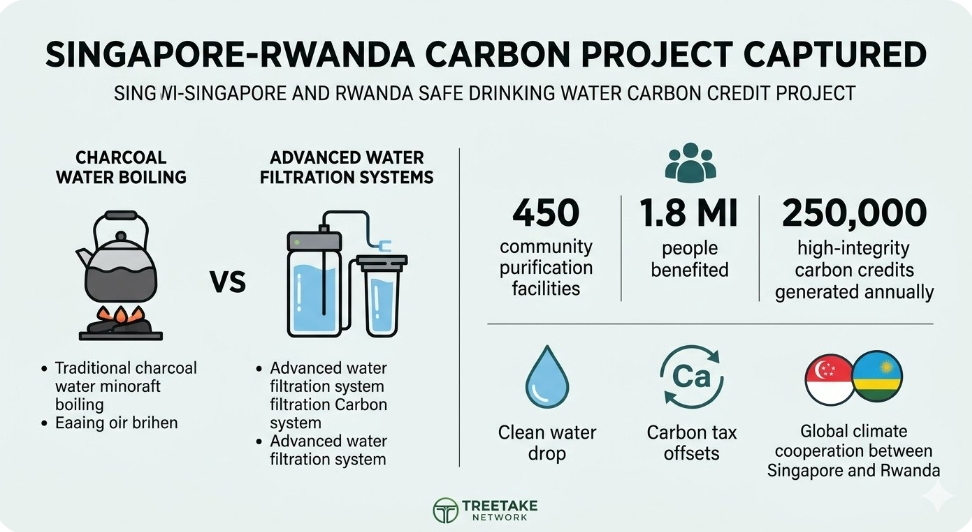
The newly authorised project introduces a systematic transformation of community water infrastructure across multiple rural provinces in Rwanda. According to technical documentation finalised by Singapore’s National Climate Change Secretariat, the programme will construct and maintain over 450 community-scale water purification facilities alongside household filtration networks. By bypassing the necessity for boiling water over open fires, the installation directly mitigates large-scale carbon dioxide emissions whilst simultaneously preserving critical regional forest cover. The initiative is projected to deliver safe drinking water to more than 1.8 million people over a 10-year operational timeframe, generating an estimated 250000 high-integrity carbon credits annually, with each credit representing one metric tonne of verified carbon dioxide equivalent avoided.
Bilateral Safeguards and the Implementation Agreement
The issuance of the Letter of Authorisation follows the robust implementation agreement signed between Singapore and Rwanda, which establishes stringent parameters to prevent double-counting of environmental benefits. Under the agreed framework, Rwanda will execute a corresponding adjustment to its national emissions inventory whenever carbon credits are transferred internationally, ensuring that the same emission reductions are not claimed by both nations. Singaporean businesses buying these credits to offset their domestic carbon tax obligations are legally bound to pay a mandatory share of proceeds, which will be channelled directly into Rwanda’s national climate adaptation fund to finance local ecosystem restoration.
Socioeconomic Impacts and Health Advancements
Beyond the quantifiable atmospheric carbon metrics, the purification infrastructure is designed to address severe public health challenges and economic vulnerabilities within rural Rwandan communities. The elimination of open-air charcoal burning minimises indoor air pollution, a primary driver of respiratory illnesses among women and children in sub-Saharan Africa. Furthermore, local authorities emphasise that reducing the regional demand for firewood significantly decreases the daily domestic labour burden on families, allowing for higher school attendance rates and local economic diversification. Environmental scientists monitoring the project have noted that the preservation of woodland habitats directly protects local biodiversity and prevents acute soil erosion along vulnerable watersheds.
Expert Operational Perspectives
"This inaugural authorisation establishes a vital precedent for high-integrity carbon trading within the Global South," stated a senior environmental economist tracking bilateral climate markets. "By linking Singapore’s capital directly to scalable public health infrastructure in Rwanda, we are observing a transition away from speculative forestry offsets towards tangible, verifiable emissions avoidance. The integration of corresponding adjustments ensures that the atmospheric integrity of the Paris Agreement is meticulously maintained whilst delivering life-changing resources to communities that require immediate adaptation support."
Official Declaration by Sovereign Authorities
Announcing the regulatory milestone, a senior representative from Singapore's Ministry of Sustainability and the Environment stated: "The formal issuance of this Letter of Authorisation demonstrates our unwavering commitment to unlocking international climate finance through robust, transparent market mechanisms. We are prioritising projects that deliver unambiguous, additionality-tested environmental outcomes alongside profound sustainable development benefits for our international partners. This is the first of many strategic steps to ensure that global carbon markets actively support the real-world modernisation of climate-vulnerable infrastructure."
Editor's Note
The operationalisation of the Singapore-Rwanda carbon pact provides a practical model for how market-driven climate finance can be successfully decoupled from speculative corporate greenwashing. For too long, the voluntary carbon market has suffered from credibility crises due to poorly monitored forestry protection projects that fail to deliver permanent emission reductions. By shifting the focus to tangible infrastructure improvements—such as municipal water purification—international buyers can secure verifiable offsets while delivering immediate public health benefits to developing countries. To scale this model effectively, upcoming international summits must streamline the regulatory approval processes for Article Six projects, ensuring that administrative delays do not stall the deployment of critical adaptation capital to regions facing severe ecological stress.



Leave a comment